
NAMASTE Scheme: 90,186 Sewer Workers Validated in 36 States, UTs
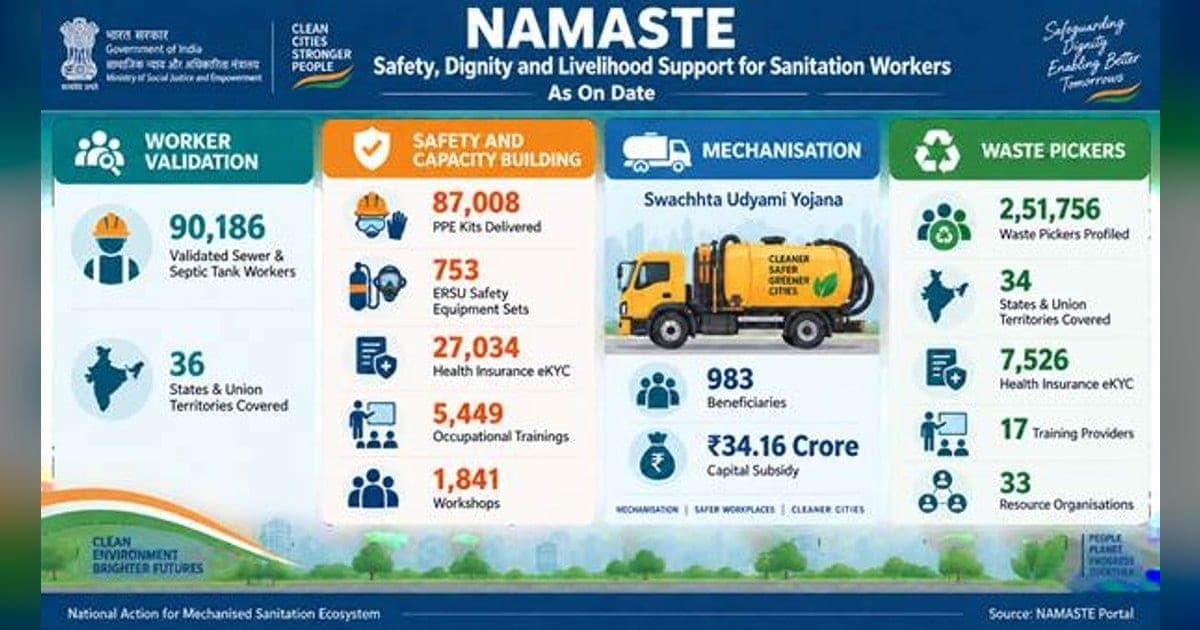
Under the NAMASTE Scheme, 90,186 sewer and septic tank workers have been validated across 36 States and UTs and 2,51,756 waste pickers profiled.
Why in News
The Ministry of Social Justice and Empowerment released fresh NAMASTE Scheme figures on 22 September 2026, covering validated sanitation workers, PPE kits, insurance eKYC and waste pickers profiled.
The Ministry of Social Justice and Empowerment has released a progress update on the NAMASTE Scheme, short for National Action for Mechanized Sanitation Ecosystem. The scheme works to secure the safety and dignity of sanitation workers by building an ecosystem that recognises their role in running and maintaining sanitation infrastructure. The figures were shared by the Ministry's Secretary, Sudhansh Pant.
Sewer and septic tank workers
As on 22 September, this component covers all 36 States and Union Territories, and 90,186 workers have been validated. The validated workforce is made up of 86,468 men, 3,713 women and five transgender persons.
Safety gear, insurance and training
| Intervention | Progress |
|---|---|
| PPE kits distributed | 87,008 |
| PPE kits ordered so far | 87,037 |
| Emergency Response Sanitation Unit safety equipment sets | 753 |
| Health insurance eKYC completions | 27,034 |
| Occupational trainings | 5,449 |
| Workshops held | 1,841 |
Mechanisation through Swachhta Udyami Yojana
Under the capital subsidy support for mechanisation, delivered through the Swachhta Udyami Yojana, 983 beneficiaries have been assisted with an amount of Rs 34.16 crore. The idea is to move sanitation work away from human effort and towards machines owned by the workers themselves.
Waste pickers
The waste picker component has profiled 2,51,756 waste pickers across 34 States and Union Territories. Of these, 1,35,233 are men, 1,16,498 are women and 25 are transgender persons. For this group the Ministry has completed 7,526 health insurance eKYC processes, and implementation is supported by 17 training providers and 33 resource organisations.
Who implements it
The Secretary said the scheme promotes sustainable livelihoods, capacity building, access to safety gear and mechanisation through interventions carried out by the National Safai Karamcharis Finance and Development Corporation, known as NSKFDC. Taken together, profiling, occupational safety, health insurance coverage, capacity building and mechanisation are meant to make the sanitation ecosystem safer and more dignified, while widening livelihood and social security support for sanitation workers and waste pickers alike.
Important Facts
| Scheme | NAMASTE - National Action for Mechanized Sanitation Ecosystem |
|---|---|
| Ministry | Ministry of Social Justice and Empowerment |
| Secretary | Sudhansh Pant |
| Workers validated | 90,186 across 36 States and Union Territories |
| Composition | 86,468 men, 3,713 women, five transgender persons |
| PPE kits distributed | 87,008 (87,037 ordered so far) |
| ERSU safety equipment sets | 753 |
| Swachhta Udyami Yojana | 983 beneficiaries supported with Rs 34.16 crore |
| Waste pickers profiled | 2,51,756 across 34 States and Union Territories |
| Implementing agency | National Safai Karamcharis Finance and Development Corporation (NSKFDC) |
Exam Point of View
Remember the full form of NAMASTE (National Action for Mechanized Sanitation Ecosystem), the ministry (Social Justice and Empowerment), the implementing corporation (NSKFDC), the linked scheme for mechanisation (Swachhta Udyami Yojana), and the headline numbers: 90,186 workers validated in 36 States and UTs, 2,51,756 waste pickers profiled in 34 States and UTs, and Rs 34.16 crore to 983 beneficiaries.
Practice Questions
What does NAMASTE stand for in the context of the sanitation workers scheme?
- A.National Action for Mechanized Sanitation Ecosystem
- B.National Mission for Advanced Sanitation and Technology
- C.National Agency for Municipal Sanitation and Training Enterprise
- D.National Authority for Mechanized Sewerage and Treatment
Show answer
Correct answer: A. National Action for Mechanized Sanitation Ecosystem
Explanation
The correct answer is National Action for Mechanized Sanitation Ecosystem. The Ministry of Social Justice and Empowerment defines NAMASTE exactly this way, and describes its aim as ensuring the safety and dignity of sanitation workers by creating an enabling ecosystem that recognises their contribution to the operation and maintenance of sanitation infrastructure. Option B is wrong because the scheme is not framed as a mission for advanced sanitation technology, and the word mission does not appear in its name. Option C is wrong because it is not a municipal training agency and it is not confined to urban local bodies alone. Option D is wrong because NAMASTE is not an authority for sewerage treatment but a scheme centred on workers. Full forms of welfare schemes are frequently asked, so learn the expansion word for word.
How many sewer and septic tank workers have been validated under the NAMASTE Scheme?
- A.58,412
- B.90,186
- C.1,24,530
- D.2,51,756
Show answer
Correct answer: B. 90,186
Explanation
The correct answer is 90,186. The Ministry's Secretary stated that the sewer and septic tank workers component now covers all 36 States and Union Territories, and that this many workers have been validated. The validated workforce is made up of 86,468 men, 3,713 women and five transgender persons, and these sub-totals add up to the figure in the correct option, which is a quick way to verify the answer. Options A and C are wrong because they do not match any figure reported for this component. Option D is a deliberate trap, because that number belongs to the separate waste picker component, where the profiled count covers 34 States and Union Territories rather than 36. Keeping the two components apart is the key to answering this question correctly.
Under the Swachhta Udyami Yojana capital subsidy, how much support has been given to 983 beneficiaries?
- A.Rs 12.40 crore
- B.Rs 21.75 crore
- C.Rs 34.16 crore
- D.Rs 48.90 crore
Show answer
Correct answer: C. Rs 34.16 crore
Explanation
The correct answer is Rs 34.16 crore. Under the capital subsidy intervention for mechanisation, routed through the Swachhta Udyami Yojana, the Ministry reported that 983 beneficiaries have been supported with this amount. The purpose of the subsidy is to help sanitation workers acquire machines so that hazardous manual work is replaced by mechanised cleaning, which is the central idea of the NAMASTE Scheme. The other three options are wrong simply because no such amount is reported for this intervention; they are plausible looking figures placed to test whether the aspirant recalls the exact number. A useful habit is to memorise the amount together with the beneficiary count, since examiners often pair the two in a single statement and change only one of them.
Which corporation implements the interventions under the NAMASTE Scheme?
- A.NSFDC
- B.NSKFDC
- C.NBCFDC
- D.NMDFC
Show answer
Correct answer: B. NSKFDC
Explanation
The correct answer is NSKFDC, the National Safai Karamcharis Finance and Development Corporation. The Secretary of the Ministry of Social Justice and Empowerment said the scheme promotes sustainable livelihoods, capacity building, access to safety gear and mechanisation through interventions implemented by this corporation. The name itself carries the clue, because Safai Karamcharis are the very workers the scheme is built around. Option A is wrong because that corporation works for scheduled caste beneficiaries in general and is not named as the implementing body here. Option C is wrong because it serves backward classes and has no role stated in this release. Option D is wrong because it works for minority communities. Matching a scheme with its implementing corporation is a standard question pattern in general awareness papers.
Frequently Asked Questions
What is the full form of the NAMASTE Scheme?
NAMASTE stands for National Action for Mechanized Sanitation Ecosystem. It is run by the Ministry of Social Justice and Empowerment to secure the safety and dignity of sanitation workers.
How many sewer and septic tank workers have been validated under NAMASTE?
A total of 90,186 workers have been validated across all 36 States and Union Territories, comprising 86,468 men, 3,713 women and five transgender persons.
Which agency implements the NAMASTE interventions?
The National Safai Karamcharis Finance and Development Corporation, or NSKFDC, carries out the interventions covering livelihoods, capacity building, safety gear and mechanisation.
How many waste pickers have been profiled under the scheme?
2,51,756 waste pickers have been profiled across 34 States and Union Territories, including 1,35,233 men, 1,16,498 women and 25 transgender persons.
Sources
- NAMASTE Strengthens Safety Dignity and Livelihood Support for Sanitation Workers (opens in a new tab) — Press Information Bureau
Current Affairs 22 September 2026
- 11th Ayurveda Day on 23 September: Theme, Facts and SchemesImportant Days
- Ayushman Bharat PM-JAY at 8: 48.51 Crore Cards, ₹2.03 Lakh Crore CareGovernment Schemes
- SEMICON India 2026: 'Silicon to Systems' Shows India's Chip EcosystemScience & Technology
- Asian Games: India's First Gold via Women's Cricket, First MMA MedalSports
- Vice-President Opens 9th India International Water Week 2026Summits & Conferences
- TRAI Mandates Voice-and-SMS-Only Recharge Packs of 30 Days or LessNational
- National Film Awards to Be Held at India's Best Tourist DestinationsAwards & Honours
- India Cine Hub: NFDC's Single-Window Portal for Film Shooting PermitsNational
Related Current Affairs
- Government Schemes
Ayushman Bharat PM-JAY at 8: 48.51 Crore Cards, ₹2.03 Lakh Crore Care
22 September 2026 · 2 min read
- Government Schemes
Jal Jeevan Mission 2.0: Nal Jal Mitra and Sujalam Shakti Push
22 September 2026 · 2 min read
- Government Schemes
Swachhata Hi Seva 2026: Theme, Dates and ODF Plus Progress
21 September 2026 · 3 min read
- Government Schemes
DDU-GKY 2.0 Training to Begin in 14 States from October
19 September 2026 · 2 min read
Related GK
- Preamble of the Indian Constitution: Notes, Keywords and PYQs
22 September 2026 · Indian Polity
- Making of the Indian Constitution: Notes, Key Dates and PYQs
21 September 2026 · Indian Polity