
Coal Ministry Launches SUVIKALP Mine Repurposing Tool
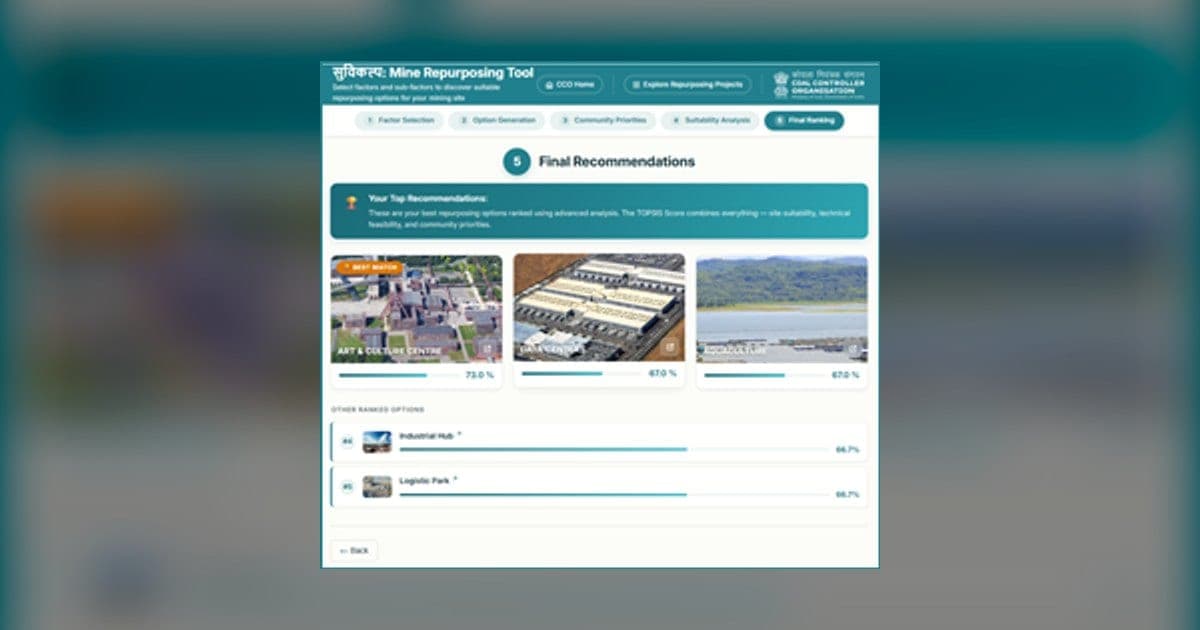
The Coal Controller Organisation has developed SUVIKALP, a digital tool that ranks post-mining land uses for closed and abandoned coal and lignite mines.
Why in News
The Ministry of Coal has detailed SUVIKALP, the mine repurposing tool developed by the Coal Controller Organisation to help turn closed and abandoned coal and lignite mines into productive assets.
The Coal Controller Organisation (CCO), which works under the Ministry of Coal, has developed SUVIKALP, a mine repurposing tool meant to turn closed and abandoned mines into productive assets. It is a digital decision-support platform, and it has been aligned with the Mining Plan Guidelines for Coal and Lignite Mine, 2025. The thinking behind it is that a mining company's duty to a mining region does not end the day digging stops: the land left behind has to be put to use, the environment restored and local livelihoods secured.
How the tool decides
SUVIKALP pulls geo-mining features, environmental conditions, availability of infrastructure, resource limits, financial factors and socio-economic conditions into one platform. A user builds a site profile by entering details of the particular mine, and the tool then tests which fresh uses that site could support. The ranking is done by a Multi-Criteria Decision-Making method built on TOPSIS, short for Technique for Order Preference by Similarity to Ideal Solution, so that options can be compared against many parameters at once and the advice stays transparent and evidence-based. The sequence runs from choosing the factors, to generating possible options, to folding in community priorities, to assessing suitability, and finally to ranking.
Two frameworks inside it
- RECLAIM, the Community Engagement and Development Framework, carries local preferences into the evaluation, so that redevelopment matches local needs for jobs, livelihoods, infrastructure and long-term benefit.
- PRISM, the Post-Mining Repurposing Implementation Strategic Model, takes the platform past ranking into implementation: project vision, repurposing strategy, investment dynamics, strategic structuring and monitoring. It is backed by a knowledge store of concept notes, Indian and foreign case studies, sample tender papers, details of implementing agencies and best-practice material.
What comes next
The next phase is about adoption and delivery. The listed priorities are wider use of the platform across closed and abandoned coal and lignite mines; turning its recommendations into site-specific feasibility studies, concept notes and detailed project reports; closer coordination between government, industry, experts and implementing agencies; mobilising investment for viable projects; sharing best practices and building the capacity of stakeholders; and monitoring implementation while measuring environmental, economic and community gains. The long-term aim is to grow SUVIKALP into a scalable national knowledge and decision-support system that can be adapted to different mining conditions and regional needs, so that the legacy of mining becomes an opportunity for restoration, economic diversification and steady regional development rather than a set of abandoned pits.
Important Facts
| Tool | SUVIKALP, a mine repurposing tool |
|---|---|
| Developed by | Coal Controller Organisation, under the Ministry of Coal |
| Nature | Digital decision-support platform |
| Aligned with | Mining Plan Guidelines for Coal and Lignite Mine, 2025 |
| Ranking method | Multi-Criteria Decision-Making based on TOPSIS |
| TOPSIS | Technique for Order Preference by Similarity to Ideal Solution |
| RECLAIM | Community Engagement and Development Framework |
| PRISM | Post-Mining Repurposing Implementation Strategic Model |
| Purpose | Turning closed and abandoned coal and lignite mines into productive assets |
Exam Point of View
Remember the full purpose of SUVIKALP (mine repurposing), the developer (Coal Controller Organisation under the Ministry of Coal), the guidelines it follows (Mining Plan Guidelines for Coal and Lignite Mine, 2025), the ranking method (Multi-Criteria Decision-Making based on TOPSIS) and the two frameworks RECLAIM for community engagement and PRISM for implementation.
Practice Questions
Which organisation has developed SUVIKALP, the mine repurposing tool?
- A.Coal India Limited
- B.Coal Controller Organisation
- C.Indian Bureau of Mines
- D.NITI Aayog
Show answer
It has built SUVIKALP as a digital decision-support platform for deciding what closed and abandoned mines should be used for, and the tool has been aligned with the Mining Plan Guidelines for Coal and Lignite Mine.
Read the full explanation →SUVIKALP ranks repurposing options using a Multi-Criteria Decision-Making method based on which technique?
- A.TOPSIS
- B.SWOT analysis
- C.Monte Carlo simulation
- D.Linear regression
Show answer
The platform uses it to evaluate and rank the possible new uses of a mined-out site, because it lets several parameters be weighed together and produces recommendations that are consistent and based on evidence rather than opinion.
Read the full explanation →In SUVIKALP, which framework brings community priorities into the evaluation of projects?
- A.PRISM
- B.RECLAIM
- C.TOPSIS
- D.SHINE
Show answer
It places the preferences of people living in mining areas alongside technical feasibility, environmental suitability and economic considerations, so that redevelopment plans answer local needs for employment, livelihoods, infrastructure and lasting benefit.
Read the full explanation →Frequently Asked Questions
What is SUVIKALP?
A mine repurposing tool developed by the Coal Controller Organisation under the Ministry of Coal. It is a digital decision-support platform that identifies and ranks suitable post-mining land uses for closed and abandoned coal and lignite mines.
Which method does SUVIKALP use to rank repurposing options?
A Multi-Criteria Decision-Making method based on TOPSIS, the Technique for Order Preference by Similarity to Ideal Solution, which allows options to be compared against several parameters at once.
What do RECLAIM and PRISM stand for in SUVIKALP?
RECLAIM is the Community Engagement and Development Framework, which brings local priorities into project evaluation. PRISM is the Post-Mining Repurposing Implementation Strategic Model, which guides implementation pathways.
Sources
- सुविकल्प- खदान पुनर्प्रयोजन उपकरण, बंद और परित्यक्त खदानों का उत्पादक संपत्ति में बदलाव (opens in a new tab) — Press Information Bureau
Current Affairs 3 November 2026
- Indian Navy Frees Hijacked Fishing Vessel Azini Off SomaliaDefence
- Health Ministry Proposes New Import Gateways for DrugsNational
- PM Modi Opens Pune Metro Hinjawadi-Shivajinagar LineNational
- TRAI Issues Telecom Interconnection Third Amendment Rules 2026National
- Exercise Tiger Triumph 2026 Opens at VisakhapatnamDefence
- Rajnath Singh Chairs Defence Modernisation Meet in JaisalmerDefence
- India Sets USD 1 Trillion Export Target for Current YearEconomy
- Aditya-L1 VELC Finds Solar Eruption Expands AsymmetricallyScience & Technology
Related Current Affairs
- Government Schemes
MSDE and Assam Sign MoU for Skill India International Centre
2 November 2026 · 2 min read
- Government Schemes
Soreng in Sikkim Is India's First Organic Fisheries Cluster
2 November 2026 · 2 min read
- Government Schemes
Khet Bachaao Abhiyaan-Rabi 2026 Covers 700 Districts, 50 Lakh Farmers
2 November 2026 · 2 min read
- Government Schemes
VB-G RAM G Grievance Redressal Rules, 2026 Notified for Rural Jobs
2 November 2026 · 2 min read
- Government Schemes
Sikkim Dairy Projects Worth Rs 251.56 Lakh Under White Revolution 2.0
2 November 2026 · 2 min read
- Government Schemes
EPFO Marks 74th Foundation Day With WhatsApp Service Launch
1 November 2026 · 2 min read





Related GK
- Famous Personalities of Rajasthan: Exam Notes
28 October 2026 · Rajasthan
- Districts and Divisions of Rajasthan: Exam Notes
28 October 2026 · Rajasthan
- Tourism and World Heritage Sites of Rajasthan Notes
27 October 2026 · Rajasthan
Take the Quiz
- Current Affairs Quiz
State Exams Current Affairs Quiz: 3 November 2026
25 questions25 minutesStart Quiz