
GST Council's 57th Meeting Clears Next-Gen Process Reforms
A PIB backgrounder of 9 October 2026 sets out the 57th GST Council's next-generation process reforms in registration, returns, refunds, ITC and disputes.
Why in News
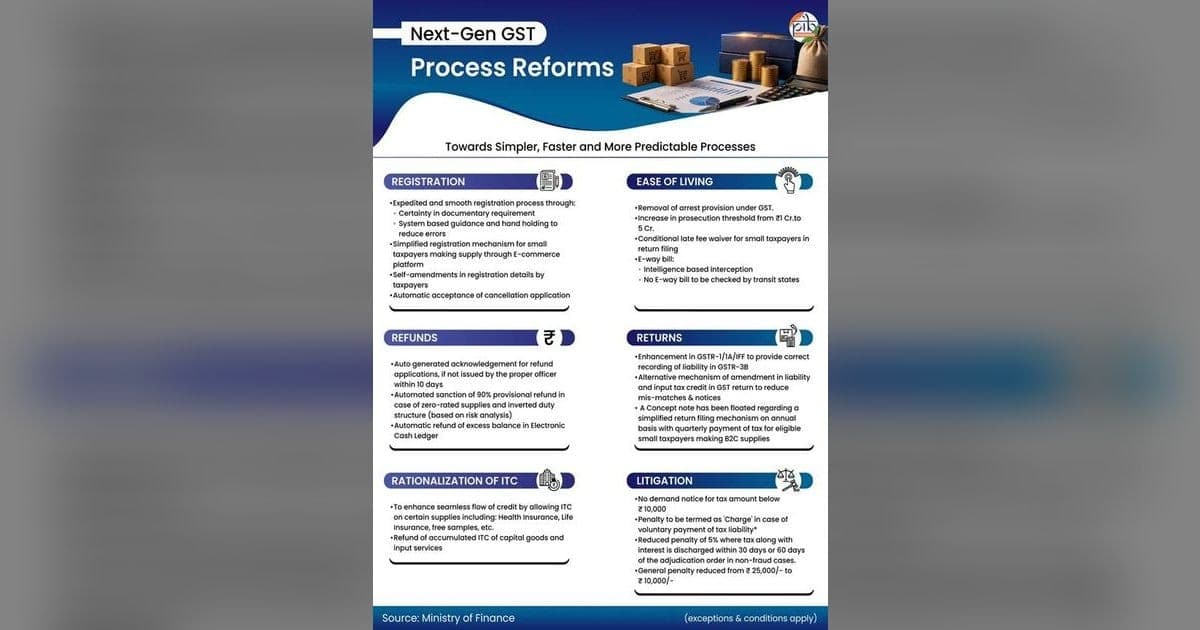
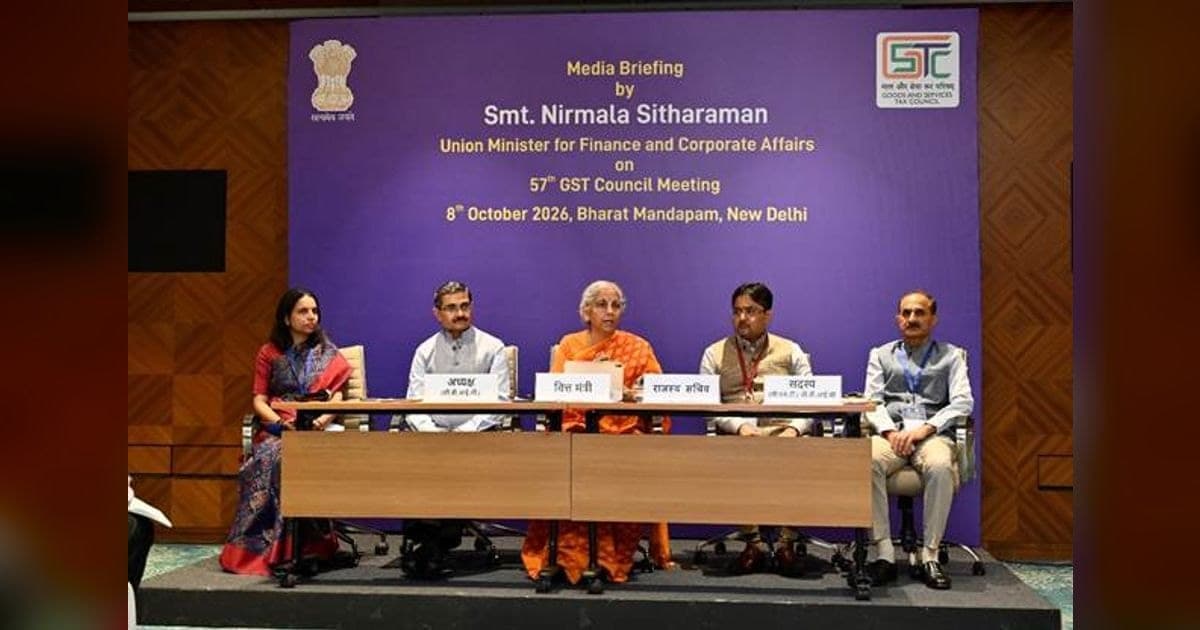
On 9 October 2026 the Press Information Bureau issued a backgrounder explaining the next-generation GST process reforms recommended at the 57th meeting of the GST Council, held in October 2026.
A Press Information Bureau backgrounder issued on 9 October 2026 explains the process reforms recommended at the 57th meeting of the GST Council, held in October 2026. The paper arranges them under five heads — registration, return filing, refunds, input tax credit and dispute settlement. It follows the rate overhaul recommended by the 56th Council, which trimmed the older four-slab pattern to two main rates of 5 per cent and 18 per cent, with a special 40 per cent rate kept for a short list of goods and services.
Nine years of GST in numbers
The Goods and Services Tax began on 1 July 2017 and folded many Central and State levies into one framework under the idea of One Nation, One Tax. Registered taxpayers have grown from roughly 60 lakh at the start to about 1.70 crore in September 2026. By 30 September 2026 the system had handled 3,053 crore invoice uploads and 833.82 crore e-way bills. Gross collections for April to September 2026 came to nearly ₹12.46 lakh crore, a rise of 11.6 per cent on the same months of the previous year.
Registration and cancellation
Amendments to registration particulars will be accepted by the portal on their own, except where the principal place of business changes; taxpayers admitted through the automatic route are spared even that exception. Cancellation shifts to a system-driven route in two phases, once pending returns are filed and all dues paid, starting with those who have not passed on input tax credit above ₹2.5 lakh in any month. Small sellers on e-commerce platforms may take a simple PAN-based registration outside their home State and name an operator's warehouse as their principal place of business.
Refunds, penalties and prosecution
| Acknowledgement of a refund claim | cut from 15 days to 10 days |
| Risk-based sanction | 90 per cent of the claimed amount |
| Show cause notice floor | none where tax is below ₹10,000 |
| Maximum general penalty | down from ₹25,000 to ₹10,000 |
| Prosecution threshold | up from ₹1 crore to ₹5 crore |
Refunds of surplus cash ledger balances become automatic. Credit blocked in the electronic credit ledger may now be objected to, with a personal hearing before the officer decides. Late fees are waived for firms whose turnover was up to ₹5 crore in the previous year, if the delayed return reaches the portal by the end of the month in which it fell due. Refund of credit on capital goods opens from 1 April 2027 and is spread over 60 months; credit on input services under an inverted duty structure opens from 1 November 2026.
Important Facts
| Body | GST Council, 57th meeting (October 2026) |
|---|---|
| GST start date | 1 July 2017 |
| Rate structure (56th Council) | Two main rates of 5% and 18%, special rate of 40% |
| Registered taxpayers | About 1.70 crore in September 2026, against roughly 60 lakh in 2017 |
| Gross collections | About ₹12.46 lakh crore in April-September 2026, up 11.6 per cent |
| System scale | 3,053 crore invoice uploads and 833.82 crore e-way bills as on 30 September 2026 |
| Refund acknowledgement | Reduced from 15 days to 10 days |
| Prosecution threshold | Raised from ₹1 crore to ₹5 crore |
| Late fee waiver | For turnover up to ₹5 crore in the previous financial year |
Exam Point of View
Remember that GST began on 1 July 2017; that the 56th Council fixed two main rates of 5 and 18 per cent with a special 40 per cent rate; and that the 57th Council of October 2026 took up process reform. Learn the figures: about 1.70 crore taxpayers, nearly ₹12.46 lakh crore collected in April-September 2026 at 11.6 per cent growth, refund acknowledgement cut to 10 days, general penalty capped at ₹10,000 and the prosecution threshold raised to ₹5 crore.
Practice Questions
Which meeting of the GST Council recommended the next-generation GST process reforms?
- A.55th
- B.56th
- C.57th
- D.58th
Show answer
Explanation
The correct answer is the 57th meeting. The backgrounder states that the process reforms covering registration, return filing, refunds, input tax credit and dispute resolution were recommended at the 57th meeting of the GST Council, held in October 2026. Option B, the 56th meeting, is wrong because that meeting dealt with rates rather than process: it replaced the earlier four-tier structure with two main rates of 5 and 18 per cent, keeping a special 40 per cent rate for a select list of goods and services. Option A, the 55th meeting, is wrong because the paper nowhere credits it with these recommendations. Option D, the 58th meeting, is wrong because it had not been held when the paper was issued on 9 October 2026. A useful way to remember the pair is that the 56th Council simplified rates and the 57th Council simplified procedure.
How many registered GST taxpayers were there as on September 2026?
- A.60 lakh
- B.1.20 crore
- C.1.70 crore
- D.2.50 crore
Show answer
Explanation
The correct answer is 1.70 crore. The backgrounder records that the taxpayer base widened from roughly 60 lakh when the tax began to about 1.70 crore in September 2026, which is close to a threefold increase over nine years. Option A, 60 lakh, is wrong because that was the count in 2017, the year GST was introduced, and not the current figure. Options B and D, 1.20 crore and 2.50 crore, are wrong because neither number appears anywhere in the paper; they are plausible-looking values placed to test whether a candidate recalls the exact total. Two companion figures are worth memorising with it: the network had handled 3,053 crore invoice uploads and 833.82 crore e-way bills as on 30 September 2026, and gross collections for April to September 2026 were close to ₹12.46 lakh crore.
Under the recommended refund reforms, within how many days must a refund claim be acknowledged?
- A.7 days
- B.10 days
- C.15 days
- D.30 days
Show answer
Explanation
The correct answer is 10 days. One of the measures meant to speed up refunds is a shorter acknowledgement window: the period comes down from 15 days to 10 days, and where no response is issued within it the claim is treated as acknowledged by deeming. Option C, 15 days, is wrong because that is the older period being replaced, a classic trap that rewards reading the direction of the change. Options A and D, 7 days and 30 days, are wrong because no such period is proposed in the paper. Along with the shorter window, the reforms make refunds of surplus cash ledger balances automatic and expect about 90 per cent of a claim to be sanctioned on the system's own risk assessment, for claims arising from zero-rated supplies and from the inverted duty structure.
The GST Council recommended raising the threshold for prosecution to which amount?
- A.₹1 crore
- B.₹2 crore
- C.₹5 crore
- D.₹10 crore
Show answer
Explanation
The correct answer is ₹5 crore. To build a trust-based tax system while keeping a deterrent against fraud, the Council recommended lifting the prosecution threshold from ₹1 crore to ₹5 crore and withdrawing certain powers of arrest under GST. Option A, ₹1 crore, is wrong because that is the old threshold being raised, not the new one. Options B and D, ₹2 crore and ₹10 crore, are wrong because neither figure is mentioned in the recommendations. Related numbers from the same set are worth learning together: no show cause notice will be issued where the tax involved is below ₹10,000, the maximum general penalty falls from ₹25,000 to ₹10,000, the minimum penalty of ₹10,000 goes in non-fraud cases, and a reduced penalty of 5 per cent applies when tax and interest are paid within the time allowed after the adjudication order.
Frequently Asked Questions
Which GST Council meeting recommended the next-generation process reforms?
The 57th meeting of the GST Council, held in October 2026. It followed the 56th meeting, which replaced the four-slab pattern with two main rates of 5 and 18 per cent and a special 40 per cent rate for selected goods and services.
How much GST was collected between April and September 2026?
Gross collections were close to ₹12.46 lakh crore, which is 11.6 per cent higher than the same months a year earlier. Registered taxpayers numbered about 1.70 crore in September 2026.
What changes for GST refunds under these reforms?
A refund claim must be acknowledged within 10 days instead of 15, refunds of extra cash ledger balance become automatic, and about 90 per cent of a claim may be sanctioned on the system's risk assessment for zero-rated supplies and the inverted duty structure.
Sources
- https://www.pib.gov.in/PressReleasePage.aspx?PRID=2321603 (opens in a new tab) — Press Information Bureau
Current Affairs 9 October 2026
- World Cotton Day Marked by India and Mali at UN HeadquartersImportant Days
- Singapore, India’s Top FDI Source, Hosts Sitharaman VisitEconomy
- Coal Supply to Power Plants Rises 36% From September LowEconomy
- 15th AITIGA Joint Committee Meeting Held in JakartaInternational
- Health Ministry Proposes Curbs on Prescription Drug AdvertisingNational
- Khadi: NIFT Centre of Excellence Builds 2,129 Design CollectionsGovernment Schemes
- National Medical Library Holds 5th ERMED Consortium ConferenceNational
- CTIL Marks 9th Anniversary, Releases Trade MagazineNational
Related Current Affairs
Related GK
- Certification Marks of India: ISI, Agmark and Hallmark
9 October 2026 · Science & Technology
- Union Territories of India: Articles, Capitals and Facts
9 October 2026 · Indian States & UTs
- Jammu and Kashmir and Ladakh GK: Facts for Exams
9 October 2026 · Indian States & UTs
Take the Quiz
- Current Affairs Quiz
RBI Current Affairs Quiz: 9 October 2026
10 questions10 minutesStart Quiz