
Great Indian Bustard Rewilding Begins at Desert National Park
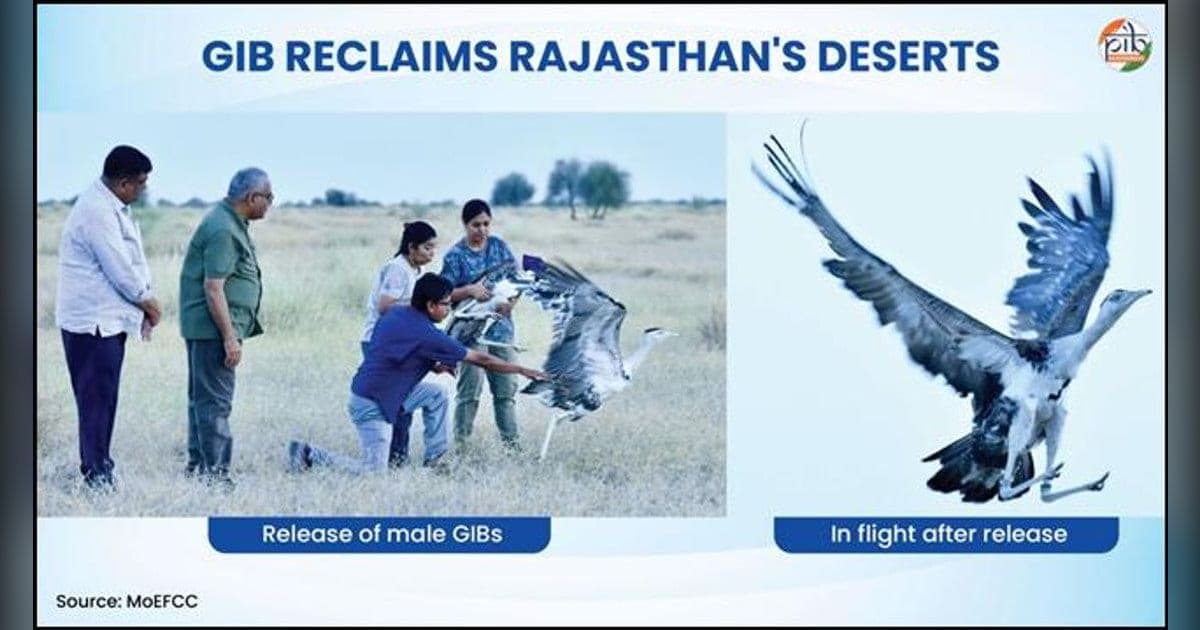
Four male Great Indian Bustards were released into the wild at Desert National Park in Jaisalmer in October 2026, the first of 10 birds picked for rewilding.
Why in News
In October 2026 the Great Indian Bustard conservation programme entered a rewilding phase: four captive-bred males were released at Desert National Park near Sam in Jaisalmer, Rajasthan, the first of 10 birds earmarked for release.
India's effort to save the Great Indian Bustard (GIB) has moved from breeding the bird behind wire to putting it back on the open desert. In October 2026 four captive-reared males walked free inside Desert National Park, close to Sam in the Jaisalmer district of Rajasthan. They are the first of 10 birds picked for release from the two conservation-breeding centres at Sam and Ramdevra, and the step turns a decade of captive breeding into an attempt to rebuild the wild flock.
Why the bird needed rescuing
The GIB is listed as Critically Endangered, a step away from extinction in the wild. The annual progress report of the Wildlife Institute of India for 2016-17 put the fall in its numbers at 75 per cent across the previous 30 years. The bird once ranged over the western half of the country. Grassland lost to other uses and pressure from people did most of the damage, and the species breeds too slowly to repair that loss on its own. Building a captive flock was the answer chosen to buy the bird time.
The breeding programme in figures
Sanctioned in 2016 with an outlay of Rs 33.85 crore for five years, the programme set up the centres at Sam and Ramdevra, secured part of the founder stock, began captive breeding and ran surveys and telemetry to guide repair of the habitat. The first chick bred in captivity hatched at the Sam centre in March 2023. In December 2024 National CAMPA cleared Rs 77.05 crore for a five-year Conservation Action Plan covering the GIB and the Lesser Florican, paying for population surveys, artificial insemination, habitat work, protection from predators, community participation and tracking of wild birds.
| Birds held at the two centres (October 2026) | 96 |
| Raised from wild-origin eggs | 40 |
| Bred in captivity | 56 |
| Kept for captive reproduction | 86 |
| Earmarked for release | 10 |
| Live chicks produced in 2025 | 24 |
| Live chicks produced in 2026 | 29 |
The Jumpstart Approach
In Kutch, Gujarat, only three female bustards were left in the wild and no male survived to fertilise an egg. A viable egg from the Sam centre was therefore carried 770 km to Naliya in a portable incubator, a trip of more than 19 hours, and slipped into the nest of a wild female. She accepted it, finished the incubation, and the chick came out four days later; field staff afterwards watched the foster mother raise it in its own habitat. This Jumpstart Approach has so far given six chicks in Rajasthan and two in Gujarat.
Preparing birds for the desert
A dedicated Rewilding Aviary at Ramdevra trains the birds before they leave. The pillar-less hall runs 160 metres long and 64 metres wide and stands 14 metres tall, clear air enough for a bustard to build flight muscle and behave as it would outside. About 200 square kilometres of fenced grassland inside Desert National Park, marked by long-term telemetry work as prime breeding ground, waits for the released birds. A soft-release facility lets chosen birds settle before the gate opens, and people were kept away from the release site so the birds were not disturbed. Gujarat has a matching GIB Soft Release Centre near Naliya.
Important Facts
| Species | Great Indian Bustard (GIB), Critically Endangered |
|---|---|
| Release site | Desert National Park, near Sam, Jaisalmer, Rajasthan |
| Birds released | Four males, out of 10 earmarked for release |
| Breeding centres | Sam and Ramdevra, Jaisalmer |
| Programme sanctioned | 2016, outlay of Rs 33.85 crore for five years |
| First captive-bred chick | March 2023, Sam Conservation Breeding Centre |
| CAMPA approval | Rs 77.05 crore in December 2024 for a five-year plan covering GIB and Lesser Florican |
| Captive stock, October 2026 | 96 birds (40 from wild-origin eggs, 56 captive-bred); 86 kept for breeding |
| Chicks produced | 24 in 2025 and 29 in 2026 |
| Rewilding Aviary, Ramdevra | Pillar-less, 160 m long, 64 m wide, 14 m high |
| Fenced grassland enclosures | About 200 square kilometres inside Desert National Park |
| Jumpstart Approach | Egg carried 770 km from Sam to Naliya, Gujarat; six chicks in Rajasthan and two in Gujarat |
Exam Point of View
Remember the species (Great Indian Bustard, Critically Endangered), the site (Desert National Park, Sam, Jaisalmer, Rajasthan), the two centres (Sam and Ramdevra), the 2016 outlay of Rs 33.85 crore, the CAMPA approval of Rs 77.05 crore in December 2024, the October 2026 stock of 96 birds, and the Jumpstart Approach with its 770 km egg transfer to Naliya.
Practice Questions
In October 2026, how many captive-bred male Great Indian Bustards were released into the wild at Desert National Park?
- A.Two
- B.Four
- C.Six
- D.Ten
Show answer
In October 2026 four male Great Indian Bustards were set free inside Desert National Park, close to Sam village in the Jaisalmer district of Rajasthan.
Read the full explanation →Whose annual progress report for 2016-17 recorded a 75 per cent decline in the Great Indian Bustard population over the previous 30 years?
- A.Zoological Survey of India
- B.Wildlife Institute of India
- C.Bombay Natural History Society
- D.National Biodiversity Authority
Show answer
Its annual progress report for 2016-17 recorded that the population of the Great Indian Bustard had fallen by three quarters over the thirty years before that report, a decline driven by the loss of its grassland habitat and by pressures created by people, and made harder to reverse by the…
Read the full explanation →How much did National CAMPA approve in December 2024 for the five-year Conservation Action Plan covering the Great Indian Bustard and the Lesser Florican?
- A.Rs 33.85 crore
- B.Rs 77.05 crore
- C.Rs 96.50 crore
- D.Rs 200 crore
Show answer
National CAMPA cleared this amount in December 2024 for a five-year Conservation Action Plan that covers both the Great Indian Bustard and the Lesser Florican.
Read the full explanation →Under the Jumpstart Approach, an egg from the Sam conservation-breeding centre was carried to which place in Gujarat and put in the nest of a wild female bustard?
- A.Naliya
- B.Bhuj
- C.Dwarka
- D.Jamnagar
Show answer
Only three female Great Indian Bustards were left in the wild in Kutch and no male survived there to fertilise an egg, so a viable egg from the conservation-breeding centre at Sam in Rajasthan was moved 770 km to Naliya in a portable incubator, a journey lasting more than 19…
Read the full explanation →Frequently Asked Questions
Where were the Great Indian Bustards released into the wild?
At Desert National Park near Sam village in Jaisalmer, Rajasthan. Four captive-bred males were freed there in October 2026, the first of 10 birds earmarked for release from the Sam and Ramdevra breeding centres.
What is the Jumpstart Approach?
It places an egg from the conservation-breeding centre in the nest of a wild female so she raises the chick herself. An egg was carried 770 km from Sam to Naliya in Gujarat in a portable incubator, and the method has produced six chicks in Rajasthan and two in Gujarat.
How many Great Indian Bustards were in captivity by October 2026?
96 birds at the Sam and Ramdevra centres, of which 40 came from wild-origin eggs and 56 were bred in captivity. Of these, 86 are kept for captive reproduction and 10 were earmarked for release.
What did National CAMPA approve for the species in December 2024?
Rs 77.05 crore for a five-year Conservation Action Plan covering the Great Indian Bustard and the Lesser Florican, funding population surveys, artificial insemination, habitat improvement, protection from predators and telemetry.
Sources
- ग्रेट इंडियन बस्टर्ड का पुनःप्रकृतिकरण — एक नई शुरुआत (opens in a new tab) — Press Information Bureau
Related Current Affairs
- Environment
Namami Gange: 199 Sewerage Projects Worth Rs 31,327 Crore Taken Up
21 October 2026 · 2 min read

Related GK
- Panchayati Raj and Urban Local Bodies of Madhya Pradesh Notes
24 October 2026 · Madhya Pradesh
- Punjab and Haryana High Court, HPSC and State Commissions
24 October 2026 · Haryana
- Panchayati Raj and Urban Local Bodies of Bihar: Tiers and Articles
24 October 2026 · Bihar