
Geothermal Energy: India's First Two Wells at Puga Valley, Ladakh
A PIB backgrounder sets out India's geothermal push: the first two wells at Puga Valley in Ladakh, 381 mapped hot springs and a 10.6 GW theoretical prospect.
Why in News
On 4 September 2026 the Press Information Bureau issued a backgrounder on geothermal energy, covering the National Policy on Geothermal Energy and the commissioning of India's first two geothermal wells at Puga Valley in Ladakh.
The Press Information Bureau issued a backgrounder on geothermal energy on 4 September 2026. Geothermal energy is the heat held inside the Earth. Unlike solar and wind power, it is available round the clock. That single property is what makes it valuable to a grid.
The policy and the nodal ministry
The Government notified the National Policy on Geothermal Energy in September 2025. The Ministry of New and Renewable Energy is the nodal ministry for implementing it. The policy supports exploration, drilling, reservoir management, direct-use applications, Ground Source Heat Pumps, a national geothermal data repository, pilot projects and Centres of Excellence. It also allows abandoned oil and gas wells to be repurposed for geothermal use.
The milestone in Ladakh
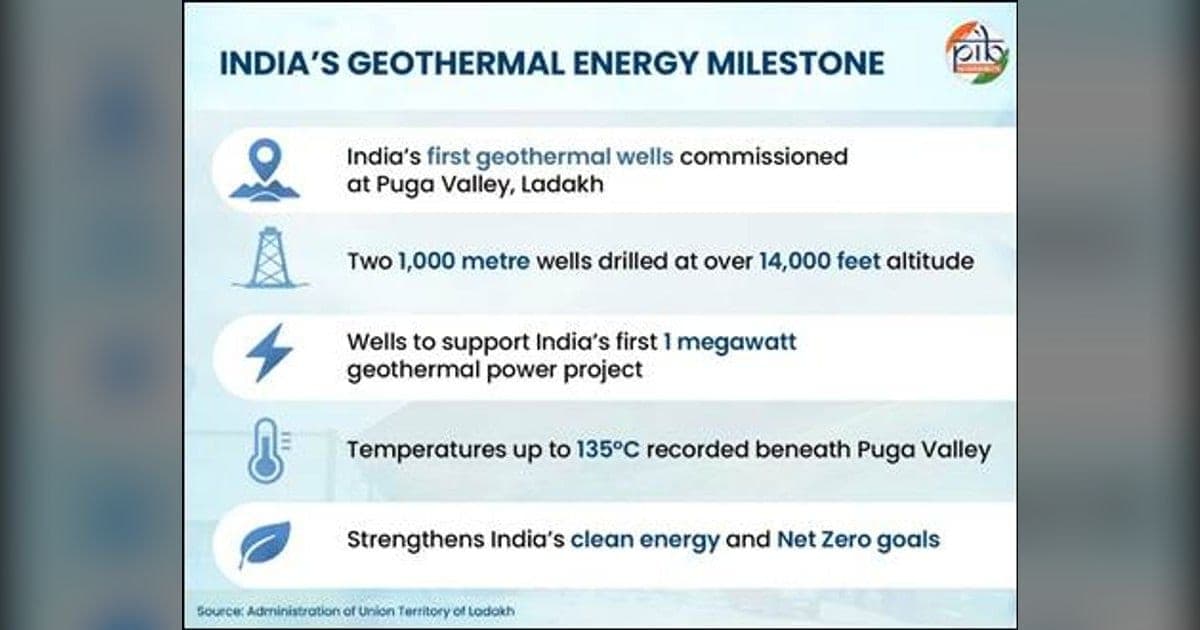
In July 2026 the ONGC Energy Centre commissioned the country's first two geothermal wells. They are at Puga Valley in Ladakh, which lies at over 14,000 feet above sea level and is known for its hot springs. Each well goes down about 1,000 metres. They will support reservoir evaluation and pave the way for India's first 1 megawatt demonstration geothermal power project.
India's resource base
| Hot springs mapped by the Geological Survey of India | 381 |
| Geothermal provinces identified | 10 |
| Theoretical geothermal prospect | Nearly 10.6 GW, or about 10,600 MW |
| Sites recognised as promising | 42 |
| Global installed capacity, end of 2025 | 15.67 GW |
The ten provinces are the Himalayan Geothermal Province, Naga-Lusai, Andaman and Nicobar Islands, Son Narmada Tapi (SONATA), West Coast, Cambay Graben, Aravalli, Mahanadi, Godavari and the South Indian Cratonic regions.
The world picture
Geothermal power is already proven worldwide. Global installed capacity reached 15.67 GW by the end of 2025. Indonesia, the United States, the Philippines, Türkiye and New Zealand lead the field and together hold around 67 per cent of that capacity. India has identified geothermal energy as an area of cooperation with Australia and Iceland, and in a memorandum of understanding with Saudi Arabia.
The science behind it
The Earth has four layers. The inner core is a solid ball of iron and nickel about 2,400 km wide. The liquid outer core is roughly 2,400 km thick. The mantle extends nearly 2,900 km and is the largest layer. The crust is about 5 to 8 km thick under the oceans and 24 to 56 km thick under the continents. Temperature rises with depth: it reaches about 3,700 degrees Celsius at the mantle-core boundary and 5,000 to 6,000 degrees Celsius in the core. The heat comes from the radioactive decay of uranium, thorium and potassium and from heat left over from the planet's formation. India is working towards Net Zero by 2070.
Important Facts
| First two geothermal wells | Puga Valley, Ladakh, commissioned in July 2026 |
|---|---|
| Commissioned by | ONGC Energy Centre |
| Depth of each well | About 1,000 metres |
| Altitude of Puga Valley | Over 14,000 feet above sea level |
| Policy | National Policy on Geothermal Energy, notified in September 2025 |
| Nodal ministry | Ministry of New and Renewable Energy (MNRE) |
| Hot springs mapped | 381, by the Geological Survey of India |
| Geothermal provinces | 10, with 42 sites recognised as promising |
| India's theoretical prospect | Nearly 10.6 GW, about 10,600 MW |
| Global installed capacity | 15.67 GW by the end of 2025 |
| Net Zero target | 2070 |
Exam Point of View
Remember Puga Valley in Ladakh as the site of India's first two geothermal wells, the ONGC Energy Centre as the body that commissioned them, MNRE as the nodal ministry, September 2025 for the policy, 381 hot springs, 10 provinces and the 10.6 GW theoretical prospect.
Practice Questions
Where were India's first two geothermal wells commissioned?
- A.Tattapani, Chhattisgarh
- B.Puga Valley, Ladakh
- C.Manikaran, Himachal Pradesh
- D.Ankleshwar, Gujarat
Show answer
Correct answer: B. Puga Valley, Ladakh
Explanation
The correct answer is Puga Valley in Ladakh. The backgrounder records that the ONGC Energy Centre commissioned the country's first two geothermal wells there in July 2026. The valley lies at over 14,000 feet above sea level, is known for its hot springs and underground heat reserves, and is among India's most promising geothermal sites. Each well goes down about 1,000 metres, and together they pave the way for India's first 1 megawatt demonstration geothermal power project. Option A, Tattapani, and option C, Manikaran, are genuine and well known Indian geothermal fields, which makes them the strongest distractors in any question of this kind, but neither is the site of these first wells. Option D, Ankleshwar in Gujarat, does appear in the same backgrounder, but in a different role: it hosts a pilot project evaluating electricity generation by retrofitting unproductive oil and gas wells. Attach the words first two wells firmly to Puga Valley.
How many hot springs has the Geological Survey of India mapped in the country?
- A.183
- B.381
- C.420
- D.106
Show answer
Correct answer: B. 381
Explanation
The correct answer is 381. The backgrounder states that the Geological Survey of India has mapped 381 hot springs and identified 10 geothermal provinces across the country, and that India's theoretical geothermal prospect stands at nearly 10.6 GW, of which 42 sites have been recognised as promising for power generation and direct heat use. Option A simply reverses the digits of the correct figure, which is the oldest trick in a numbers question and catches anyone who recalls the digits but not their order. Option C is built from the count of promising sites, forty-two, and option D from the theoretical prospect of 10.6 GW, so both are made of real numbers from the same passage placed under the wrong heading. Keep the four figures of this paragraph in a line and in order: 381 hot springs, 10 provinces, 10.6 GW of prospect, 42 promising sites. The ten provinces include the Himalayan Geothermal Province and the Cambay Graben.
Which ministry is the nodal ministry for implementing the National Policy on Geothermal Energy?
- A.Ministry of Petroleum and Natural Gas
- B.Ministry of Earth Sciences
- C.Ministry of New and Renewable Energy
- D.Ministry of Power
Show answer
Correct answer: C. Ministry of New and Renewable Energy
Explanation
The correct answer is the Ministry of New and Renewable Energy. The backgrounder states that the Government notified the National Policy on Geothermal Energy in September 2025 and that this ministry is the nodal ministry for its implementation. The same ministry runs the Renewable Energy Research and Technology Development Programme and sanctioned five research and development projects between July and August 2025 covering resource assessment, indigenous technology development and field demonstration. Option A, the Ministry of Petroleum and Natural Gas, is tempting because the first wells were commissioned by the ONGC Energy Centre and because the policy allows abandoned oil and gas wells to be repurposed, but the nodal role is not with it. Option B, the Ministry of Earth Sciences, deals with the earth system sciences and is a natural but wrong guess for anything involving the Earth's interior. Option D, the Ministry of Power, handles conventional electricity and is not named here. Geothermal energy is treated as a renewable source, and the ministry follows from that.
Frequently Asked Questions
Where are India's first two geothermal wells?
At Puga Valley in Ladakh, commissioned by the ONGC Energy Centre in July 2026. Each well is about 1,000 metres deep and the valley lies at over 14,000 feet above sea level.
What is India's theoretical geothermal potential?
Nearly 10.6 GW, which is about 10,600 MW. The Geological Survey of India has mapped 381 hot springs and identified 10 geothermal provinces, of which 42 sites are recognised as promising.
Which ministry is the nodal ministry for geothermal energy?
The Ministry of New and Renewable Energy. It implements the National Policy on Geothermal Energy, which was notified in September 2025.
Sources
- Geothermal Energy (opens in a new tab) — Press Information Bureau
Current Affairs 4 September 2026
- ISRO Launches EOS-05 on GSLV-F17: A Geosynchronous FirstScience & Technology
- India-France Space Talks Ahead of Paris International Space SummitInternational
- India Wins Best-Ever 9 Medals at 19th Earth Science OlympiadAwards & Honours
- Amit Shah Opens World Archery Para Series in AhmedabadSports
- SAIL Posts Best-Ever August Output and 13% Sales GrowthEconomy
- India-EU FTA Binds a Market of 2 Billion People: Piyush GoyalEconomy
- Special Campaign 3 Settles 2,306 Long-Pending Pension GrievancesGovernment Schemes
Related Current Affairs
- Environment
Gujarat Action Plan for Great Indian Bustard Released at Bhuj
23 September 2026 · 2 min read
- Environment
India to Host World Circular Economy Forum 2026 at Gandhinagar
23 September 2026 · 2 min read
- Environment
Jal Sanchay Jan Bhagidari Crosses 1.58 Crore Recharge Structures
23 September 2026 · 2 min read
- Environment
IBCA and ADB Sign MoU at Tiger Landscapes Workshop in Delhi
23 September 2026 · 2 min read
- Environment
Swachh Sagar Surakshit Sagar 5.0 Launched for Ocean Cleanup
23 September 2026 · 2 min read



Related GK
- Fundamental Rights (Articles 12–35): Notes, Writs and PYQs
23 September 2026 · Indian Polity
- Preamble of the Indian Constitution: Notes, Keywords and PYQs
22 September 2026 · Indian Polity
- Making of the Indian Constitution: Notes, Key Dates and PYQs
21 September 2026 · Indian Polity
Take the Quiz
- Current Affairs Quiz
State Exams Current Affairs Quiz: 4 September 2026
24 questions24 minutesStart Quiz