
IIA Team Traces Black Hole Behind Bright X-ray Source ULX-8
A 24-year X-ray study led from the Indian Institute of Astrophysics finds NGC 4490 ULX-8 is powered by a black hole feeding above the Eddington limit.
Why in News
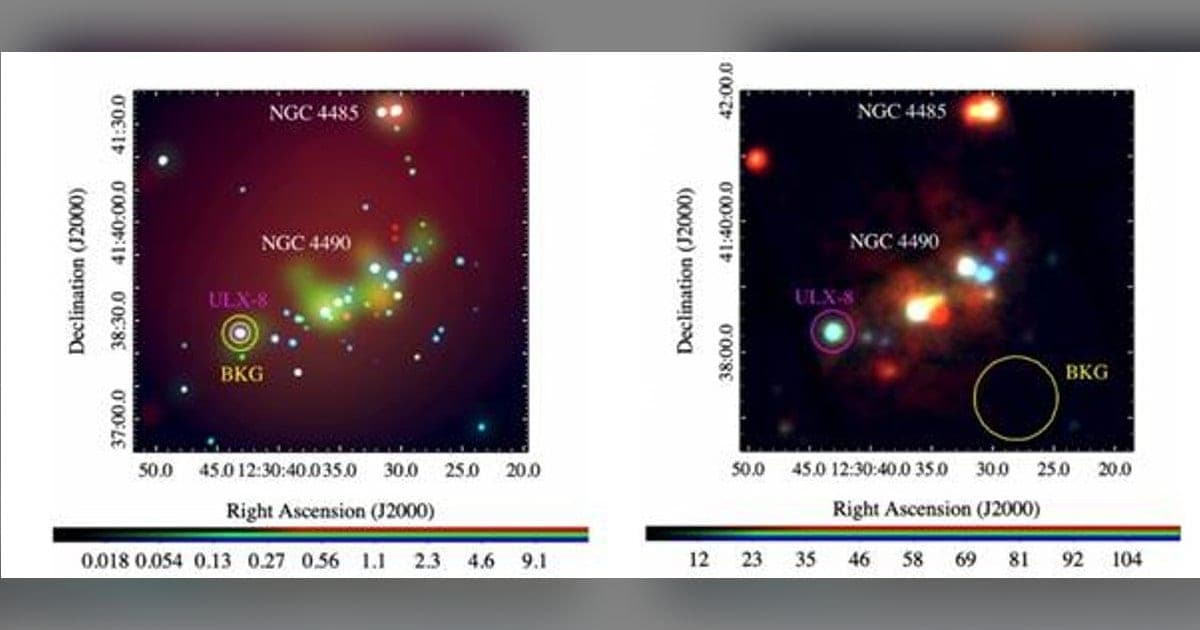
On 2 November 2026 the Ministry of Science and Technology announced that a team including the Indian Institute of Astrophysics had explained the X-ray behaviour of NGC 4490 ULX-8 using observations spanning 2000 to 2024.
Indian astronomers have explained the shifting X-ray behaviour of NGC 4490 ULX-8, one of the brightest X-ray emitters in a nearby galaxy, by following it for nearly a quarter of a century. Their work points to a stellar-mass black hole that is swallowing matter at or beyond the classical limit on how fast such an object can feed.
What an ultraluminous X-ray source is
Ultraluminous X-ray sources, or ULXs, are the brightest X-ray emitters in nearby galaxies apart from the supermassive black holes at galactic centres. A ULX is thought to hold either a neutron star or a black hole that pulls gas off a companion star. As the gas spirals in it heats up and pours out X-rays. Oddly, ULXs look brighter than the Eddington limit allows. That limit is the brightness at which the outward push of radiation balances the inward pull of gravity, and it is the usual yardstick for how luminous an accreting object can be.
How the study was done
A team from the Indian Institute of Astrophysics and the Raman Research Institute, both autonomous institutes of the Department of Science and Technology, worked with IUCAA and other institutions. They combined archival and recent observations of ULX-8 in the interacting galaxy pair NGC 4490/4485, taken by the Chandra, XMM-Newton and Swift space telescopes between 2000 and 2024. Aru Beri of the Indian Institute of Astrophysics, a co-author, described it as one of the longest X-ray studies of this source so far.
What they found
- The source stayed exceptionally luminous through the whole observing span, though its brightness swung widely.
- It showed none of the sharp switches between accretion states that are common in black hole X-ray binaries.
- Its emission kept the marks of a persistently active ultraluminous accretion flow.
- Long-term spectral changes indicate that conditions around the compact object are evolving.
Taken together, the evidence favours a black hole feeding at super-Eddington rates, making the system a natural laboratory for studying how compact objects sustain such extremes and release so much energy.
Who wrote it and what comes next
The paper was written by Tarang Vashisht, a student at IISER Mohali, with Aru Beri and researchers from IUCAA and the Raman Research Institute, and appeared in Monthly Notices of the Royal Astronomical Society. Sharper instruments are on the way: the European Space Agency's NewAthena mission and India's proposed next-generation timing and spectroscopy mission XSat are both expected to improve sensitivity and monitoring of such sources.
Important Facts
| Object studied | NGC 4490 ULX-8, an ultraluminous X-ray source |
|---|---|
| Location | Interacting galaxy pair NGC 4490/4485 |
| Observation period | 2000 to 2024, about 24 years |
| Telescopes used | Chandra, XMM-Newton and Swift |
| Finding | Powered by a stellar-mass black hole accreting at or above the Eddington limit |
| Lead institutes | Indian Institute of Astrophysics and Raman Research Institute, autonomous institutes of the Department of Science and Technology |
| Other institutions | IUCAA and IISER Mohali |
| Authors named | Tarang Vashisht (IISER Mohali) and Aru Beri (Indian Institute of Astrophysics) |
| Journal | Monthly Notices of the Royal Astronomical Society |
| Future missions | NewAthena of the European Space Agency and India's proposed XSat |
Exam Point of View
Remember the source (NGC 4490 ULX-8, in the interacting galaxy pair NGC 4490/4485), the three telescopes used (Chandra, XMM-Newton, Swift), the period covered (2000 to 2024), the concept tested (Eddington limit and super-Eddington accretion), the institutes involved (Indian Institute of Astrophysics and Raman Research Institute under the Department of Science and Technology, with IUCAA and IISER Mohali), and the upcoming missions NewAthena of the European Space Agency and India's XSat.
Practice Questions
Over roughly how long a period were the X-ray observations of NGC 4490 ULX-8 tracked in the new study?
- A.6 years
- B.12 years
- C.24 years
- D.40 years
Show answer
Archival and recent observations of the source were drawn from the Chandra, XMM-Newton and Swift space-based X-ray telescopes covering the years 2000 to 2024, which makes it one of the longest X-ray studies of this object carried out so far.
Read the full explanation →Which limit describes the brightness at which radiation pressure pushing matter outward balances gravity pulling it inward?
- A.Chandrasekhar limit
- B.Eddington limit
- C.Roche limit
- D.Schwarzschild radius
Show answer
It is often used as a benchmark for how bright an accreting object can be, since beyond it the outward push of radiation would overwhelm the inward pull of gravity.
Read the full explanation →The research team that explained the behaviour of ULX-8 was drawn mainly from which institutes?
- A.Indian Institute of Astrophysics and Raman Research Institute
- B.Physical Research Laboratory and Space Applications Centre
- C.Tata Institute of Fundamental Research and Indian Institute of Science
- D.National Centre for Radio Astrophysics and Aryabhatta Research Institute
Show answer
The paper was authored by Tarang Vashisht, a student at IISER Mohali, together with Aru Beri of the Indian Institute of Astrophysics and researchers from IUCAA and the Raman Research Institute.
Read the full explanation →Which of these is India's proposed next-generation timing and spectroscopy mission named in the announcement?
- A.AstroSat
- B.NewAthena
- C.XSat
- D.Aditya
Show answer
The announcement describes it as India's proposed next-generation timing and spectroscopy mission, which together with other future observatories will bring improved sensitivity and monitoring capability for studying ultraluminous X-ray sources.
Read the full explanation →Frequently Asked Questions
What is an ultraluminous X-ray source?
A ULX is among the brightest X-ray emitters in a nearby galaxy, other than the supermassive black hole at its centre. It is thought to hold a neutron star or black hole drawing matter from a companion star, which heats up and emits intense X-rays.
What is the Eddington limit?
It is the brightness at which radiation pressure pushing matter outward balances gravity pulling it inward, used as a benchmark for how luminous an accreting object can be. ULXs appear to shine beyond it, which makes them puzzling.
Which telescopes provided the data?
Chandra, XMM-Newton and Swift, three space-based X-ray telescopes. Archival and recent observations taken between 2000 and 2024 were analysed, making this one of the longest X-ray studies of NGC 4490 ULX-8 to date.
Which missions will study such sources in future?
The European Space Agency's NewAthena mission and India's proposed next-generation timing and spectroscopy mission, XSat. Both are expected to bring improved sensitivity and monitoring for ultraluminous X-ray sources.
Sources
- https://www.pib.gov.in/PressReleasePage.aspx?PRID=2331589 (opens in a new tab) — Press Information Bureau
Current Affairs 2 November 2026
- India-EU Talks: Commerce Secretary Rajesh Agrawal Meets EC OfficialsInternational
- Sacred Piprahwa Buddha Relics Reach Tawang Monastery in ArunachalNational
- Sikkim Dairy Projects Worth Rs 251.56 Lakh Under White Revolution 2.0Government Schemes
- MoD Signs Rs 53,866.50 Crore Deal for 8 Next Generation CorvettesDefence
- Captive and Commercial Coal Mines Produce 22.03 MT in October 2026Economy
- VB-G RAM G Grievance Redressal Rules, 2026 Notified for Rural JobsGovernment Schemes
- Khet Bachaao Abhiyaan-Rabi 2026 Covers 700 Districts, 50 Lakh FarmersGovernment Schemes
- JanHIT: First National Orientation of Tribal Healers at HyderabadNational
Related Current Affairs
- Science & Technology
Kishtwar Seismological Observatory Opens; J&K Now Has Four
2 November 2026 · 2 min read
- Science & Technology
Digi Yatra Begins International Trials at Seven Airports
1 November 2026 · 2 min read
- Science & Technology
NVS-03 Completes First Orbit Manoeuvre of NavIC Mission
1 November 2026 · 2 min read
- Science & Technology
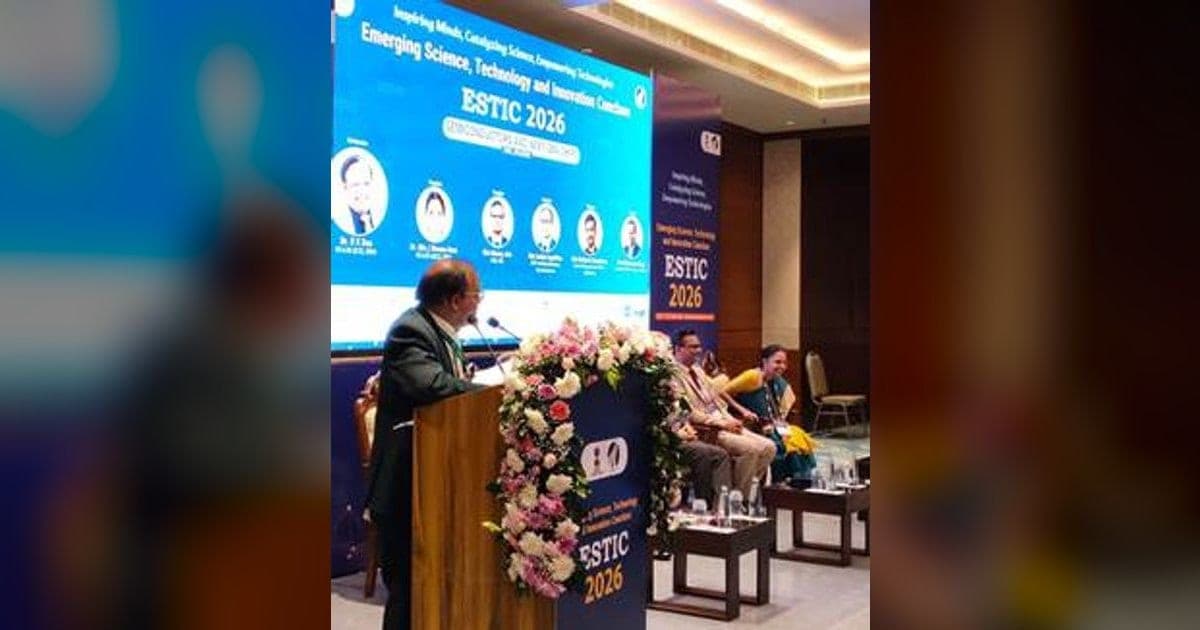
DRDO Leads Semiconductor Session at ESTIC 2026 in Delhi
30 October 2026 · 2 min read
- Science & Technology
TRAI Issues Draft AI Guidelines for Telecom Networks
30 October 2026 · 2 min read
Related GK
- Famous Personalities of Rajasthan: Exam Notes
28 October 2026 · Rajasthan
- Districts and Divisions of Rajasthan: Exam Notes
28 October 2026 · Rajasthan
- Tourism and World Heritage Sites of Rajasthan Notes
27 October 2026 · Rajasthan
Take the Quiz
- Current Affairs Quiz
Defence Current Affairs Quiz: 2 November 2026
11 questions11 minutesStart Quiz