
DRDO AIP Energy Module Begins Setting to Work Phase-2
DRDO opened the Setting to Work Phase-2 activity of its indigenous AIP Energy Module at L&T Hazira, meant for the Navy's diesel-electric submarines.
Why in News
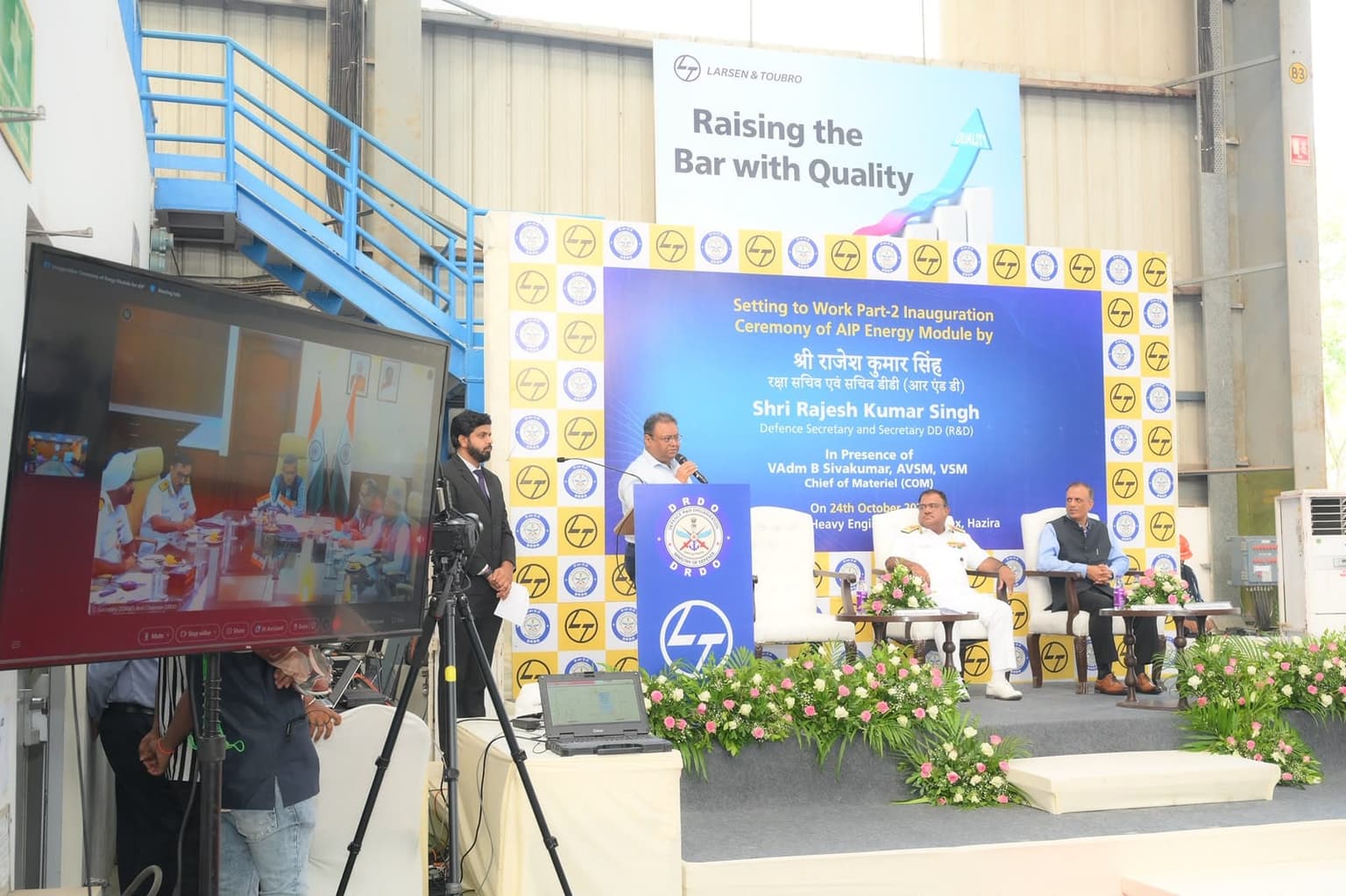
On 24 October 2026 the Setting to Work Phase-2 activity of the indigenously developed AIP Energy Module for the Indian Navy's diesel-electric submarines was inaugurated at L&T Hazira in Gujarat.
India's home-grown Air Independent Propulsion (AIP) programme for submarines crossed a fresh milestone on 24 October 2026 with the start of the Setting to Work (STW) Phase-2 activity of the AIP Energy Module. The module has been designed and built in India by the Naval Materials Research Laboratory (NMRL), a laboratory of the Defence Research and Development Organisation. The ceremony was held at the AM Naik Heavy Engineering Complex of Larsen and Toubro at Hazira in Gujarat.
What an AIP system does
A conventional diesel-electric submarine must come up close to the surface to run its diesel engines, because those engines need oxygen from the air to recharge the batteries. That is the moment a submarine is easiest to detect. An AIP plant generates power without drawing oxygen from the atmosphere, so the boat can stay submerged far longer. The Indian system uses hydrogen and fuel cell technology, which the DRDO chief said demands an exacting safety culture at every step.
Who was present
Rajesh Kumar Singh, Defence Secretary, Secretary of the Department of Defence Research and Development and Chairman of the DRDO, was the chief guest and joined the function virtually. Vice Admiral B Sivakumar, Chief of Materiel of the Indian Navy, and Dr R Balamuralikrishnan, Director General (Naval Systems and Materials) of the DRDO, attended at the L&T yard. The Chairman praised the scientists and the industry partners for turning a laboratory idea into hardware on the shop floor, and acknowledged the Navy's part in testing and validating the system through every stage of trials.
The road ahead
In the next stage the Energy Module will be energised so that it produces power, and then put through rigorous testing against the Indian Navy's own protocols. Once cleared, it is to be handed over to Mazagon Dock Shipbuilders Limited for fitting on a Kalvari-class submarine in early 2027. The DRDO chairman asked the team to work towards the following phases of the programme so that the Navy's induction timelines for the AIP system are met. For the Navy the gain is plain: greater underwater endurance for its conventional submarines, delivered by Indian laboratories and Indian industry rather than bought abroad.
Important Facts
| System | Air Independent Propulsion (AIP) Energy Module |
|---|---|
| Developed by | Naval Materials Research Laboratory (NMRL), DRDO |
| Milestone | Inauguration of Setting to Work (STW) Phase-2 activity |
| Venue | AM Naik Heavy Engineering Complex, L&T, Hazira, Gujarat |
| Chief guest | Rajesh Kumar Singh, Defence Secretary and Chairman, DRDO (virtually) |
| Integration | Mazagon Dock Shipbuilders Limited, on a Kalvari-class submarine in early 2027 |
| Technology | Hydrogen and fuel cell based; raises underwater endurance |
| Date | 24 October 2026 |
Exam Point of View
Remember the full form of AIP, the developing laboratory (NMRL, DRDO), the venue (AM Naik Heavy Engineering Complex, Hazira, Gujarat), the phase name (Setting to Work Phase-2), the shipyard that will integrate it (Mazagon Dock Shipbuilders) and the submarine class and timeline (Kalvari class, early 2027).
Practice Questions
Which DRDO laboratory has indigenously developed the AIP Energy Module for the Indian Navy's submarines?
- A.Naval Materials Research Laboratory
- B.Defence Metallurgical Research Laboratory
- C.Naval Physical and Oceanographic Laboratory
- D.Research Centre Imarat
Show answer
The Setting to Work Phase-2 activity of this module was inaugurated on 24 October 2026 at the AM Naik Heavy Engineering Complex of Larsen and Toubro at Hazira in Gujarat, and the system rests on hydrogen and fuel cell technology.
Read the full explanation →What is the chief advantage an Air Independent Propulsion system gives a diesel-electric submarine?
- A.It allows the submarine to carry ballistic missiles
- B.It increases underwater endurance by reducing dependence on atmospheric oxygen
- C.It replaces the submarine's torpedo tubes with vertical launchers
- D.It makes the submarine capable of flight-deck operations
Show answer
A conventional diesel-electric boat has to come near the surface to run its diesel engines and recharge batteries, because those engines need air, and that is when it is most easily spotted.
Read the full explanation →On which class of submarines will the indigenous AIP Energy Module be integrated, and by which shipyard?
- A.Shishumar class, by Garden Reach Shipbuilders
- B.Arihant class, by Hindustan Shipyard
- C.Kalvari class, by Mazagon Dock Shipbuilders Limited
- D.Sindhughosh class, by Cochin Shipyard
Show answer
In the stage that follows the Setting to Work Phase-2 activity, the AIP Energy Module will be energised for power production and tested rigorously against the Indian Navy's protocols.
Read the full explanation →Where was the Setting to Work Phase-2 activity of the indigenous AIP Energy Module inaugurated?
- A.Visakhapatnam, Andhra Pradesh
- B.Hazira, Gujarat
- C.Mumbai, Maharashtra
- D.Kochi, Kerala
Show answer
Rajesh Kumar Singh, Defence Secretary, Secretary of the Department of Defence Research and Development and Chairman of the DRDO, was the chief guest and took part virtually, while Vice Admiral B Sivakumar, Chief of Materiel of the Indian Navy, and Dr R Balamuralikrishnan, Director General for Naval Systems and Materials…
Read the full explanation →Frequently Asked Questions
Which laboratory has developed India's indigenous AIP system for submarines?
The Naval Materials Research Laboratory (NMRL) of the DRDO. Its AIP Energy Module entered the Setting to Work Phase-2 stage on 24 October 2026 at L&T's AM Naik Heavy Engineering Complex at Hazira in Gujarat.
Why is an AIP system important for a diesel-electric submarine?
The system produces power without using oxygen from the atmosphere, so the submarine need not surface often to run its diesel engines. That increases underwater endurance and makes the boat harder to detect.
Where will the AIP Energy Module be fitted?
After being energised and tested to the Indian Navy's protocols, it will be handed to Mazagon Dock Shipbuilders Limited for integration on a Kalvari-class submarine in early 2027.
Sources
- https://www.pib.gov.in/PressReleasePage.aspx?PRID=2328040 (opens in a new tab) — Press Information Bureau
Current Affairs 24 October 2026
- Great Indian Bustard Rewilding Begins at Desert National ParkEnvironment
- 11 Crore Farmer IDs Created Under Digital Agriculture MissionGovernment Schemes
- VB-G RAM G Guarantees 125 Days of Rural Wage EmploymentGovernment Schemes
- 8th All India Conference of GRP Chiefs Concludes in New DelhiNational
- Piyush Goyal Ends Germany Visit With Berlin Industry MeetingsInternational
- Shram Samvad Campaign Covers 316 Districts on Labour CodesGovernment Schemes
- AATAL Lab Opens in Delhi to Trace Air Pollution SourcesScience & Technology
- India Chem 2026 Ends in Mumbai With Japan as Partner CountrySummits & Conferences
Related Current Affairs


Related GK
- Research Institutes of India and Their Locations
11 October 2026 · Static GK
- Missile Systems of India: Agni, BrahMos and IGMDP
29 September 2026 · Science & Technology
- Indian Organisations and Headquarters: City-wise List
29 September 2026 · Static GK
Take the Quiz
- Current Affairs Quiz
State Exams Current Affairs Quiz: 24 October 2026
25 questions25 minutesStart Quiz