
Metal-Free Catalyst TTT-DHTD Rivals Platinum in Zn-Air Cells
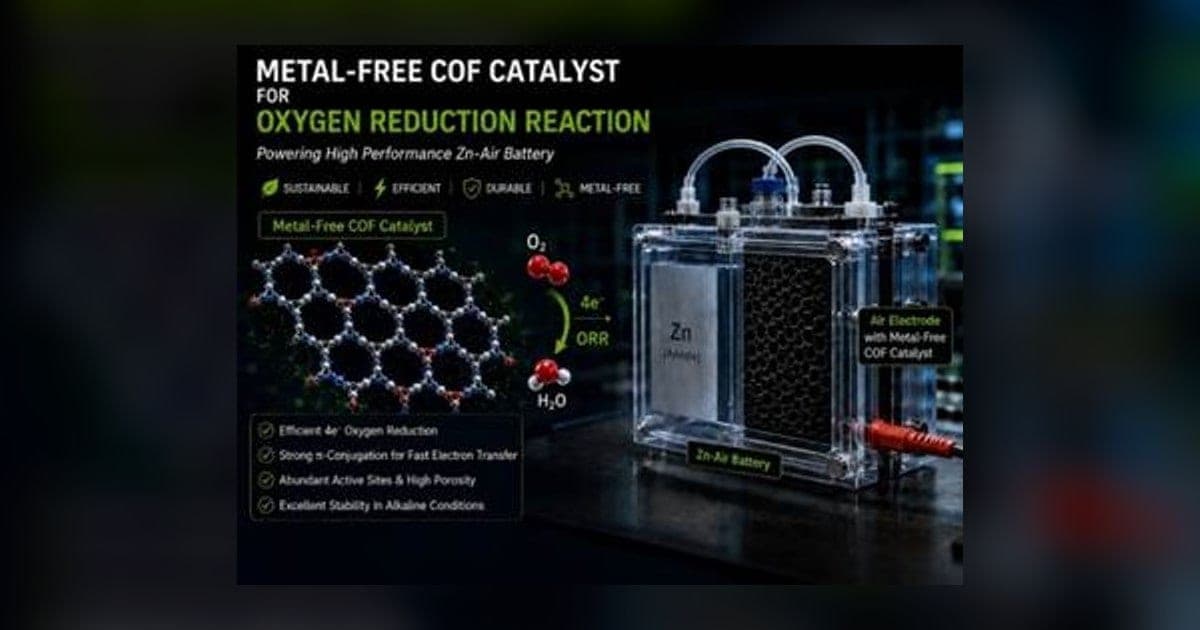
Indian scientists have built TTT-DHTD, a metal-free porous material that reaches about 96 per cent of platinum's performance in zinc-air battery electrodes.
Why in News
On 7 October 2026 the Ministry of Science and Technology announced that scientists at DST institutes and SRM University, Amaravati, had developed TTT-DHTD, a metal-free porous catalyst that performs nearly as well as platinum in zinc-air batteries.
A team of Indian researchers has made a porous organic material that does the work of platinum in a battery electrode without using any precious metal. The Ministry of Science and Technology announced the result on 7 October 2026, and the study has appeared in the journal Science Advances.
The problem it solves
In a zinc-air battery, oxygen drawn straight from the air reacts at the electrode in what chemists call the oxygen reduction reaction (ORR), and how well that reaction runs decides how well the cell runs. Such cells are attractive because zinc is cheap, plentiful and reasonably safe, and because the oxygen comes from the air, so no active cathode material has to be carried inside the battery. Against a lithium-ion cell they promise more energy for the same weight, lower material cost, better safety and less environmental strain, though rechargeability and cycle life are still being worked on. The catch has been the catalyst: most clean-energy devices, hydrogen fuel cells above all, lean on platinum, one of the rarest and dearest metals on earth, which keeps them expensive and hard to scale.
What was made
The new material, named TTT-DHTD, is built by joining two organic linkers known in short as TTT and DHTD. It uses only abundant elements — carbon, sulphur, nitrogen and hydrogen — and forms an extremely porous, honeycomb-like framework. Used as the air-electrode catalyst in a zinc-air cell, it reached roughly 96 per cent of the performance of commercial platinum catalysts. It also held steady through 120 hours of continuous running without the fouling or decay that often troubles metal-based catalysts. Computer simulations showed why: the molecular design creates sites where oxygen molecules settle and react easily.
Who did it
| Institutions | S. N. Bose National Centre for Basic Sciences, Kolkata; Institute of Nano Science and Technology, Mohali; SRM University, Amaravati |
| Lead researchers | Dr. Pradip Pachfule; Prof. Ramendra Sundar Dey; Prof. Ranjit Thapa |
| Journal | Science Advances |
The first two institutions work under the Department of Science and Technology. Replacing platinum with cheap organic matter could bring down the price of zinc-air cells sharply, making clean transport, portable power packs and storage for renewable electricity more affordable.
Important Facts
| Material | TTT-DHTD, a metal-free organic porous framework |
|---|---|
| Application | Air-electrode catalyst in zinc-air (Zn-air) batteries |
| Reaction | Oxygen reduction reaction (ORR) |
| Metal it replaces | Platinum |
| Performance | About 96 per cent of commercial platinum catalysts |
| Stability | Maintained performance over 120 hours of continuous operation |
| Elements used | Carbon, sulphur, nitrogen and hydrogen |
| Institutions | S. N. Bose National Centre for Basic Sciences, Kolkata; Institute of Nano Science and Technology, Mohali; SRM University, Amaravati |
| Lead researchers | Dr. Pradip Pachfule, Prof. Ramendra Sundar Dey, Prof. Ranjit Thapa |
| Published in | Science Advances |
Exam Point of View
Remember the catalyst's name TTT-DHTD, that it is metal-free and platinum-free, the figure of about 96 per cent of platinum performance, the 120 hours of stable operation, the reaction involved (oxygen reduction reaction), the three institutions and the journal Science Advances.
Practice Questions
The newly developed metal-free catalyst TTT-DHTD is designed to replace which costly metal used in clean-energy devices?
- A.Palladium
- B.Platinum
- C.Iridium
- D.Ruthenium
Show answer
Correct answer: B. Platinum
Explanation
The correct answer is platinum. Many clean-energy technologies, and hydrogen fuel cells in particular, depend on platinum to speed up the oxygen reduction reaction, and because it is one of the rarest and most expensive metals available, its cost and limited supply stand in the way of large-scale use. The newly reported organic framework matched about ninety-six per cent of the performance of commercial platinum catalysts while using no precious metal at all, which is why the work matters for the price of zinc-air cells. Options A, C and D name palladium, iridium and ruthenium, which are also costly metals used in various catalytic applications, but none of them is the metal identified as the benchmark and the bottleneck in this study. Candidates should link the material to platinum, to the oxygen reduction reaction and to zinc-air batteries together, since questions usually test one of these three links.
In laboratory tests, TTT-DHTD held its performance without decay for how long of continuous operation?
- A.48 hours
- B.72 hours
- C.120 hours
- D.240 hours
Show answer
Correct answer: C. 120 hours
Explanation
The correct answer is 120 hours. Tests showed that even after that long a spell of continuous running, the material kept its performance and did not suffer the degradation or contamination that commonly affects catalysts built around metals. This durability matters as much as the raw activity figure, because a catalyst that performs brilliantly for an hour and then decays is of little practical use in a battery meant for transport or for storing renewable power. Options A and B understate the tested period, while option D overstates it by a wide margin. Candidates should pair this number with the other headline figure from the same study, namely that the material reached roughly ninety-six per cent of the performance of commercial platinum catalysts, and should also remember that the simulations traced the result to sites in the molecular structure where oxygen attaches and reacts readily.
TTT-DHTD was developed by researchers from which set of institutions?
- A.IIT Madras, IISc Bengaluru and CSIR-NCL Pune
- B.S. N. Bose National Centre for Basic Sciences, Institute of Nano Science and Technology and SRM University, Amaravati
- C.TIFR Mumbai, IISER Pune and BARC
- D.IIT Kanpur, JNCASR and ARCI Hyderabad
Show answer
Correct answer: B. S. N. Bose National Centre for Basic Sciences, Institute of Nano Science and Technology and SRM University, Amaravati
Explanation
The correct answer is S. N. Bose National Centre for Basic Sciences, Kolkata, the Institute of Nano Science and Technology, Mohali, and SRM University, Amaravati. The first two are institutions of the Department of Science and Technology, and the team was led by Dr. Pradip Pachfule, Prof. Ramendra Sundar Dey and Prof. Ranjit Thapa respectively, with the findings published in the journal Science Advances. Options A, C and D list well-known Indian research bodies, including engineering institutes, basic science institutes and national laboratories, but none of these combinations is the group credited with this particular material. Remember that questions on such announcements often ask either for the lead institution, for the parent department, or for the journal, so it is worth memorising all three: the Department of Science and Technology as parent, Kolkata and Mohali as the two institute locations, and Science Advances as the journal.
Frequently Asked Questions
What is TTT-DHTD?
A metal-free organic porous material made from two linkers called TTT and DHTD. Used as an air-electrode catalyst in zinc-air batteries, it reached about 96 per cent of the performance of commercial platinum catalysts.
Why is replacing platinum important?
Platinum is among the rarest and costliest metals and is the standard catalyst for the oxygen reduction reaction in fuel cells, so its price and scarcity hold back large-scale use of clean-energy devices.
Which institutions developed the material?
The S. N. Bose National Centre for Basic Sciences, Kolkata, and the Institute of Nano Science and Technology, Mohali, both under the Department of Science and Technology, together with SRM University, Amaravati.
Sources
- https://www.pib.gov.in/PressReleasePage.aspx?PRID=2320120 (opens in a new tab) — Press Information Bureau
Current Affairs 7 October 2026
- Pre-COP31 in Fiji: Bhupender Yadav Leads Indian DelegationEnvironment
- Additive Manufacturing: MeitY's NSAM Moves to NSAM 2.0 PhaseScience & Technology
- TRAI Drive Test Grades Mobile Networks in Balasore CityReports & Indices
- Fleet Support Ship FSS-1 Launched at Hindustan ShipyardDefence
- 153rd IPU Assembly: Harivansh Leads India in ArushaInternational
- Piyush Goyal Meets Top US Firms in New York on InvestmentEconomy
- MoSPI Releases Environmental Accounts Strategy for 2026-2030Reports & Indices
- Textiles Ministry Wraps Up Swachhata Hi Seva 2026 DriveGovernment Schemes
Related Current Affairs
- Science & Technology
Additive Manufacturing: MeitY's NSAM Moves to NSAM 2.0 Phase
7 October 2026 · 3 min read
- Science & Technology
ARIES Study Tracks Blazar OJ 287 Twin Black Holes for a Decade
6 October 2026 · 2 min read
- Science & Technology
IMC 2026 Theme Scale Without Boundaries, 10th Edition at Yashobhoomi
5 October 2026 · 2 min read
- Science & Technology
ITRA Study: Ayurveda with Yoga Cuts Bedwetting by 70 Per Cent
5 October 2026 · 2 min read
- Science & Technology
Sanchar Saathi Portal Crosses 30 Crore Visits Against Telecom Fraud
5 October 2026 · 2 min read
- Science & Technology
TDB Backs Project VeerAI With Rs 130 Crore for AI Vision Chip
5 October 2026 · 2 min read




Related GK
- Arunachal Pradesh GK: Tawang, Tribes, Rivers and Exam Facts
7 October 2026 · Indian States & UTs
- Geographical Epithets of the World: Nicknames of Places
7 October 2026 · Static GK
- Cyber Security and Digital Public Infrastructure: Notes
7 October 2026 · Science & Technology
Take the Quiz
- Current Affairs Quiz
RRB NTPC Current Affairs Quiz: 7 October 2026
25 questions25 minutesStart Quiz