
Bharatiya Vayuyan Niyam 2026 Replaces Aircraft Rules of 1937
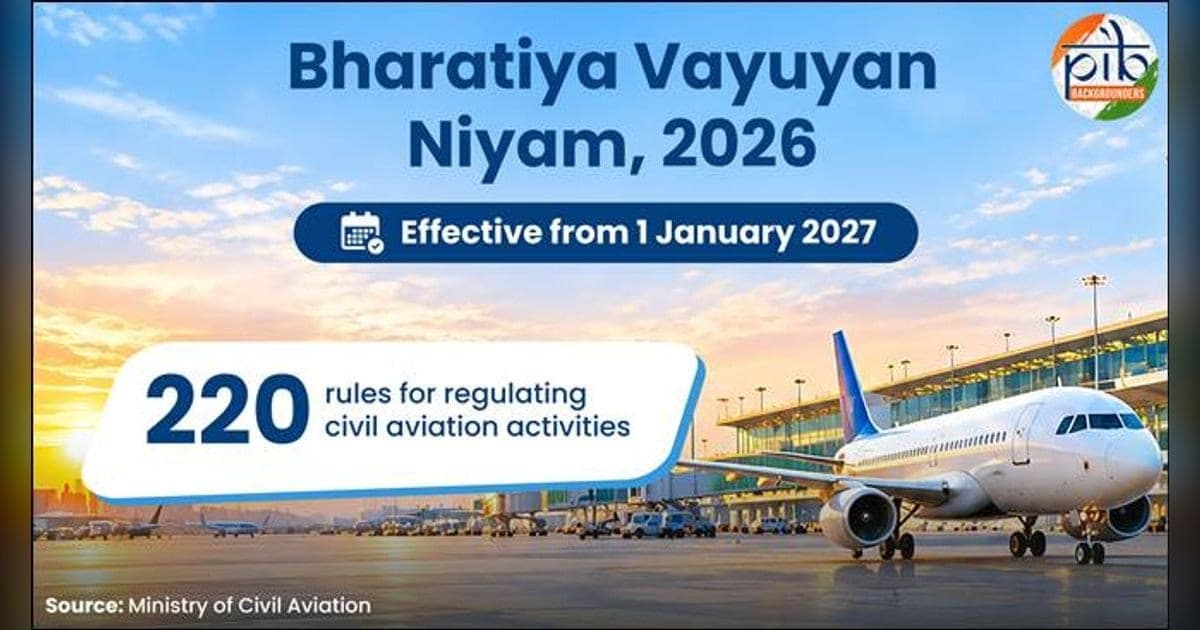
The Centre notified the Bharatiya Vayuyan Niyam 2026, a code of 220 rules that replaces the Aircraft Rules 1937 and takes effect on 1 January 2027.
Why in News
The Government has notified the Bharatiya Vayuyan Niyam, 2026, which takes effect on 1 January 2027 and replaces the Aircraft Rules, 1937 as the principal rulebook for civil aviation in India.
India's civil aviation sector has a new principal rulebook. The Government has notified the Bharatiya Vayuyan Niyam, 2026, framed under the Bharatiya Vayuyan Adhiniyam, 2024, and it comes into force on 1 January 2027. The code retires the Aircraft Rules, 1937, which governed Indian skies for close to nine decades, and also Part IX of the Aircraft Rules, 1920. The Radio Telephone Operator (Restricted) Certificate and Licence Rules, 2025 stand repealed too, subject to saving provisions.
Why a new code was framed
Operational airports in the country rose from 74 in 2014 to 166 as of October 2026, and the rules governing aircraft technology, financing and day-to-day operations had to keep pace with that spread. The new code keeps safety at its centre while making room for commercial practices that did not exist when the 1937 rules were drafted.
How the code is arranged
There are 220 rules set out in eight chapters, supported by six schedules. They deal with aircraft registration, airworthiness, personnel licensing, aerodrome operations, air navigation services and flight operations, and then lay down regulatory oversight, safety management, enforcement and penalties. Every Indian aircraft must display the nationality mark VT, followed by a hyphen and three assigned capital letters, and the DGCA keeps a register of Indian-registered aircraft open to public inspection.
Leasing, licensing and fares
The code recognises fractional ownership, under which an aircraft may be jointly held so long as the arrangement names who is answerable for its operation and upkeep. Read with the Protection of Interests in Aircraft Objects Act, 2025, which brings the Cape Town Convention framework into Indian law, an eligible deregistration request from an IDERA holder must be processed within five working days. Twenty-three categories of licences, ratings and certificates are listed, covering pilots, flight engineers, aircraft maintenance engineers, air traffic controllers and radio-telephone operators. On the passenger side, airlines must publish tariffs digitally and show the full payable amount with a break-up of fares, taxes and other charges, and the Centre may issue proportionate, time-bound directions in extraordinary situations.
Offences and penalties
The code prescribes 21 punishable offences carrying imprisonment of up to two years, a fine of up to one crore rupees, or both, and makes 18 offences compoundable. Penalties are graded across ten severity levels, beginning at ten thousand rupees and rising to one crore rupees depending on the nature of the breach and the size of the offender.
Important Facts
| New rulebook | Bharatiya Vayuyan Niyam, 2026 |
|---|---|
| Parent law | Bharatiya Vayuyan Adhiniyam, 2024 |
| Replaces | Aircraft Rules, 1937 and Part IX of the Aircraft Rules, 1920 |
| In force from | 1 January 2027 |
| Structure | 220 rules, eight chapters, six schedules |
| Licence categories | Twenty-three kinds of licences, ratings and certificates |
| Nationality mark | VT, followed by a hyphen and three capital letters |
| Operational airports | 166 as of October 2026, against 74 in 2014 |
| Regulator | Directorate General of Civil Aviation (DGCA) |
Exam Point of View
Remember the name of the new code, its parent law (Bharatiya Vayuyan Adhiniyam, 2024), what it replaces (Aircraft Rules, 1937 and Part IX of the Aircraft Rules, 1920), the commencement date of 1 January 2027, the count of 220 rules in eight chapters and six schedules, the nationality mark VT, the twenty-three licence categories, the five-working-day IDERA timeline and the ten-level penalty ladder.
Practice Questions
The Bharatiya Vayuyan Niyam, 2026 replace which earlier rulebook as India's principal civil aviation code?
- A.The Aircraft Act, 1934
- B.The Aircraft Rules, 1937
- C.The Carriage by Air Act, 1972
- D.The Airports Authority of India Act, 1994
Show answer
The new code, notified under the Bharatiya Vayuyan Adhiniyam, 2024, takes over from the Aircraft Rules, 1937, which served as the principal rulebook for Indian civil aviation for close to nine decades, and it also replaces Part IX of the Aircraft Rules, 1920.
Read the full explanation →How many rules does the Bharatiya Vayuyan Niyam, 2026 contain, and how are they arranged?
- A.180 rules in six chapters and four schedules
- B.200 rules in seven chapters and five schedules
- C.220 rules in eight chapters and six schedules
- D.260 rules in ten chapters and eight schedules
Show answer
That is the structure of the new civil aviation code, and its chapters run across aircraft registration, airworthiness and maintenance, personnel licensing, aerodrome operations, air navigation services, aircraft operations, regulatory oversight and safety management, and offences with penalties and appeals.
Read the full explanation →Which nationality mark must an aircraft registered in India display under the Bharatiya Vayuyan Niyam, 2026?
- A.IN
- B.VT
- C.AI
- D.BH
Show answer
Under the new code an aircraft on the Indian register must display the nationality mark VT, followed by a hyphen and three assigned capital letters, which is why Indian aircraft registrations are read as VT and then a three-letter group.
Read the full explanation →Frequently Asked Questions
When do the Bharatiya Vayuyan Niyam, 2026 come into force?
On 1 January 2027. They were framed under the Bharatiya Vayuyan Adhiniyam, 2024 and replace the Aircraft Rules, 1937 along with Part IX of the Aircraft Rules, 1920.
How many rules does the new aviation code contain?
It has 220 rules in eight chapters with six schedules, covering registration, airworthiness, personnel licensing, aerodromes, air navigation services and flight operations.
What does fractional ownership of aircraft mean under the new rules?
An aircraft may be owned jointly by more than one party, provided the arrangement clearly identifies who is responsible for operating and maintaining it.
Sources
- https://www.pib.gov.in/PressReleasePage.aspx?PRID=2332687 (opens in a new tab) — Press Information Bureau
Current Affairs 4 November 2026
- India-Poland Trade Push: Jitin Prasada Visits WarsawInternational
- NLMC Phase II RINL Land Auction Fetches Rs 218 CroreEconomy
- Railways Freight Loading Hits 145.07 MT in October 2026Economy
- CSIR and DAKSHIN-RIS Sign Pact for Global South ScienceScience & Technology
- Ayush Minister Ties Dhanteras to Preventive HealthcareImportant Days
- Schedule M Amendment Aligns Grade A Limits With WHO NormsNational
- Cabinet Clears Rs 2,814 Crore Critical Mineral Capex SchemeGovernment Schemes
- Cabinet Approves Rs 4,371.10 Crore VISTAR Statistics SchemeEconomy
Related Current Affairs
Related GK
- Famous Personalities of Rajasthan: Exam Notes
28 October 2026 · Rajasthan
- Districts and Divisions of Rajasthan: Exam Notes
28 October 2026 · Rajasthan
- Tourism and World Heritage Sites of Rajasthan Notes
27 October 2026 · Rajasthan
Take the Quiz
- Current Affairs Quiz
State Exams Current Affairs Quiz: 4 November 2026
25 questions25 minutesStart Quiz