
India Eyes USD 40-45 Billion Space Economy in 7-8 Years
Dr Jitendra Singh said India's space economy, now about USD 9 billion, should reach USD 40-45 billion in seven to eight years as private investment rises.
Why in News
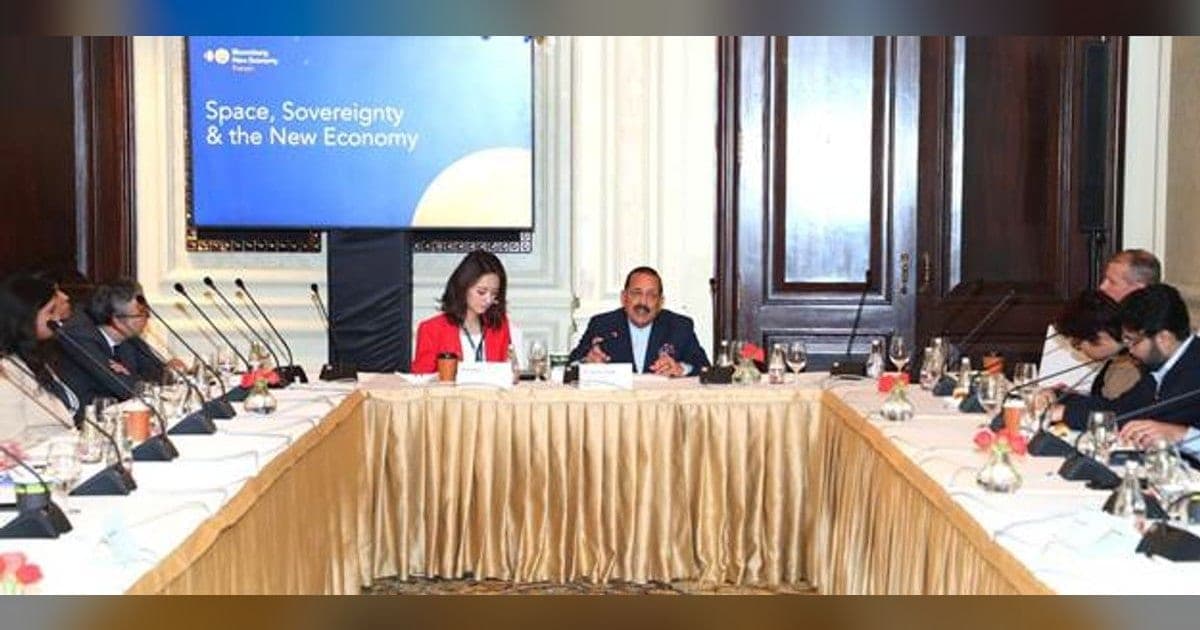
At a Bloomberg New Economy Forum roundtable in New Delhi on 17 October 2026, Dr Jitendra Singh put India's space economy at about USD 9 billion and said it should reach USD 40-45 billion in seven to eight years, with private investment, assured demand and faster approvals driving the climb.
India's space economy, valued at about USD 9 billion today, is expected to grow to USD 40-45 billion within the next seven to eight years, Union Minister of State (Independent Charge) for Science and Technology and Earth Sciences Dr Jitendra Singh said at a media roundtable held in New Delhi on 17 October 2026. The session, titled 'Space, Sovereignty and New Economy', was organised by the Bloomberg New Economy Forum.
From proving capability to selling it
The Minister argued that the country must now move past proving it can build rockets and satellites, and start raising space firms able to win business abroad. Four things, he said, will decide whether that happens: heavier investment from within India and outside it, demand a company can count on, licences cleared inside fixed timeframes, and business models that pay for themselves. A firm applying for an installation or export licence should know by when its file will be decided, and the recent relief on goods and services tax for space products must show up as a real saving on a company's books.
Who took part
Vinod Kumar, Director (Promotion) at the Indian National Space Promotion and Authorisation Centre (IN-SPACe), joined the discussion, as did Aisha Bowe, founder and chief executive of STEMBoard and LINGO, a former NASA engineer who has flown with Blue Origin. Industry representatives, entrepreneurs, academics and members of the international space community made up the rest of the table.
Space technology at work on the ground
Dr Jitendra Singh traced the shift to 2019-2020, when the sector was opened to private players, and said the five to six years since have been enough to show results. He pointed to everyday uses of the technology: satellite communication, geospatial tools and earth observation now feed project clearances, the geotagging of public works, farm advice, disaster warnings and defence needs. India also shares space-based disaster information with Myanmar, Bangladesh and Sri Lanka. Downstream services and data-driven products, he said, will widen the market for Indian companies as much as launch vehicles and satellites do.
Important Facts
| Present size | About USD 9 billion |
|---|---|
| Projection | USD 40-45 billion in seven to eight years |
| Said by | Dr Jitendra Singh, MoS (IC) Science and Technology and Earth Sciences |
| Event | Media roundtable on 'Space, Sovereignty and New Economy' |
| Organiser and venue | Bloomberg New Economy Forum, New Delhi |
| Sector opened to private players | 2019-2020 |
| Regulator named | IN-SPACe, the Indian National Space Promotion and Authorisation Centre |
| Disaster support given to | Myanmar, Bangladesh and Sri Lanka |
Exam Point of View
Remember the present size (about USD 9 billion), the projection (USD 40-45 billion in seven to eight years), who said it (Dr Jitendra Singh), the event ('Space, Sovereignty and New Economy' roundtable of the Bloomberg New Economy Forum, New Delhi), when the sector opened to private players (2019-2020), the regulator (IN-SPACe) and the three neighbours India helps with space-based disaster information.
Practice Questions
What size is India's space economy expected to reach over the next seven to eight years?
- A.USD 15-20 billion
- B.USD 40-45 billion
- C.USD 90-100 billion
- D.USD 5-9 billion
Show answer
Dr Jitendra Singh told the roundtable that the Indian space economy, valued at roughly USD 9 billion at present, is expected to climb to USD 40-45 billion over the next seven to eight years as private capital, assured demand and quicker regulatory clearances take hold.
Read the full explanation →In which period was India's space sector opened to private participation, as recalled by the Minister?
- A.2014-2015
- B.2016-2017
- C.2019-2020
- D.2022-2023
Show answer
The Minister said the space sector was thrown open to private participation in 2019-2020 and that the five to six years since have already produced significant results, which is why the focus has shifted to building globally competitive commercial companies.
Read the full explanation →Which body organised the media roundtable on 'Space, Sovereignty and New Economy' in New Delhi?
- A.World Economic Forum
- B.Bloomberg New Economy Forum
- C.NITI Aayog
- D.IN-SPACe
Show answer
The discussion examined how a country can convert sovereign space capability into commercially competitive industry, attract private capital and build stronger supply chains while protecting national interests.
Read the full explanation →Which set of neighbouring countries was named as receiving space-based disaster management support from India?
- A.Nepal, Bhutan and Maldives
- B.Myanmar, Bangladesh and Sri Lanka
- C.Pakistan, Afghanistan and Iran
- D.Indonesia, Thailand and Vietnam
Show answer
Describing how space technology serves development on earth, the Minister said India provides space-based information and support for disaster management to neighbouring countries, naming these three.
Read the full explanation →Frequently Asked Questions
How large is India's space economy and how large is it expected to become?
It is valued at about USD 9 billion at present and is expected to reach USD 40-45 billion over the next seven to eight years, Dr Jitendra Singh said on 17 October 2026.
Which forum organised the 'Space, Sovereignty and New Economy' roundtable?
The Bloomberg New Economy Forum, at its New Delhi meeting. IN-SPACe Director (Promotion) Vinod Kumar and former NASA engineer Aisha Bowe were among those who took part.
When was India's space sector opened to private participation?
In 2019-2020. The Minister said the five to six years since have produced significant results, and the task now is to build commercial space companies that can compete globally.
Sources
- https://www.pib.gov.in/PressReleasePage.aspx?PRID=2324662 (opens in a new tab) — Press Information Bureau
Current Affairs 17 October 2026
- IDBI Bank Stake: Ministry Cites 2003 Repeal Act and Court RulingBanking & Finance
- Kashmir Connectivity: USBRL, Chenab Bridge and Zojila TunnelNational
- FSSAI Draft Bars Added Sucrose, Fructose in Infant FoodsNational
- Bhupender Yadav Meets Start-ups on Delhi-NCR Air PollutionEnvironment
- Project Seabird Phase IIA Facilities Opened at Karwar BaseDefence
- IITM Pune Hosts First CSSIF Climate Services ConsultationSummits & Conferences
- FSSAI Draft Fixes Pesticide Residue Limits for TeaNational
- Khet Bachao Abhiyan to Run 22 October to 30 NovemberGovernment Schemes
Related Current Affairs
- Science & Technology
BSIP Study Reconstructs 4,600 Years of Monsoon History
16 October 2026 · 2 min read
- Science & Technology
Indian Scientists Identify Martian Analogue Sites in Tamil Nadu
16 October 2026 · 2 min read
- Science & Technology
TDB Signs Rs 150 Crore Quantum Security Deal With QNu Labs
16 October 2026 · 2 min read
- Science & Technology
BHASHINI and IISc Build Sourashtra Text-to-Speech Models
16 October 2026 · 2 min read
- Science & Technology
TDB Supports Development of Indigenous 32-Slice CT Scanner
15 October 2026 · 2 min read
- Science & Technology
ARCI Workshop Marks National Hydrogen and Fuel Cell Day
15 October 2026 · 2 min read


Related GK
- Medieval MP: Paramaras, Chandelas and Gond Kingdoms
17 October 2026 · Madhya Pradesh
- Ancient Madhya Pradesh: Bhimbetka, Sanchi and Ujjain
17 October 2026 · Madhya Pradesh
- Ancient Haryana: Rakhigarhi, Kurukshetra and Vedic Age
17 October 2026 · Haryana
Take the Quiz
- Current Affairs Quiz
State Exams Current Affairs Quiz: 17 October 2026
25 questions25 minutesStart Quiz