
World Television Day: India's Analogue to Digital TV Journey
A PIB backgrounder on World Television Day, observed on 21 November since 1996, traces Indian television from the 1959 Delhi experiment to OTT and D2M.
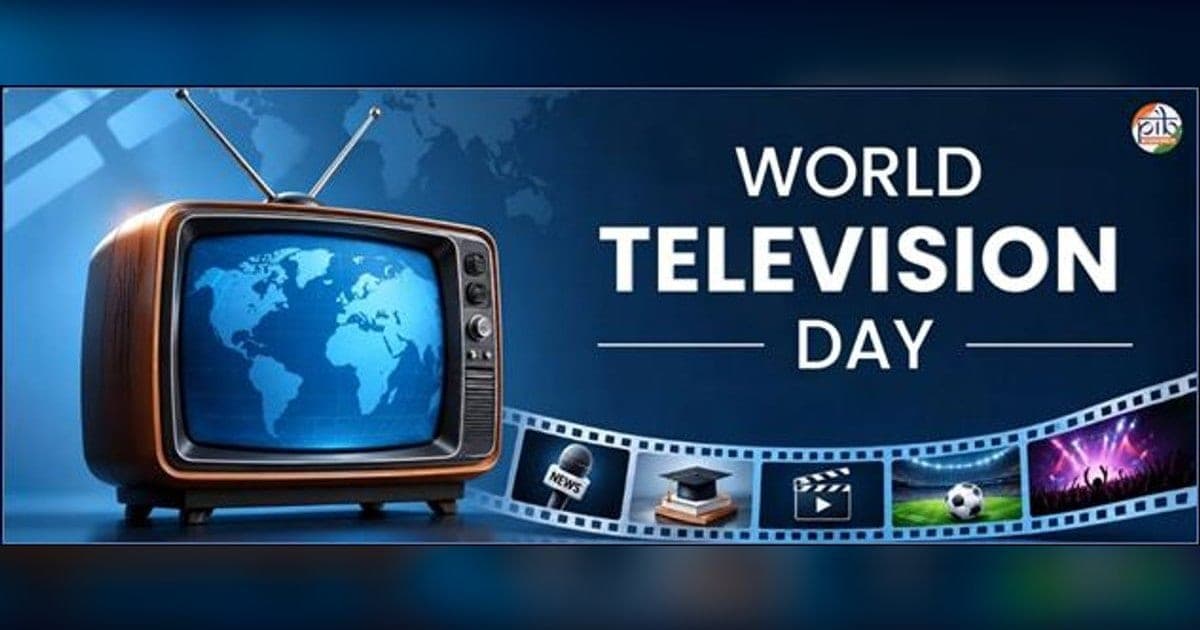
Why in News
On 20 November 2026, ahead of World Television Day on 21 November, PIB issued a backgrounder tracing Indian television from the 1959 Delhi experiment through satellite, cable and DTH to OTT and Direct-to-Mobile broadcasting.
Ahead of World Television Day, the Press Information Bureau issued a backgrounder on 20 November 2026 tracing how television reached Indian homes. The United Nations General Assembly proclaimed 21 November as World Television Day in 1996, in recognition of the medium's hold over public opinion, global communication and cultural exchange.
The terrestrial beginning
Indian television opened with an experimental broadcast in Delhi on 15 September 1959, launched by All India Radio under the Ministry of Information and Broadcasting from a makeshift studio. Regular service followed in 1965, and Doordarshan's daily Hindi news bulletin began on 15 August 1965. Mumbai and Amritsar were covered by 1972 and seven more cities by 1975. On 1 April 1976 Doordarshan was carved out as a separate department of the ministry.
Satellite and colour
The Satellite Instructional Television Experiment (SITE), run between August 1975 and July 1976, carried educational programming by satellite to villages in six States. INSAT-1A, launched in April 1982, was India's first operational domestic communications satellite, though it was abandoned in 1983; INSAT-1B followed in August 1983. Doordarshan's first colour telecast came on 15 August 1982 with the National Programme, and colour reached a mass audience through the Asian Games in New Delhi in November 1982.
Cable, DTH and digital
Private satellite channels arrived in the early 1990s, beginning with CNN and then Star TV and Zee TV, and cable networks spread from the mid-1990s. Dish TV began India's first commercial DTH service in October 2003, and Prasar Bharati launched DD Direct Plus, now DD Free Dish, in December 2004. DTH broadcasting generally uses the Ku-band, which operates in the 12 to 18 GHz range and allows smaller dish antennas, though heavy rain can disturb reception.
Where television stands now
Prasar Bharati launched its OTT platform WAVES in November 2024; it had about 1.6 crore registered users by November 2026. Doordarshan now runs 35 channels, up from 17 in 2010, and DD Free Dish carries 482 channels against 59 earlier. Permitted private satellite channels numbered 917 as of March 2026, of which 908 could be downlinked in India, comprising 342 pay and 566 free-to-air channels. Private pay DTH had 49.05 million active subscribers on 31 March 2026, while Doordarshan's own DTH service claims 100% geographical coverage. The newer frontier is Direct-to-Mobile (D2M) broadcasting, which sends video to handsets without a SIM card or mobile data; Prasar Bharati signed an MoU with IIT Kanpur for a next-generation roadmap and a proof of concept was completed there.
Important Facts
| World Television Day | 21 November, proclaimed by the UN General Assembly in 1996 |
|---|---|
| First telecast in India | Experimental broadcast in Delhi, 15 September 1959, by All India Radio |
| Doordarshan as separate department | 1 April 1976, under the Ministry of Information and Broadcasting |
| SITE | Satellite Instructional Television Experiment, August 1975 to July 1976, in six States |
| First operational domestic communications satellite | INSAT-1A, launched April 1982 |
| First colour telecast | 15 August 1982, with the National Programme |
| First commercial DTH | Dish TV, October 2003; DD Direct Plus in December 2004 |
| WAVES | Prasar Bharati's OTT platform, launched November 2024, about 1.6 crore registered users by November 2026 |
| Private satellite channels | 917 permitted as of March 2026, of which 908 downlinkable, 342 pay and 566 free-to-air |
| Ku-band | Satellite frequency band of about 12 to 18 GHz used for DTH |
Exam Point of View
Remember that World Television Day is observed on 21 November and was proclaimed by the UN General Assembly in 1996. Also note the first experimental telecast on 15 September 1959, Doordarshan's separation on 1 April 1976, SITE in 1975-76, INSAT-1A in April 1982, the first colour telecast on 15 August 1982, DTH from October 2003, DD Free Dish from December 2004, WAVES from November 2024, and that Ku-band spans 12 to 18 GHz.
Practice Questions
World Television Day, proclaimed by the United Nations General Assembly in 1996, is observed on which date?
- A.15 September
- B.21 November
- C.1 April
- D.15 August
Show answer
The United Nations General Assembly set aside that date as World Television Day in the year 1996, recognising the influence television exercises over public opinion, global communication and cultural exchange, and the responsibility that comes with it.
Read the full explanation →Which satellite was India's first operational domestic communications satellite, used to feed Doordarshan's regional stations?
- A.INSAT-1A
- B.INSAT-1B
- C.Aryabhata
- D.Rohini
Show answer
Launched in April 1982, it was the country's first generation operational domestic communications satellite and made it possible to send a common programme feed from Delhi to regional stations across the country.
Read the full explanation →WAVES, the OTT platform launched by Prasar Bharati in November 2024, had about how many registered users by November 2026?
- A.16 lakh
- B.1.6 crore
- C.16 crore
- D.6 crore
Show answer
Prasar Bharati launched WAVES as its own over-the-top streaming service in November 2024, so that public service broadcasting content would reach audiences who watch on phones and laptops rather than television sets, and by November 2026 the platform had recorded roughly one point six crore registered users.
Read the full explanation →The Satellite Instructional Television Experiment (SITE) was conducted between which years?
- A.1965 and 1966
- B.1975 and 1976
- C.1982 and 1983
- D.1959 and 1960
Show answer
The Satellite Instructional Television Experiment ran from August 1975 to July 1976 and used satellite technology to beam educational programmes directly to villages spread across six States, with the declared aim of using television for education and socio-economic development.
Read the full explanation →Frequently Asked Questions
When is World Television Day observed and who proclaimed it?
It is observed every year on 21 November. The United Nations General Assembly proclaimed the day in 1996, recognising television's role in informing, educating and connecting societies.
When did television broadcasting begin in India?
With an experimental broadcast in Delhi on 15 September 1959, launched by All India Radio under the Ministry of Information and Broadcasting. Regular service began in 1965 and Doordarshan became a separate department on 1 April 1976.
What is Direct-to-Mobile broadcasting?
D2M uses terrestrial broadcast infrastructure to send video, audio and data straight to compatible mobile devices, without a SIM card or a mobile data connection. Prasar Bharati signed an MoU with IIT Kanpur on a next-generation roadmap and a proof of concept was completed there.
How many subscribers did private pay DTH have in India?
49.05 million active subscribers as on 31 March 2026. Doordarshan's own DTH service, DD Free Dish, carries 482 channels and claims 100% geographical and population coverage.
Sources
- https://www.pib.gov.in/PressReleasePage.aspx?PRID=2338893 (opens in a new tab) — Press Information Bureau
Current Affairs 20 November 2026
- Swachh Shauchalay Garimamay Bhavishya Campaign Launched by DDWSGovernment Schemes
- CGST Faridabad Seizes Four Pan Masala Machines in RewariEconomy
- Cheetah KOMG 3 Has Four Cubs, India's Cheetah Count Hits 62Environment
- Basmati Rice Exports Rise 25.4% to US$ 1.60 Billion in Half-YearEconomy
- Aadi Mahotsav 2026 at Dilli Haat With 115 Tribal StallsNational
- NFDC Ties Up With Svayam for Accessible 57th IFFI in GoaNational
- MeitY Holds Talks With UN Rapporteur Heba Hagrass on AccessInternational
- President Murmu Attends 12th ABVIMS and Dr RML Hospital ConvocationNational
Related Current Affairs
- International
MeitY Holds Talks With UN Rapporteur Heba Hagrass on Access
20 November 2026 · 2 min read
- International
India and Japan Hold Fourth 2+2 Ministerial Meeting in Tokyo
19 November 2026 · 2 min read
- Environment
India Seeks an Open, Equitable Second Global Stocktake at COP31
18 November 2026 · 2 min read
- Summits & Conferences
India Presses Climate Justice, CBDR-RC at COP31 Antalya
18 November 2026 · 2 min read
Related GK
- Forts and Palaces of Rajasthan: Builders and Key Facts
21 October 2026 · Rajasthan
- Devotional Music of India: Bhajan, Kirtan and Qawwali
17 October 2026 · Art & Culture
- Chandigarh GK: Capitol Complex, Sectors and Static Facts
12 October 2026 · Indian States & UTs
Take the Quiz
- Current Affairs Quiz
State Exams Current Affairs Quiz: 20 November 2026
25 questions25 minutesStart Quiz