
Waste-to-Energy Under Swachh Bharat: Prayagraj to Gwalior
A PIB backgrounder of 27 September 2026 maps four waste-to-energy sites under Swachh Bharat Mission-Urban 2.0, from a 343-tonne bio-CNG plant at Prayagraj.
Why in News
A Press Information Bureau backgrounder issued on 27 September 2026 set out four waste-to-energy sites under Swachh Bharat Mission-Urban 2.0, at Prayagraj, Gwalior, Hyderabad and Gandhinagar, with their capacities and savings.
Organic waste is being read as a resource rather than a burden, and a backgrounder issued on 27 September 2026 sets out four sites where that shift is already paying. All four sit under the waste-to-energy work of Swachh Bharat Mission-Urban 2.0; the parent mission itself was launched in October 2014 with scientific handling of municipal solid waste as a core aim. Biogas is made by anaerobic decomposition of organic matter, and the slurry left behind is rich in nitrogen, so one plant yields both a cooking fuel and an organic fertiliser.
Prayagraj: one plant, four feedstocks
The bio-CNG facility at Prayagraj in Uttar Pradesh takes in 343 tonnes of organic waste a day and turns out about 21 tonnes of bio-CNG. Its multi-feedstock design accepts wet waste, paddy straw, cattle dung and poultry litter, which gives crop residue a use and eases the pressure to burn stubble. Run on a public-private partnership, it draws bulk waste from hotels, restaurants and apartment blocks; the daily wet-waste supply has climbed from seven to eight tonnes at the start to around 125 tonnes. The gas is sold under the Compressed Bio-Gas and City Gas Distribution synchronisation scheme and currently moves city transport. The plant also makes 28 tonnes of compost a day for nearby farmers, and is expected to carry piped gas to about 45,000 households while cutting roughly 57,000 tonnes of carbon emissions a year.
Gwalior: a cowshed that became a power plant
Adarsh Gaushala at Laltipara is Gwalior's largest cowshed and home to more than 10,000 cattle. In October 2024 it opened a 100 tonnes-per-day compressed bio-gas plant, which made it the country's first modern, self-sufficient gaushala built around such a facility. Spread over 5 acres and costing 31 crore rupees, it was built with Indian Oil Corporation and is also Madhya Pradesh's first CBG plant designed to take vegetable and fruit waste from markets and homes. Every day it converts 100 tonnes of dung into two tonnes of compressed biogas along with 10 to 15 tonnes of dry bio-manure.
Hyderabad and Gandhinagar
At the Bowenpally Vegetable Market in Hyderabad, roughly 10 tonnes of vegetable and fruit waste that once went to landfill is now processed on site. The plant generates about 400 to 500 units of electricity and 30 kg of biofuel a day, running the market's streetlights, stalls, administrative building and water supply, while the biofuel feeds its commercial kitchen. The electricity bill has fallen by roughly half from about three lakh rupees a month, and five more such plants have been funded at Gudimalkapur, Gaddiannaram, Erragadda, Alwal and Saroornagar. Women of the market sort waste, run machinery and handle administration there.
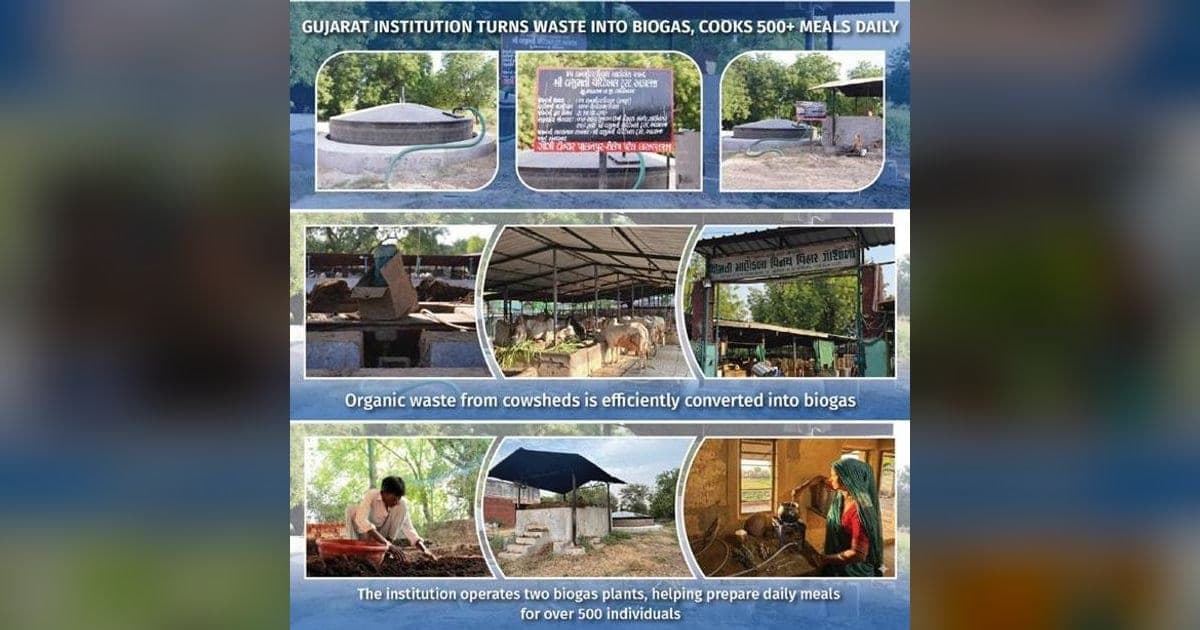
At the Shrimati Manekba Vinay Vihar Educational Complex near Adalaj in Gandhinagar, Gujarat, the kitchen feeds more than 500 people a day, including about 250 hostel students and 15 staff families. Two biogas plants of the Vasumati Charitable Trust, together 90 cubic metres a day, run on dung from 222 cows plus kitchen waste and farm residue, and meet the whole cooking requirement that would otherwise need 30 LPG cylinders a month. Gujarat's Institutional Biogas Plant Scheme and the Gujarat Energy Development Agency backed the switch.
Important Facts
| Programme | Waste-to-energy under Swachh Bharat Mission-Urban 2.0 |
|---|---|
| Mission launched | October 2014 |
| Prayagraj plant intake | 343 tonnes of organic waste a day |
| Prayagraj output | About 21 tonnes of bio-CNG and 28 tonnes of compost daily |
| Prayagraj reach | About 45,000 households; 57,000 tonnes of emissions cut a year |
| Gwalior plant | 100 tonnes-per-day CBG plant at Adarsh Gaushala, Laltipara |
| Gwalior cost and partner | 31 crore rupees, with Indian Oil Corporation, on 5 acres |
| Hyderabad site | Bowenpally Vegetable Market, about 10 tonnes of waste a day |
| Hyderabad output | 400 to 500 units of electricity and 30 kg of biofuel a day |
| Gandhinagar campus | Two biogas plants of 90 cubic metres, dung from 222 cows |
Exam Point of View
Remember that Swachh Bharat Mission began in October 2014; the Prayagraj bio-CNG plant handles 343 tonnes of waste for 21 tonnes of gas and 28 tonnes of compost; Gwalior's Adarsh Gaushala runs India's first gaushala-based CBG plant of 100 tonnes per day, built with Indian Oil Corporation for 31 crore rupees; and Bowenpally market in Hyderabad powers its streetlights from vegetable waste.
Practice Questions
How much organic waste can the multi-feedstock bio-CNG plant at Prayagraj process every day?
- A.143 tonnes
- B.243 tonnes
- C.343 tonnes
- D.443 tonnes
Show answer
Correct answer: C. 343 tonnes
Explanation
The correct answer is 343 tonnes. The plant in Uttar Pradesh takes in that quantity of organic waste each day and yields about twenty-one tonnes of bio-CNG, along with twenty-eight tonnes of good quality compost that goes to farmers nearby. Its multi-feedstock design accepts wet waste, paddy straw, cattle dung and poultry litter, which is what lets it give crop residue a paying use instead of leaving it to be burnt. Options A at 143 tonnes, B at 243 tonnes and D at 443 tonnes are near misses built by changing the leading digit, a trap that catches a candidate who remembers only the last two digits of the figure. Aspirants should also hold on to the linked numbers for this plant: daily wet-waste supply has risen from seven or eight tonnes to about 125 tonnes, piped gas is expected to reach roughly 45,000 households, and annual emissions are expected to fall by about 57,000 tonnes.
In which city is Adarsh Gaushala, described as India's first modern self-sufficient gaushala built around a compressed bio-gas plant?
- A.Bhopal
- B.Gwalior
- C.Indore
- D.Jabalpur
Show answer
Correct answer: B. Gwalior
Explanation
The correct answer is Gwalior, in Madhya Pradesh. Adarsh Gaushala stands at Laltipara and is the city's largest cowshed, home to more than ten thousand cattle. Its compressed bio-gas plant of 100 tonnes per day opened in October 2024, spread over five acres, cost 31 crore rupees and was developed with Indian Oil Corporation. It is also the state's first such plant designed to take vegetable and fruit waste from markets and homes along with dung, and it converts 100 tonnes of dung a day into two tonnes of gas and ten to fifteen tonnes of dry bio-manure. Option A, Bhopal, is the state capital but not the site. Option C, Indore, is widely known for cleanliness rankings, which is exactly why it tempts a guess here. Option D, Jabalpur, is another large city of the same state and has no link to this facility.
The Bowenpally Vegetable Market, whose streetlights run on electricity made from vegetable waste, is in which city?
- A.Bengaluru
- B.Chennai
- C.Hyderabad
- D.Pune
Show answer
Correct answer: C. Hyderabad
Explanation
The correct answer is Hyderabad. At the Bowenpally Vegetable Market roughly ten tonnes of vegetable and fruit waste is collected each day, and since an on-site biogas plant came up almost all of it is used rather than sent to landfill. The plant makes about 400 to 500 units of electricity and 30 kg of biofuel daily, which run the streetlights, stalls, administrative building and water supply network, while the biofuel goes to the market's kitchen and to a generator that works wholly on biogas. The power bill has come down by about half from roughly three lakh rupees a month, and five more plants have been funded at Gudimalkapur, Gaddiannaram, Erragadda, Alwal and Saroornagar. Options A, B and D are large cities in other states and none of them was named for this model, so they only test whether the candidate has tied the market's name to the right city.
In which month and year was the Swachh Bharat Mission launched?
- A.October 2014
- B.August 2014
- C.October 2015
- D.April 2016
Show answer
Correct answer: A. October 2014
Explanation
The correct answer is October 2014. Scientific management of municipal solid waste has been a core objective of the mission since that launch, and as the mission grew, organic waste came to be treated as a resource for clean energy rather than as rubbish. The waste-to-energy work described at Prayagraj, Gwalior, Hyderabad and Gandhinagar all falls under the urban arm of the mission in its second phase. Option B, August 2014, is close enough in the same year to catch a hasty reader, but it is the wrong month. Option C, October 2015, keeps the right month and moves the year by one, the commonest form of trap in date questions. Option D, April 2016, matches neither. A helpful anchor is that cleanliness is tied to the birth anniversary of Mahatma Gandhi, which falls on the second of October, so the month of the launch is easy to fix in memory.
Frequently Asked Questions
How much organic waste does the Prayagraj bio-CNG plant process in a day?
It processes 343 tonnes a day and produces about 21 tonnes of bio-CNG, plus 28 tonnes of compost for local farmers.
Which gaushala has India's first modern CBG plant of its kind?
Adarsh Gaushala at Laltipara in Gwalior, Madhya Pradesh. Its 100 tonnes-per-day compressed bio-gas plant opened in October 2024 and cost 31 crore rupees.
What does the Bowenpally market biogas plant in Hyderabad produce?
About 400 to 500 units of electricity and 30 kg of biofuel a day from roughly 10 tonnes of vegetable and fruit waste, halving the market's power bill.
Sources
- Power from Waste (opens in a new tab) — Press Information Bureau
Current Affairs 27 September 2026
Read the full edition →Related Current Affairs
- Environment
India's First Port-Based e-Methanol Plant Comes Up at Kandla
26 September 2026 · 2 min read
- Environment
NRAA Holds REWARD Meeting on Watershed Guidelines for PMKSY
23 September 2026 · 2 min read
- Environment
Swachh Sagar Surakshit Sagar 5.0: 15 Lakh Take Ocean Pledge
21 September 2026 · 2 min read
- Environment
NGT Conference on Future of Environment and Climate Concludes
20 September 2026 · 2 min read


Related GK
- State Symbols and Nicknames of Indian Cities and States
27 September 2026 · Static GK
- Gaganyaan and Human Spaceflight: Mission, Vehicle, Astronauts
27 September 2026 · Science & Technology
- Rajasthan GK: Geography, History, Culture and Economy
27 September 2026 · Indian States & UTs