
Space Sector Opening Curbed Brain Drain: Jitendra Singh
Dr Jitendra Singh said opening the space sector to private players has created jobs at home, with the space economy at about USD 9 billion now.
Why in News
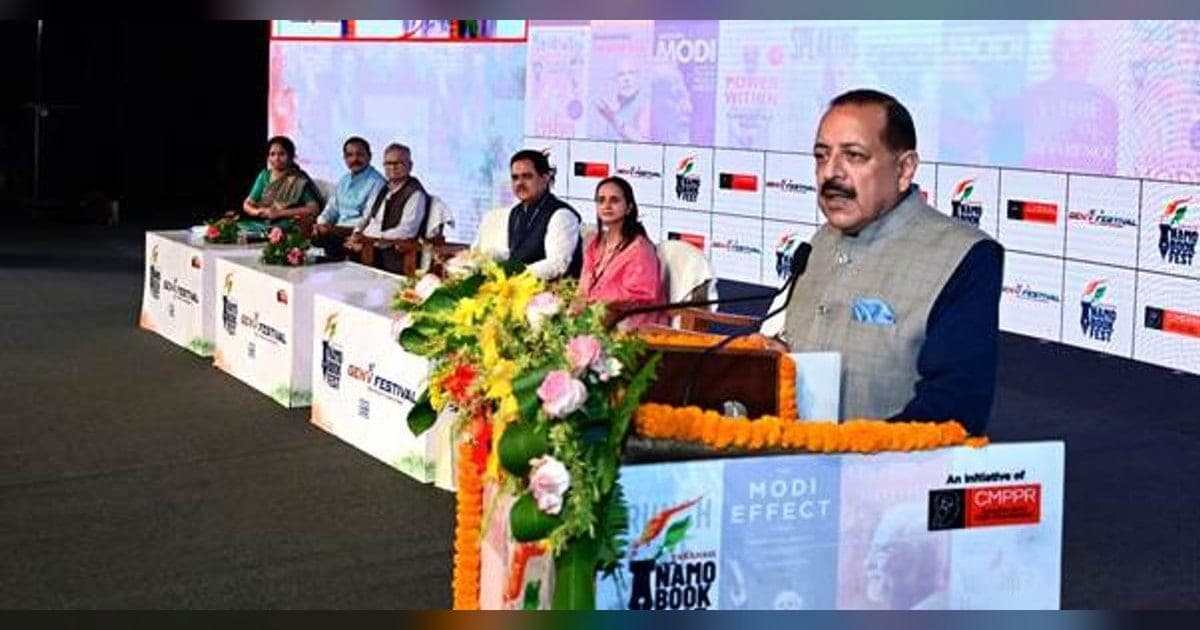
On 8 October 2026, speaking to students at the NaMo Book Fest in Varanasi, Dr Jitendra Singh said the opening of the space sector to private players has reduced brain drain and created openings for young talent, and put the space economy at about USD 9 billion.
Opening India's space sector to private companies has widened the choices available to young scientific and technical talent at home and cut the compulsion to look abroad for work, Union Minister of State (Independent Charge) for Science and Technology and Earth Sciences Dr Jitendra Singh said on 8 October 2026. He also holds charge as Minister of State in the Prime Minister's Office and for Personnel, Public Grievances and Pensions, Atomic Energy and Space.
Where he said it
The minister was speaking to students at the NaMo Book Fest at the Rudraksh International Cooperation and Convention Centre in Varanasi, a two-day festival on 7 and 8 October marking 25 years of Narendra Modi as Head of Government through books by various authors on his life, leadership and public service. A question-and-answer session and a panel discussion with students followed his address, with the Banaras Hindu University Vice-Chancellor among the panellists.
The space economy
Limited openings in the domestic space ecosystem once pushed young professionals overseas, the minister said; the opening up has let more of them stay and work in a growing sector, with private startups such as Skyroot creating roles for young engineers. He put India's space economy at about USD 9 billion today and said it could touch USD 45 to 46 billion in the next 8 to 10 years if the pace holds. Declaring that the age of silos is over, he argued that government bodies, private industry, startups, academia and research institutions have to build capability together to compete globally. Space, he added, is no longer only about rockets and launches: it is used in infrastructure planning, project monitoring and disaster management, and Indian satellites supply information to Nepal, Bangladesh, Myanmar and Sri Lanka to help them prepare for floods and other disasters.
The wider science push
The last 12 to 13 years, he said, have been an era of science in India, in which the talent that always existed finally met a policy environment capable of converting it into national strength. He listed the Deep Ocean Mission, the Quantum Mission, artificial intelligence, cyber security and the Anusandhan National Research Foundation among the efforts building capacity in new fields. On biotechnology he pointed to a policy framework built around biotechnology for economy, environment and employment, the world's first DNA vaccine against COVID-19 and the Genome India initiative as markers of indigenous capability and of preparation for precision medicine. Chandrayaan-3, he said, showed that India can run sophisticated missions at remarkably low cost.
Nuclear energy and research spending
The minister also spoke of the nuclear sector being opened to private participation and of India's target of 100 GW of nuclear capacity by 2047, with nuclear power treated as a clean source for future demand from artificial intelligence and data centres. The priority given to research, he said, shows up in gross expenditure on research and development, which has risen from about Rs 46,000 to 47,000 crore in 2013-14 to roughly Rs 2 to 2.5 lakh crore. Asked about artificial intelligence, he told students to use the technology while keeping their own judgement and curiosity intact, adding that one has to be intelligent enough to use artificial intelligence. India, he concluded, has moved from following the world to walking alongside it, and is ahead in several fields.
Important Facts
| Speaker | Dr Jitendra Singh, Minister of State (Independent Charge) for Science and Technology and Earth Sciences |
|---|---|
| Occasion | Address to students at the NaMo Book Fest |
| Venue | Rudraksh International Cooperation and Convention Centre, Varanasi |
| Festival dates | 7 and 8 October, marking 25 years of Narendra Modi as Head of Government |
| Space economy now | About USD 9 billion |
| Projected space economy | USD 45 to 46 billion in the next 8 to 10 years |
| Private space startup named | Skyroot |
| Nuclear energy target | 100 GW of capacity by 2047 |
| Research spending (GERD) | From about Rs 46,000 to 47,000 crore in 2013-14 to roughly Rs 2 to 2.5 lakh crore |
| Missions cited | Deep Ocean Mission, Quantum Mission, Anusandhan National Research Foundation, Genome India, Chandrayaan-3 |
| Neighbours aided by Indian satellites | Nepal, Bangladesh, Myanmar and Sri Lanka, for flood and disaster preparedness |
Exam Point of View
Remember the speaker and his portfolios (Dr Jitendra Singh, Minister of State with Independent Charge for Science and Technology and Earth Sciences), the venue (NaMo Book Fest, Rudraksh International Cooperation and Convention Centre, Varanasi, 7 and 8 October), the space economy figures (about USD 9 billion now, USD 45 to 46 billion in 8 to 10 years), the nuclear target of 100 GW by 2047, the rise in research spending from about Rs 46,000 to 47,000 crore in 2013-14, and the missions named: Deep Ocean Mission, Quantum Mission, Genome India and Chandrayaan-3.
Practice Questions
According to Dr Jitendra Singh, what is the present size of India's space economy?
- A.About USD 2 billion
- B.About USD 9 billion
- C.About USD 24 billion
- D.About USD 45 billion
Show answer
Explanation
The correct answer is about USD 9 billion. The minister described this as the current size of the space economy and said it could reach USD 45 to 46 billion over the next 8 to 10 years if the present momentum continues, crediting the expansion to the opening of the sector and the entry of a wider set of stakeholders. Option D is the trap: USD 45 billion is the projected figure for 8 to 10 years out, not the present one, and papers often ask candidates to tell the two apart. Options A and C are invented values placed between the real numbers. A useful companion point is that the opening of the sector has let young engineers find work at home in private startups such as Skyroot instead of going abroad, which is the brain-drain argument the minister was making to the students.
What is India's target for nuclear energy capacity, as mentioned by the minister?
- A.50 GW by 2040
- B.75 GW by 2035
- C.100 GW by 2047
- D.200 GW by 2050
Show answer
Explanation
The correct answer is 100 GW by 2047. The minister referred to this target together with the opening of the nuclear sector to private participation, and described nuclear power as an important clean-energy source for future requirements, among them the demand created by artificial intelligence and data centres. Options A, B and D pair plausible capacity figures with plausible years, which is exactly how such questions are built, so both halves of the answer must be remembered. The year 2047 matters because it marks a century of independence and is the horizon for several national targets, so a candidate who recalls the year can often reason to the right option. The capacity figure of 100 GW should be stored alongside the space economy numbers from the same address.
Which of these was NOT named by the minister as an initiative building capability in emerging scientific fields?
- A.Deep Ocean Mission
- B.Quantum Mission
- C.Anusandhan National Research Foundation
- D.National Supercomputing Mission
Show answer
Explanation
The correct answer is the National Supercomputing Mission, which the minister did not name in this address. The initiatives he cited as creating capability in emerging fields were the Deep Ocean Mission, the Quantum Mission, artificial intelligence, cyber security and the Anusandhan National Research Foundation, so options A, B and C all appear on that list. On the Deep Ocean Mission he said India is only beginning to explore the scientific and economic potential of its oceans, including resources that remain largely unexamined. In biotechnology he separately pointed to a framework built around biotechnology for economy, environment and employment, the world’s first DNA vaccine against COVID-19 and the Genome India initiative. Chandrayaan-3 was his example of running a sophisticated mission at remarkably low cost.
Frequently Asked Questions
What is the size of India's space economy, according to Dr Jitendra Singh?
About USD 9 billion at present, with the potential to reach USD 45 to 46 billion over the next 8 to 10 years if the current momentum continues, he said on 8 October 2026.
What is India's nuclear energy capacity target?
100 GW by 2047. The minister spoke of this alongside the opening of the nuclear sector to private participation, describing nuclear power as a clean source for future demand including from artificial intelligence and data centres.
How much has research spending risen?
Gross expenditure on research and development has gone up from about Rs 46,000 to 47,000 crore in 2013-14 to roughly Rs 2 to 2.5 lakh crore, the minister said.
Sources
- https://pib.gov.in/PressReleaseIframePage.aspx?PRID=2320904 (opens in a new tab) — Press Information Bureau
Current Affairs 8 October 2026
- GMPCS Licensing: Government Calls Satcom Rules Non-DiscriminatoryScience & Technology
- Women Form 43% of Ayush Services Workforce: RIS ReportReports & Indices
- India Seeks Balanced COP31 Outcome at Pre-COP in Nadi, FijiEnvironment
- National SC-ST Hub Procurement Rises Nearly 39-Fold in a DecadeGovernment Schemes
- Veteran Hindi and Marathi Actor Nana Patekar Passes AwayObituaries
- PM Modi Opens 10th India Mobile Congress at YashobhoomiScience & Technology
- Nadda Launches JOSH Teams for Youth-Led TB EliminationGovernment Schemes
- C.R. Paatil Chairs 20th Ganga Empowered Task Force MeetingEnvironment
Related Current Affairs
- Science & Technology
TRAI Drive Test Rates Mobile Networks in Fazilka, Punjab
8 October 2026 · 2 min read
- Science & Technology
PM Modi Opens 10th India Mobile Congress at Yashobhoomi
8 October 2026 · 2 min read
- Science & Technology
GMPCS Licensing: Government Calls Satcom Rules Non-Discriminatory
8 October 2026 · 2 min read
- Science & Technology
PM Modi Meets GSMA Board at Seva Teerth Before IMC 2026
7 October 2026 · 2 min read
- Science & Technology
IICT and YouTube Unveil First Four AI-Enabled Short Films
7 October 2026 · 2 min read
- Science & Technology
Metal-Free Catalyst TTT-DHTD Rivals Platinum in Zn-Air Cells
7 October 2026 · 2 min read
Related GK
- The UN and Its Specialised Agencies: Organs, Headquarters and PYQs
8 October 2026 · Static GK
- Indian Scientists and Their Contributions: Discoveries and Prizes
8 October 2026 · Science & Technology
- Nagaland, Tripura and Sikkim GK: Statehood, Articles and Landmarks
8 October 2026 · Indian States & UTs
Take the Quiz
- Current Affairs Quiz
Defence Current Affairs Quiz: 8 October 2026
10 questions10 minutesStart Quiz