
Sivok-Rangpo Rail Line: Excavation Done in All 14 Tunnels
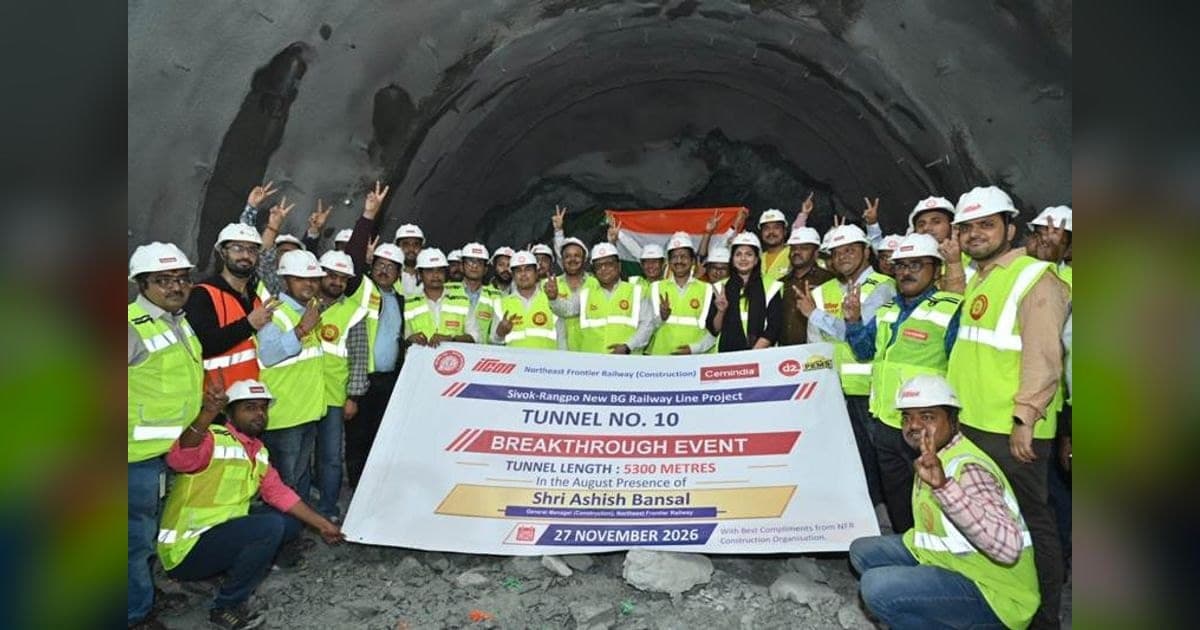
Indian Railways completed excavation of the 5.3-km Tunnel No. 10 on the Sivok-Rangpo new line, finishing work in all 14 tunnels on the route to Sikkim.
Why in News
On 27 November 2026 Indian Railways completed excavation of the 5.3-km Tunnel No. 10 on the Sivok-Rangpo new line, finishing the digging of all 14 tunnels and taking Sikkim a step closer to its first railway link.
Indian Railways finished excavating Tunnel No. 10, the longest tunnel on the Sivok-Rangpo new line railway project, on 27 November 2026. At 5.3 km, the tunnel is the longest of the 14 on the alignment, and with it the digging of all 14 tunnels is now complete, bringing Sikkim nearer to its first rail link.
How the tunnel was dug
Excavation of Tunnel No. 10 was driven from both portals and through two access tunnels. The two faces have now met, closing the excavation stage. What remains is tunnel lining, track laying and the fitting of the essential railway safety systems before trains can run.
The project at a glance
| Item | Detail |
|---|---|
| Project | Sivok-Rangpo broad gauge new line |
| Route length | 45 km |
| Tunnels | 14, excavation complete in all |
| Longest tunnel | Tunnel No. 10, 5.3 km |
| Share of route in tunnels | About 86 per cent |
| Bridges | 23 |
| Stations | Sivok, Riyang, Melli and Rangpo |
| Underground halt | Teesta Bazaar |
Where the line runs
The 45-km broad gauge alignment passes through the Darjeeling and Kalimpong districts of West Bengal and the Pakyong district of Sikkim. Because it crosses difficult Himalayan mountain country, tunnels account for roughly 86 per cent of its total length, an unusually high share for an Indian line. Besides the 14 tunnels there are 23 bridges. Trains will serve Sivok, Riyang, Melli and Rangpo, with an underground halt at Teesta Bazaar. At the Sivok end the new line meets the existing New Jalpaiguri-Alipurduar route, which is how Sikkim will be joined to the national railway network.
Why it matters
Once services begin, the Sivok-Rangpo line will give Sikkim direct railway connectivity for the first time. For residents and for tourists it offers a safer, quicker and more dependable option than National Highway 10, the road the state now depends on. Railways expects the link to ease the movement of essential goods, widen market access for local businesses and lift tourism in the state. Sikkim is at present the only state in the region without a railway station of its own, so the completion of tunnelling is read as the decisive engineering milestone on the project, with the civil and track works that follow being comparatively routine in such terrain.
Important Facts
| Project | Sivok-Rangpo broad gauge new line railway project |
|---|---|
| Milestone | Excavation completed in all 14 tunnels on 27 November 2026 |
| Longest tunnel | Tunnel No. 10, 5.3 km |
| Route length | 45 km |
| Tunnel share of route | About 86 per cent |
| Bridges | 23 |
| Stations | Sivok, Riyang, Melli, Rangpo |
| Underground halt | Teesta Bazaar |
| Districts covered | Darjeeling and Kalimpong (West Bengal), Pakyong (Sikkim) |
| Connects with | New Jalpaiguri-Alipurduar route at Sivok |
| Road alternative today | National Highway 10 |
Exam Point of View
Remember the project (Sivok-Rangpo new broad gauge line), its length (45 km), the number of tunnels (14) and bridges (23), the longest tunnel (No. 10, 5.3 km), the tunnel share of the route (about 86 per cent), the districts crossed (Darjeeling and Kalimpong in West Bengal, Pakyong in Sikkim), the four stations, the underground halt at Teesta Bazaar and the junction with the New Jalpaiguri-Alipurduar route at Sivok.
Practice Questions
How many tunnels are there on the Sivok-Rangpo new line railway project, in all of which excavation is now complete?
- A.10 tunnels
- B.14 tunnels
- C.23 tunnels
- D.45 tunnels
Show answer
The breakthrough in Tunnel No. 10, the longest on the alignment at 5.3 km, completed the excavation of all 14 tunnels on the project, which is why Railways described it as a major milestone for rail connectivity to Sikkim.
Read the full explanation →The Sivok-Rangpo railway line, once operational, will provide the first railway connectivity to which state?
- A.Arunachal Pradesh
- B.Mizoram
- C.Sikkim
- D.Nagaland
Show answer
The Sivok-Rangpo new line will give Sikkim direct railway connectivity, and the completion of excavation in all 14 tunnels was presented as a milestone towards that goal.
Read the full explanation →Roughly what share of the Sivok-Rangpo route length is made up of tunnels?
- A.About 45 per cent
- B.About 60 per cent
- C.About 86 per cent
- D.About 95 per cent
Show answer
The line traverses geographically challenging Himalayan mountain terrain, and its 14 tunnels account for roughly 86 per cent of the total route length, an unusually high proportion that explains why the completion of tunnelling is the decisive engineering step on this project.
Read the full explanation →Frequently Asked Questions
Which tunnel of the Sivok-Rangpo project was completed on 27 November 2026?
Excavation of Tunnel No. 10, the longest tunnel on the alignment at 5.3 km, was completed. It was dug from both ends and through two access tunnels, and with it excavation is finished in all 14 tunnels of the project.
How long is the Sivok-Rangpo railway line and where does it run?
It is a 45-km broad gauge new line running through the Darjeeling and Kalimpong districts of West Bengal and the Pakyong district of Sikkim. Tunnels account for about 86 per cent of the route and there are 23 bridges.
Why is the Sivok-Rangpo line important for Sikkim?
It will give Sikkim direct railway connectivity for the first time, joining the national network through the New Jalpaiguri-Alipurduar route at Sivok. It offers a safer and faster alternative to National Highway 10 and is expected to help the movement of essential goods and boost tourism.
Sources
- https://www.pib.gov.in/PressReleasePage.aspx?PRID=2343068 (opens in a new tab) — Press Information Bureau
Current Affairs 28 November 2026
- 'Aqui' Wins Golden Peacock for Best Film at 57th IFFI in GoaAwards & Honours
- Kashi Tamil Sangamam 5.0 Opens; Thirukkural in 50 LanguagesNational
- President Murmu Reviews INA Ezhimala Passing Out Parade 2026Defence
- NAVYA 2.0 Launched in Haridwar for 100 Districts, 24 StatesGovernment Schemes
- Dr Ambedkar Medical Aid Scheme Gives SC, ST Patients Rs 3.50 LakhGovernment Schemes
Related Current Affairs
- National
Jitendra Singh Opens Personnel Secretaries Conference at Lucknow
27 November 2026 · 2 min read

Related GK
- Famous Personalities of Rajasthan: Exam Notes
28 October 2026 · Rajasthan
- Districts and Divisions of Rajasthan: Exam Notes
28 October 2026 · Rajasthan
- Tourism and World Heritage Sites of Rajasthan Notes
27 October 2026 · Rajasthan
Take the Quiz
- Current Affairs Quiz
Railway Current Affairs Quiz: 28 November 2026
18 questions18 minutesStart Quiz