
CeNS Bengaluru Develops Stable Tunable White LED Technology
Researchers at CeNS Bengaluru and IIT Delhi have stopped colour blurring in perovskite nanocrystals, opening the way to stable, tunable and flexible white LEDs.
Why in News
On 27 November 2026 the Ministry of Science and Technology announced that CeNS Bengaluru and IIT Delhi had developed a dual-protection method that prevents colour blurring in halide perovskite nanocrystals, enabling stable and tunable white LEDs.
A team at the Centre for Nano and Soft Matter Sciences (CeNS), Bengaluru, an autonomous institute of the Department of Science and Technology, working with the Indian Institute of Technology (IIT) Delhi, has found a way to stop colour blurring in halide perovskite nanocrystals. The work, announced on 27 November 2026, points towards white lighting that is stable, flexible, cheap to make and adjustable in tone.
The problem with today's white LEDs
Commercial white light-emitting diodes in homes and smartphones are highly energy efficient, but they depend on costly rare-earth elements and on complicated high-temperature manufacturing. Once such a lamp is built, the tone of its white light is fixed and cannot be changed.
Why perovskites blur
Researchers have turned to all-inorganic halide perovskite nanocrystals, written as CsPbX₃, where X may be chlorine, bromine or iodine. They are bright, cheap and emit unusually pure colours. The trouble is anion exchange: when nanocrystals of different halide make-up, such as green-emitting CsPbBr₃ and red-emitting CsPbI₃, sit close together, their halide ions migrate and swap places. The two intended colours merge into an unwanted orange, and this blurring can set in within minutes.
The dual-protection strategy
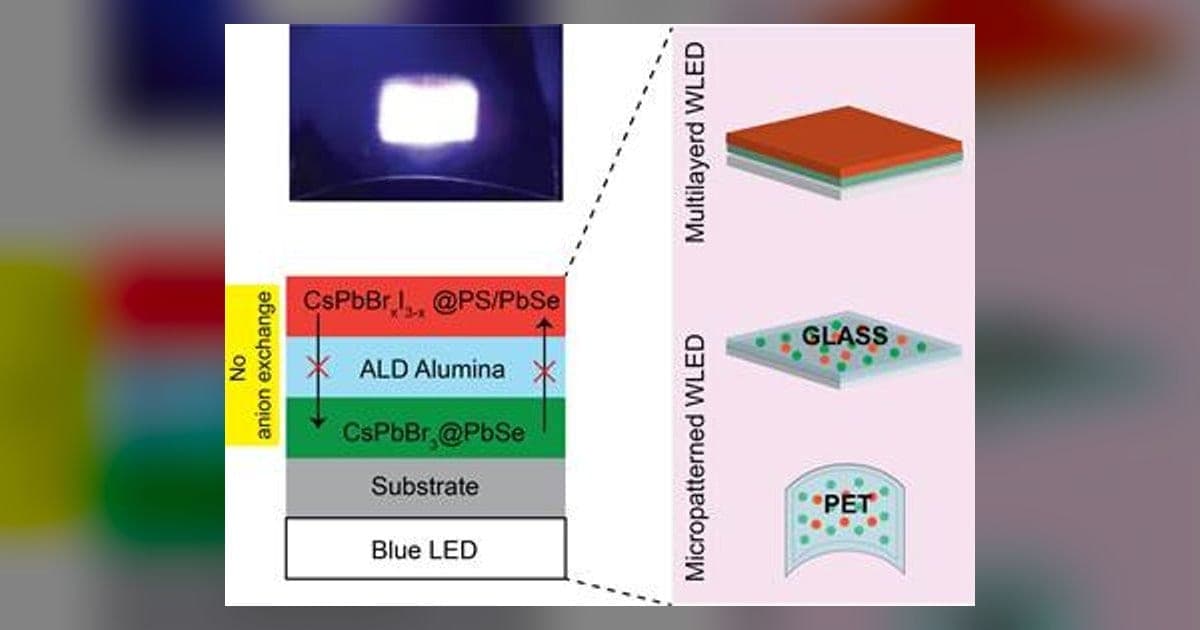
The team, made up of Gauri Sharma, Swati Khurana, Sameer Sapra and Pralay K. Santra, locked the colours in place in two steps. First, halide vacancies on the crystal surface were reduced using lead selenide, which closed the main route for ion movement without dimming the material or spoiling its colour. Second, atomic layer deposition was used to lay an ultrathin transparent coat of aluminium oxide, only about 5 to 6 nanometres thick, which acts as a physical wall against ions diffusing between the colour-emitting layers.
The devices built
Using simple spray coating together with micropatterning, the group made multi-layered white-LED devices on both rigid glass and flexible plastic substrates of PET. Optimised versions ran continuously for up to 24 hours, holding a stable white emission whose colour stayed close to ideal white even while being heated and cooled. The team also showed that the tone of the white light can be shifted to a dim or warm setting simply by changing the electrical current, which ordinary white LEDs cannot do.
What remains
The study has appeared in the journal Small. The approach still needs refinement before it reaches the market, chiefly to deal with the toxicity of lead and to find an environmentally safer route.
Important Facts
| Lead institute | Centre for Nano and Soft Matter Sciences (CeNS), Bengaluru |
|---|---|
| Parent department | Department of Science and Technology (CeNS is an autonomous institute) |
| Collaborating institute | Indian Institute of Technology (IIT) Delhi |
| Material | All-inorganic halide perovskite nanocrystals, CsPbX₃ (X = chlorine, bromine or iodine) |
| Problem solved | Anion exchange, which blurs green and red emission into an unwanted orange |
| First protection | Lead selenide, to reduce halide vacancies on the crystal surface |
| Second protection | Atomic layer deposition of aluminium oxide, about 5 to 6 nanometres thick |
| Fabrication method | Spray coating with micropatterning |
| Substrates used | Rigid glass and flexible PET plastic |
| Operating stability | Up to 24 hours of continuous stable white emission |
| Researchers | Gauri Sharma, Swati Khurana, Sameer Sapra and Pralay K. Santra |
| Journal | Small |
Exam Point of View
Note the institutes (CeNS Bengaluru under the Department of Science and Technology, with IIT Delhi), the material class (all-inorganic halide perovskite nanocrystals, CsPbX₃), the defect fixed (anion exchange causing colour blurring), the two protections (lead selenide for halide vacancies and atomic layer deposition of aluminium oxide 5 to 6 nanometres thick), the substrates (glass and flexible PET), the 24-hour run and the journal Small.
Practice Questions
Which institute, working with IIT Delhi, developed the dual-protection strategy for stable white LEDs?
- A.Centre for Nano and Soft Matter Sciences, Bengaluru
- B.Indian Institute of Science, Bengaluru
- C.National Institute of Technology, Tiruchirappalli
- D.Raman Research Institute, Bengaluru
Show answer
Its team, working with the Indian Institute of Technology Delhi, built a two-step shield that keeps halide perovskite nanocrystals from exchanging ions and blurring their colours.
Read the full explanation →Which defect in halide perovskite nanocrystals causes two intended colours to blend into an unwanted orange?
- A.Anion exchange
- B.Thermal quenching
- C.Auger recombination
- D.Photo-oxidation
Show answer
When nanocrystals of different halide composition, such as green-emitting caesium lead bromide and red-emitting caesium lead iodide, come into close contact, their halide ions migrate and swap places between crystals.
Read the full explanation →In the new technology, how is the tone of the white light changed from bright to a dim or warm setting?
- A.By replacing the phosphor layer
- B.By changing the electrical current
- C.By raising the operating temperature
- D.By adding a rare-earth coating
Show answer
One of the main claims of the study is that the tone of the emitted white light can be shifted to a dim or warm setting simply by altering the current through the device, which ordinary white light-emitting diodes cannot do, since their tone is fixed once the lamp is…
Read the full explanation →Frequently Asked Questions
Which institutes developed the new white LED technology?
The Centre for Nano and Soft Matter Sciences (CeNS), Bengaluru, an autonomous institute of the Department of Science and Technology, in collaboration with the Indian Institute of Technology (IIT) Delhi. The work was published in the journal Small.
What is anion exchange and why does it matter?
When perovskite nanocrystals of different halide composition sit close together, their halide ions migrate and swap between crystals. Green-emitting and red-emitting crystals then blend into an unwanted orange, so the intended colours blur, sometimes within minutes.
What is the dual-protection strategy?
First, lead selenide reduces halide vacancies on the crystal surface, removing the main pathway for ion migration. Second, atomic layer deposition lays a transparent aluminium oxide coat about 5 to 6 nanometres thick, which blocks ions from diffusing between the colour-emitting layers.
What advantage does the new white LED have over commercial ones?
Commercial white LEDs rely on costly rare-earth elements and high-temperature manufacturing, and their white tone is fixed. The new devices are made by spray coating on glass or flexible PET, ran stably for up to 24 hours, and their tone can be dimmed or warmed by changing the electrical current.
Sources
- https://www.pib.gov.in/PressReleasePage.aspx?PRID=2342511 (opens in a new tab) — Press Information Bureau
Current Affairs 27 November 2026
- Vindhyagiri Delivered to Navy, Project 17A Series CompletedDefence
- India to Host ITU Plenipotentiary Conference PP-30 in 2030International
- Tunnel-14 Breakthrough on Rishikesh-Karnaprayag Rail ProjectNational
- Power Ministers Conference Opens in New Delhi, 563 GW CapacityEconomy
- NBA Releases Rs 13.76 Crore in ABS Funds to 28 States, 4 UTsEnvironment
- Karnataka Brain Health Initiative Proposed as National ModelState News
- National Overseas Scholarship Funds 20 ST Students Every YearGovernment Schemes
- Dr Ambedkar Medical Aid Scheme Gives SC, ST Patients ₹3.50 LakhGovernment Schemes
Related Current Affairs
- Science & Technology
BHASHINI and Social Justice Department Sign MoU on Languages
26 November 2026 · 2 min read
- Science & Technology
Gamma-Ray Detectors at Polar Stations Catch Solar Event GLE 77
26 November 2026 · 2 min read
- Science & Technology
Chariot-1 Foundation Models Launched Under IndiaAI Mission
26 November 2026 · 2 min read
- Science & Technology
India's Bio-Economy to Hit 300 Billion Dollars by 2030
25 November 2026 · 2 min read
- Science & Technology
IASST Develops First North-East Specific Pit Viper Antivenom
25 November 2026 · 2 min read
- Science & Technology
Telecom Startups and MSME Conclave 2026 Held at Bharat Mandapam
24 November 2026 · 2 min read

Related GK
- Famous Personalities of Rajasthan: Exam Notes
28 October 2026 · Rajasthan
- Districts and Divisions of Rajasthan: Exam Notes
28 October 2026 · Rajasthan
- Tourism and World Heritage Sites of Rajasthan Notes
27 October 2026 · Rajasthan
Take the Quiz
- Current Affairs Quiz
Railway Current Affairs Quiz: 27 November 2026
25 questions25 minutesStart Quiz