
IASST Develops First North-East Specific Pit Viper Antivenom
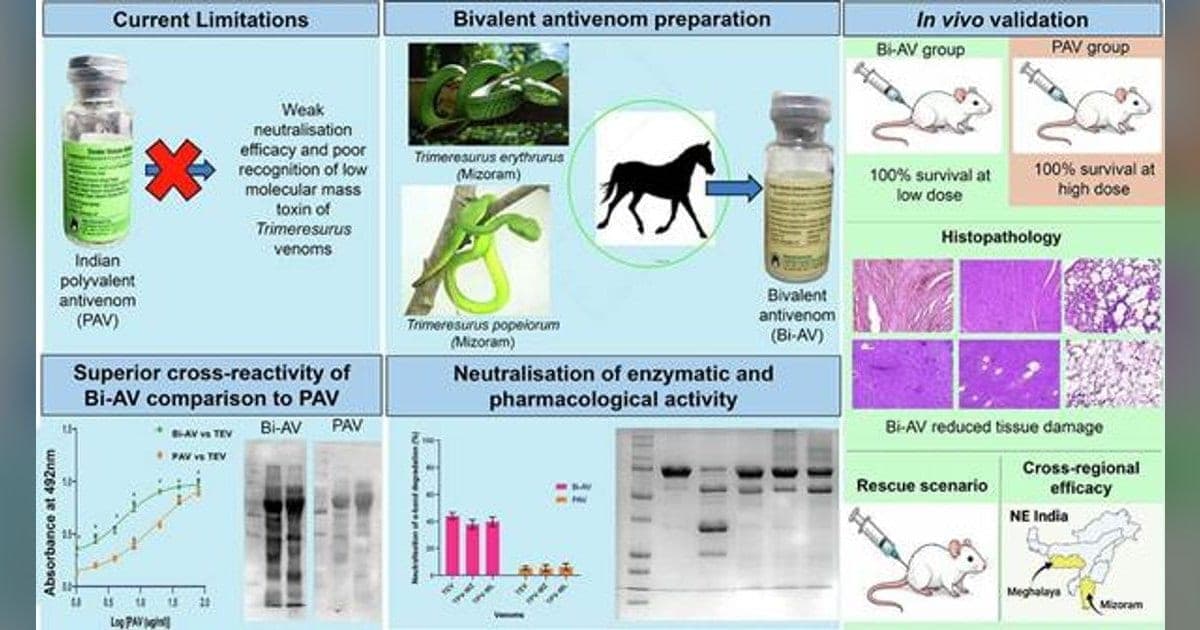
Scientists at IASST Guwahati have made a bivalent antivenom targeted at two pit viper species of North-East India, the first of its kind for the region.
Why in News
On 25 November 2026 the Department of Science and Technology announced that IASST Guwahati has developed the first North-East India-specific bivalent antivenom, effective against the venom of two pit viper species of the region.
A team at the Institute of Advanced Study in Science and Technology (IASST), Guwahati, an autonomous institute of the Department of Science and Technology, has developed the first antivenom made specifically for pit vipers of North-East India. The work was announced on 25 November 2026.
The gap it fills
Antivenom sold in India is built around the so-called Big Four snakes: Russell’s viper, the spectacled cobra, the common krait and the saw-scaled viper. The North East, however, has a far wider range of venomous snakes, and that polyvalent product works poorly against several of them. Bites by two pit vipers are a common emergency in the region, yet no antivenom was designed for them.
The two snakes
- Pope’s pit viper, scientific name Trimeresurus popeiorum
- Red-tailed bamboo pit viper, scientific name Trimeresurus erythrurus
Venom for the work was collected from specimens in Mizoram and Meghalaya.
What was made
The product is an equine bivalent antivenom of the F(ab)2 type, meaning it is raised in horses and uses antibody fragments rather than whole antibodies. Being bivalent, it is aimed at the venom of both species. In laboratory and preclinical tests it protected markedly better than the Indian polyvalent antivenom. Pit viper envenomation disrupts blood clotting and injures local tissue and organs, and the new preparation cut both effects substantially.
Who worked on it
The research was led by Professor Ashis K. Mukherjee, Director of IASST. Collaborators came from Premium Serums and Vaccines Private Limited in Pune, the Amrita Research Center in the Delhi-NCR region, Mizoram University and the Guwahati-based organisation Aaranyak, making it an example of academic and industry cooperation.
What comes next
Professor Mukherjee said further clinical and regulatory testing is needed before the antivenom can be used routinely on patients. The findings appeared in the International Journal of Biological Macromolecules.
The wider point
Snakebite is classed by the World Health Organization as a neglected tropical disease and a medical emergency. The study argues for region-specific antivenoms, since several medically important snakes in parts of India, the North East above all, fall outside the Big Four framework on which treatment has long rested.
Important Facts
| Development | First North-East India-specific bivalent antivenom against pit vipers |
|---|---|
| Institute | Institute of Advanced Study in Science and Technology (IASST), Guwahati |
| Parent department | Department of Science and Technology |
| Led by | Professor Ashis K. Mukherjee, Director, IASST |
| Target species | Trimeresurus popeiorum and Trimeresurus erythrurus |
| Venom sourced from | Mizoram and Meghalaya |
| Type | Equine F(ab)2 bivalent antivenom |
| Big Four snakes | Russell’s viper, spectacled cobra, common krait, saw-scaled viper |
| Published in | International Journal of Biological Macromolecules |
Exam Point of View
Remember the institute (IASST Guwahati, under the Department of Science and Technology), the scientist (Professor Ashis K. Mukherjee), the two species (Trimeresurus popeiorum and Trimeresurus erythrurus), the states where venom was collected (Mizoram and Meghalaya), the Big Four snakes, the WHO classification of snakebite, and the journal of publication.
Practice Questions
Which institute has developed India’s first North-East-specific antivenom against pit vipers?
- A.Indian Institute of Science, Bengaluru
- B.Institute of Advanced Study in Science and Technology, Guwahati
- C.National Institute of Virology, Pune
- D.Centre for Cellular and Molecular Biology, Hyderabad
Show answer
The team was led by its Director, Professor Ashis K. Mukherjee, and worked with a vaccine maker in Pune, the Amrita Research Center in the Delhi-NCR region, Mizoram University and the Guwahati organisation Aaranyak.
Read the full explanation →The new bivalent antivenom is effective against which two snake species?
- A.Russell’s viper and saw-scaled viper
- B.Spectacled cobra and common krait
- C.Trimeresurus popeiorum and Trimeresurus erythrurus
- D.King cobra and banded krait
Show answer
Bites by these two are a frequent medical emergency in the North Eastern states, yet no antivenom had been designed for them, and the new equine F(ab)2 preparation is bivalent precisely because it covers both.
Read the full explanation →How does the World Health Organization classify snakebite?
- A.As a neglected tropical disease and a medical emergency
- B.As a non-communicable disease
- C.As a public health emergency of international concern
- D.As a vector-borne disease
Show answer
The correct answer is that the World Health Organization regards snakebite as a neglected tropical disease and a medical emergency, a classification the study cites while arguing for antivenoms matched to the snakes of each region.
Read the full explanation →Frequently Asked Questions
Which institute developed the first North-East specific antivenom for pit vipers?
The Institute of Advanced Study in Science and Technology, Guwahati, an autonomous institute of the Department of Science and Technology. The research was led by its Director, Professor Ashis K. Mukherjee, with partners in Pune, the Delhi-NCR region, Mizoram University and Aaranyak.
Which snakes make up India’s Big Four?
Russell’s viper, the spectacled cobra, the common krait and the saw-scaled viper. Commercial polyvalent antivenom in India is made against these four, which is why its protection against several venomous snakes of the North East is limited.
Which pit vipers does the new antivenom work against?
Pope’s pit viper, Trimeresurus popeiorum, and the red-tailed bamboo pit viper, Trimeresurus erythrurus. Venom from these species was collected in Mizoram and Meghalaya, and the bivalent preparation performed better than Indian polyvalent antivenom in laboratory and preclinical tests.
Sources
- https://www.pib.gov.in/PressReleasePage.aspx?PRID=2341204 (opens in a new tab) — Press Information Bureau
Current Affairs 25 November 2026
- Kashi Tamil Sangamam 5.0 Set for 28 November to 12 DecemberSummits & Conferences
- National Milk Day: India's Milk Output at 247.87 Million TonnesImportant Days
- Service Producer Price Index Out for Q2 of FY 2026-27Economy
- Cabinet Clears Rs 11,000 Crore CIE Manufacturing SchemeGovernment Schemes
- CCEA Clears Rs 2,014 Crore Doloo Greenfield Airport in AssamNational
- CCEA Clears Second Container Terminal at Kamarajar PortEconomy
- Exercise Suryakiran XX Begins in Nepal with 334 Indian TroopsDefence
- Cabinet Extends Postal Operations Scheme, Rs 1,141 CroreGovernment Schemes
Related Current Affairs
- Science & Technology
Telecom Startups and MSME Conclave 2026 Held at Bharat Mandapam
24 November 2026 · 2 min read
- Science & Technology
India's Space Economy Set to Grow to USD 40-45 Billion
24 November 2026 · 2 min read
- Science & Technology
IASST Guwahati Builds MOF Material That Destroys Pyrene
23 November 2026 · 2 min read
- Science & Technology
IIA Bengaluru Team Finds Rare Stellar Fossil HE 1153-0518
23 November 2026 · 2 min read
- Science & Technology
India’s First Human Metabolic Chamber Opens at CMC Vellore
23 November 2026 · 2 min read
- Science & Technology
IIT Madras Gets Sleep Study Facility and Autism Lab
22 November 2026 · 2 min read


Related GK
- Famous Personalities of Rajasthan: Exam Notes
28 October 2026 · Rajasthan
- Districts and Divisions of Rajasthan: Exam Notes
28 October 2026 · Rajasthan
- Tourism and World Heritage Sites of Rajasthan Notes
27 October 2026 · Rajasthan
Take the Quiz
- Current Affairs Quiz
State Exams Current Affairs Quiz: 25 November 2026
25 questions25 minutesStart Quiz