
CSIR and SINTEF Hold India-Norway Waste to Resource Dialogue
CSIR, SINTEF and the Research Council of Norway held the India-Norway Dialogue on waste to resource solutions for cement and construction in New Delhi.
Why in News
On 10 November 2026 CSIR, SINTEF and the Research Council of Norway held the India-Norway Dialogue on Waste to Resource Solutions in the Cement and Construction Sector at the India Habitat Centre, New Delhi, to plan joint technologies that turn industrial waste into construction resources.
The Council of Scientific and Industrial Research (CSIR) joined Norway's SINTEF and the Research Council of Norway for the India-Norway Dialogue on Waste to Resource Solutions in the Cement and Construction Sector. The meeting was held on 10 November 2026 at the India Habitat Centre in New Delhi, and the Ministry of Science and Technology set out its outcome the next day.
Who took part
Scientists from CSIR laboratories sat with SINTEF researchers, officials from regulatory authorities and representatives of the cement and construction industries. Prof. S. K. Singh of CSIR-CBRI delivered the welcome address. The opening session was addressed by Dr. Rama Swami Bansal, Head of ISTAD at CSIR Headquarters, Dr. Arvinn Gadgil of the Royal Norwegian Embassy in New Delhi, Dr. Kare Helge Karstensen, Chief Scientist at SINTEF, and Prof. R. Pradeep Kumar, Director of CSIR-CBRI.
The Green Strategic Partnership behind it
India and Norway raised their relationship to a Green Strategic Partnership when Prime Minister Narendra Modi visited Norway in May, and circular economy, clean technology and research sit at the centre of it. Mr. Modi and Norway's Prime Minister Jonas Gahr Store set that course, and this dialogue carried it into one industry.
Turning industrial waste into building material
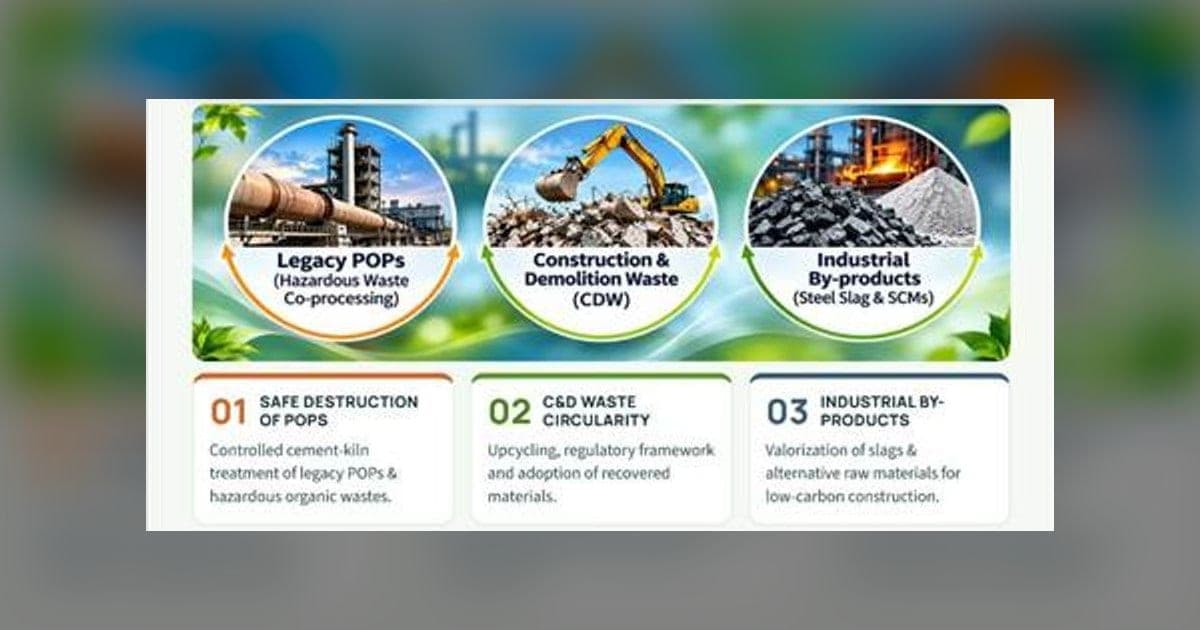
Prof. Pradeep Kumar spoke of the shift from a linear economy to a circular one and of the need to treat building and industrial waste as a resource. Delegates examined uses for construction and demolition (C&D) waste, steel slag, fly ash and red mud, along with the hurdles of processing technology, standardisation, economic viability and market acceptance. CSIR-CRRI and CSIR-AMPRI showed their work on fly ash, copper slag, red mud, plastic waste and steel grit in road building, geopolymer concrete and specialised aggregates.
Destroying hazardous waste in cement kilns
A technical session on the safe destruction of persistent organic pollutants (POPs) and hazardous waste was led by Dr. Karstensen with Dr. Ramesh Kumar, Chief Scientist at CSIR-NEERI. It weighed cement kiln co-processing, in which hazardous organic matter such as DDT and material contaminated with PCB is destroyed at controlled high temperature while waste-derived fuel replaces fossil fuel. CSIR-NEERI described India's National Implementation Plan under its Stockholm Convention commitments, the 2025 CDW Rules and the inventory of legacy POPs. Dr. Christian John Engelsen of SINTEF led a separate session on recycling C&D waste, covering recycled aggregate products, mobile recycling units and ways of removing impurities.
What the two sides agreed to pursue
The dialogue listed priorities for the years ahead: two to three joint India-Norway research proposals, pilot-scale demonstration projects for hazardous waste treatment, technical guidelines for disposing of DDT and PCB contaminated waste, better waste-derived construction materials and stronger industry-academia partnerships.
Important Facts
| Event | India-Norway Dialogue on Waste to Resource Solutions in the Cement and Construction Sector |
|---|---|
| Date | 10 November 2026 |
| Venue | India Habitat Centre, New Delhi |
| Organisers | CSIR (India) with SINTEF and the Research Council of Norway |
| Ministry | Ministry of Science and Technology |
| Bilateral framework | India-Norway Green Strategic Partnership, agreed during the Prime Minister's visit to Norway in May |
| Norway's Prime Minister | Jonas Gahr Store |
| CSIR laboratories involved | CSIR-CBRI, CSIR-NEERI, CSIR-CRRI and CSIR-AMPRI |
| Key technology discussed | Cement kiln co-processing to destroy POPs, DDT and PCB-contaminated waste |
| Wastes examined | C&D waste, steel slag, fly ash, red mud, copper slag, plastic waste and steel grit |
Exam Point of View
Remember the organisers (CSIR with SINTEF and the Research Council of Norway), the date and venue (10 November 2026, India Habitat Centre, New Delhi), the India-Norway Green Strategic Partnership, Norway's Prime Minister Jonas Gahr Store, the CSIR laboratories involved (CBRI, NEERI, CRRI, AMPRI) and cement kiln co-processing for POPs, DDT and PCB waste.
Practice Questions
Which organisations joined CSIR in holding the India-Norway Dialogue on Waste to Resource Solutions in the Cement and Construction Sector?
- A.SINTEF and the Research Council of Norway
- B.Innovation Norway and the Norwegian Polar Institute
- C.Equinor and the Norwegian Mapping Authority
- D.The Norwegian Water Resources Directorate alone
Show answer
The dialogue on waste to resource solutions for the cement and construction sector was put together by the Council of Scientific and Industrial Research of India along with SINTEF, a Norwegian research organisation, and the Research Council of Norway.
Read the full explanation →Under which bilateral framework, agreed during the Prime Minister's visit to Norway in May, was the waste to resource dialogue held?
- A.Blue Economy Compact
- B.Green Strategic Partnership
- C.Comprehensive Economic Partnership Agreement
- D.Clean Energy Mission Statement
Show answer
India and Norway lifted their relationship to a Green Strategic Partnership when the Indian Prime Minister travelled to Norway in May, and circular economy, clean technology and research were placed at its heart.
Read the full explanation →Which method was examined at the dialogue for the safe destruction of persistent organic pollutants such as DDT and PCB-contaminated material?
- A.Deep-well injection
- B.Open burning at landfill sites
- C.Cement kiln co-processing
- D.Ocean dumping in sealed drums
Show answer
The technical session on persistent organic pollutants and hazardous waste, led by SINTEF's Chief Scientist Dr. Kare Helge Karstensen with Dr. Ramesh Kumar of CSIR-NEERI, looked at the ability of cement kilns to destroy hazardous organic contaminants under controlled high-temperature conditions, while fuel derived from waste takes the place of…
Read the full explanation →Frequently Asked Questions
Who organised the India-Norway Dialogue on Waste to Resource Solutions?
CSIR of India, together with SINTEF and the Research Council of Norway. The dialogue was held on 10 November 2026 at the India Habitat Centre in New Delhi and was announced by the Ministry of Science and Technology.
What is the India-Norway Green Strategic Partnership?
It is the level to which the two countries raised their relationship during Prime Minister Narendra Modi's visit to Norway in May. Circular economy, clean technology and research lie at its heart, and the waste to resource dialogue was held in line with it.
Which technology was discussed for destroying DDT and PCB-contaminated waste?
Cement kiln co-processing. Hazardous organic pollutants are destroyed at controlled high temperature inside a cement kiln, while fuel made from waste replaces conventional fossil fuel. The session was led by SINTEF's Chief Scientist Dr. Kare Helge Karstensen with Dr. Ramesh Kumar of CSIR-NEERI.
Sources
- https://www.pib.gov.in/PressReleasePage.aspx?PRID=2334888 (opens in a new tab) — Press Information Bureau
Current Affairs 11 November 2026
- NCAHP Drafts Provisional Registration Rules for 2026National
- Nasha Mukt Bharat Abhiyaan Reaches 35.84 Crore in Six YearsGovernment Schemes
- INS Betwa Refit Contract Worth Rs 498.58 Crore Goes to CSLDefence
Related Current Affairs
- Science & Technology
BRIC Third Foundation Day: India-UK Biomanufacturing LoI
10 November 2026 · 2 min read
- Science & Technology
TRAI Caps IP Port Charges in Third Amendment Regulations 2026
9 November 2026 · 2 min read
- Science & Technology
I-STEM and Startup India Portals Linked Through API Integration
6 November 2026 · 2 min read
- Science & Technology
Semicon 2.0 Portal Opens; 12 More Units Cleared Under ECMS
6 November 2026 · 2 min read
- Science & Technology
Indian Astronomers Find Star Cluster UBC 63 Is Really Two
5 November 2026 · 2 min read
Related GK
- Famous Personalities of Rajasthan: Exam Notes
28 October 2026 · Rajasthan
- Districts and Divisions of Rajasthan: Exam Notes
28 October 2026 · Rajasthan
- Tourism and World Heritage Sites of Rajasthan Notes
27 October 2026 · Rajasthan
Take the Quiz
- Current Affairs Quiz
State Exams Current Affairs Quiz: 11 November 2026
14 questions14 minutesStart Quiz