
Indian Army Launches Bharat Rice for Troops, Signs FCI MoU
The Indian Army launched Bharat Rice for troops on 12 October 2026 and signed a five-year MoU with FCI to draw on its warehouses during operational contingencies.
Why in News
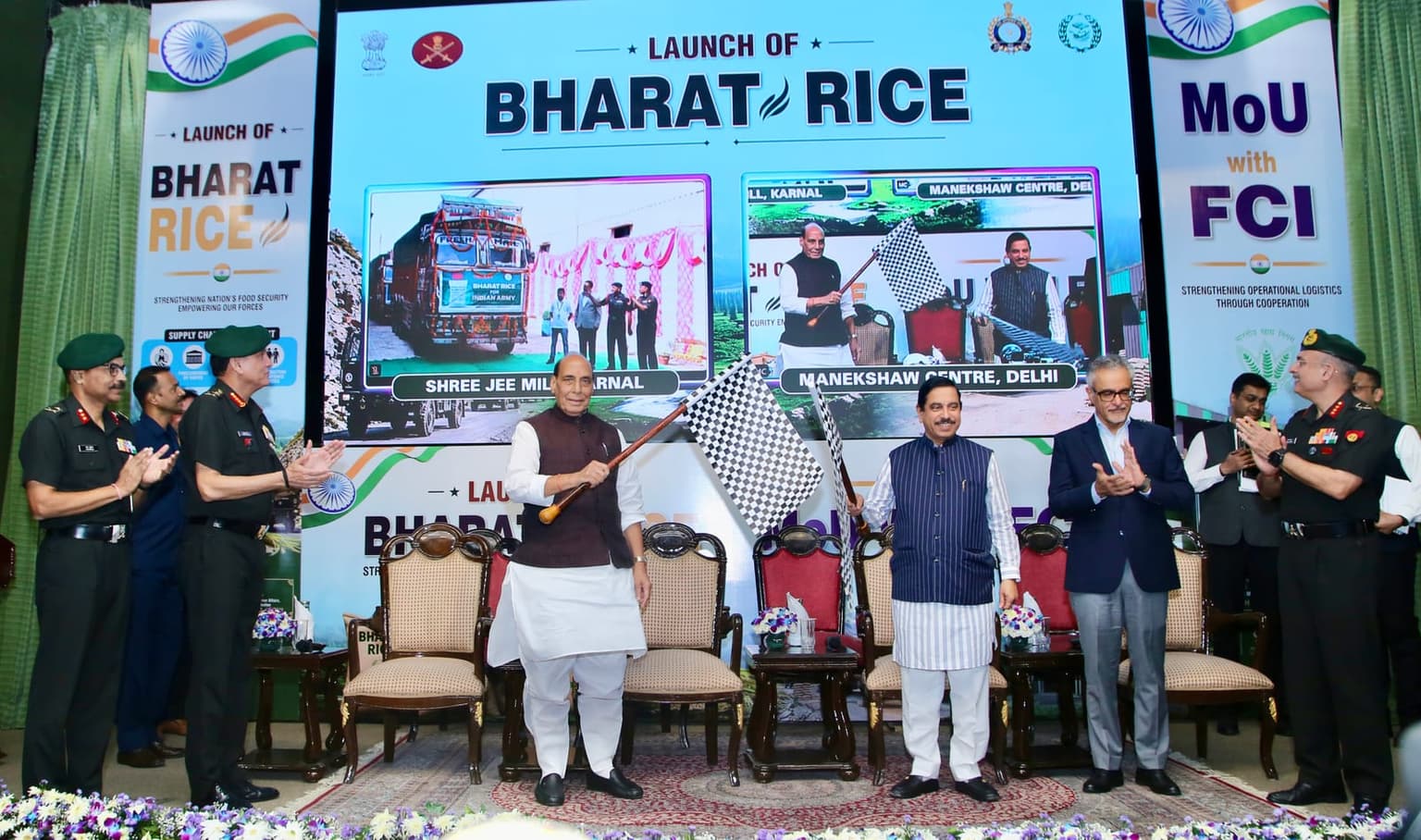
On 12 October 2026 the Indian Army launched Bharat Rice for troops in New Delhi and signed an MoU with the Food Corporation of India for the use of its warehousing, manpower and material-handling resources during operational contingencies.
The Indian Army launched Bharat Rice for the defence forces at a ceremony in New Delhi on 12 October 2026, attended by Defence Minister Rajnath Singh and Minister of Consumer Affairs, Food and Public Distribution Pralhad Joshi. At the same event the Army and the Food Corporation of India (FCI) signed a Memorandum of Understanding that lets the force use FCI's storage and handling network when operations demand it.
What changes for the soldier
Until now Army depots collected rice from nearby FCI facilities. Under the new arrangement the better-grade rice will be carried straight to Army Supply Depots, including those in remote parts of Ladakh and the North East. The grain will be milled to defence specifications, checked for quality, and kept free of foreign matter and admixture, with very few broken, damaged or discoloured grains. Packing in 10 kg and 30 kg bags is meant to make loading and carriage easier, which matters most at forward posts. The effort is led by the Directorate General of Supplies and Transport, grew out of steady feedback from troops, and the rice will be supplied through NAFED during the financial year 2026-27. Nearly 18 months of work among the Army, FCI, NAFED and the Department of Food and Public Distribution went into it.
The MoU with FCI
The agreement gives the Army a formal route to use identified FCI warehouses, labour and material-handling equipment during operational contingencies. Coordination will run at formation level between the Army's supply and transport elements and FCI's regional and divisional offices, and will be built into operational logistics plans. The MoU holds for five years and can be extended by mutual consent. It allows extra storage, quicker mobilisation, dispersal and forward placing of rations, stores and equipment nearer to operational areas.
Why logistics was the theme
Rajnath Singh said logistics is itself combat power, and that supply chains, storage capacity, transport networks and timely replenishment weigh as much as weapons and platforms. He pointed to the study of Operation Sindoor, which showed that warning times in future conflicts could be very short and that logistics chains would be tested over long periods. He called the MoU a dual-use step that aligns national capacity with security needs, comparing it to fighter aircraft landing on expressways and Border Roads Organisation roads used by local residents. Pralhad Joshi said supplying quality rice to those who guard the country is a matter of pride for his department. Chief of the Army Staff General Dhiraj Seth and Food Secretary Sanjeev Chopra were present. The Army has also added rations for Agniveer recruits, brought ration scales closer across the three Services, and proposes to introduce organic rations.
Important Facts
| Initiative | Bharat Rice, for the defence forces |
|---|---|
| Launched on | 12 October 2026, New Delhi |
| Launched in presence of | Rajnath Singh and Pralhad Joshi |
| MoU signed with | Food Corporation of India (FCI) |
| MoU validity | Five years, extendable by mutual consent |
| Lead agency | Directorate General of Supplies and Transport |
| Supplying agency | NAFED, during the financial year 2026-27 |
| Bag sizes | 10 kg and 30 kg |
| Lessons drawn from | Operation Sindoor |
| Army Chief present | General Dhiraj Seth |
Exam Point of View
Remember the name of the initiative (Bharat Rice), the partner for the MoU (FCI) and its five-year validity, the supplying agency (NAFED) and the year (financial year 2026-27), the lead body (Directorate General of Supplies and Transport), the bag sizes (10 kg and 30 kg), and the operation whose lessons shaped the MoU (Operation Sindoor).
Practice Questions
With which organisation did the Indian Army sign an MoU for the use of warehousing and material-handling resources during operational contingencies?
- A.NAFED
- B.Food Corporation of India
- C.Border Roads Organisation
- D.Central Warehousing Corporation
Show answer
Explanation
The correct answer is the Food Corporation of India. The MoU signed alongside the launch of Bharat Rice gives the Army a formal framework to use identified FCI warehouses, labour resources and material-handling equipment when operations require them, and it holds for five years with the option of extension by mutual consent. Option A, NAFED, does appear in the story, but its role is to supply the rice itself during the financial year 2026-27, not to lend warehousing. Option C, the Border Roads Organisation, was mentioned only as an example of dual use, since roads and bridges it builds are also used by local residents. Option D, the Central Warehousing Corporation, does not figure in the arrangement at all. The Defence Minister described the FCI agreement as a force multiplier for operational preparedness.
Which agency will supply Bharat Rice to the defence forces during the financial year 2026-27?
- A.Food Corporation of India
- B.NAFED
- C.Army Purchase Organisation
- D.State civil supplies corporations
Show answer
Explanation
The correct answer is NAFED, the National Agricultural Cooperative Marketing Federation of India Limited, which will supply the rice during the financial year 2026-27 after it is milled to prescribed defence specifications and cleared by quality-control checks. Option A, the Food Corporation of India, is the partner for the separate logistics MoU on warehousing and material handling, so it has a different role in the same announcement. Option C, an Army Purchase Organisation, is not named in the arrangement. Option D, state civil supplies corporations, also do not feature; in fact the change is that the rice moves directly to Army Supply Depots instead of depots drawing it from nearby facilities. The initiative is led by the Directorate General of Supplies and Transport and followed nearly 18 months of coordination.
In which bag sizes will Bharat Rice be procured to ease handling at forward posts?
- A.5 kg and 25 kg
- B.10 kg and 30 kg
- C.20 kg and 50 kg
- D.15 kg and 40 kg
Show answer
Explanation
The correct answer is 10 kg and 30 kg. Procurement in these two bag sizes is meant to make the grain easier to lift, load and carry, which matters most where rations have to be taken to remote and difficult terrain such as Ladakh and the North East. The other three pairs of weights are plausible packing sizes for food grain but none of them is part of this initiative. The point behind the choice is operational rather than commercial: the Defence Minister noted that ergonomic packaging, though it may look like a small change, offers real relief to the soldiers who move rations to forward posts. Along with the packing, the rice will be milled to defence specifications and kept free of foreign matter and admixture, with minimal broken, damaged or discoloured grains.
Frequently Asked Questions
What is Bharat Rice?
A better-grade rice for the defence forces, milled to defence specifications and delivered straight to Army Supply Depots, including in Ladakh and the North East. It was launched on 12 October 2026.
With which body did the Indian Army sign the MoU?
The Food Corporation of India. The MoU lets the Army use identified FCI warehouses, labour and material-handling equipment during operational contingencies, and runs for five years.
Who will supply Bharat Rice and in what packing?
NAFED will supply it during the financial year 2026-27, in 10 kg and 30 kg bags to ease handling at forward posts.
Which operation's lessons shaped the FCI agreement?
Operation Sindoor, whose study pointed to very short warning times and the need for resilient logistics arrangements over prolonged periods.
Sources
- https://www.pib.gov.in/PressReleasePage.aspx?PRID=2322149 (opens in a new tab) — Press Information Bureau
Current Affairs 12 October 2026
- Coal Stocks at Power Plants Stay Above 18 MT in October 2026Economy
- TDB Backs Peptris VIGOR Programme With Rs 86 Crore RDI SupportScience & Technology
- MY Bharat Holds Youth Parliaments at 1,469 Locations in 34 StatesGovernment Schemes
- IGNFA Begins IFS Mid-Career Training for 68 OfficersEnvironment
- Asian Games 2026: Services Athletes Win Record 27 MedalsSports
- PM GatiShakti at Five: 58 Ministries, 23,493 Data LayersGovernment Schemes
- PM-SETU: Rs 440 Crore Cleared for Nine Government ITIsGovernment Schemes
- Exercise Tarang Shakti 2026: CAPSS-IAF Seminar on Air PowerDefence
Related Current Affairs
- Defence
INS Trishul Reaches Plymouth for Exercise KONKAN-26 with Royal Navy
11 October 2026 · 2 min read
Related GK
- Uttar Pradesh Location and Physical Divisions for Exams
12 October 2026 · Uttar Pradesh
- Rajasthan Location and Physical Divisions: Extent, Aravalli, Thar
12 October 2026 · Rajasthan
- Madhya Pradesh Location and Physical Divisions for Exams
12 October 2026 · Madhya Pradesh
Take the Quiz
- Current Affairs Quiz
Defence Current Affairs Quiz: 12 October 2026
12 questions12 minutesStart Quiz