
Raigarh Steel Slag Road Sets Guinness World Record in India
A 1.85-km road built with processed steel slag at Raigarh in Chhattisgarh won a Guinness World Record, cutting construction cost by about 40 per cent.
Why in News
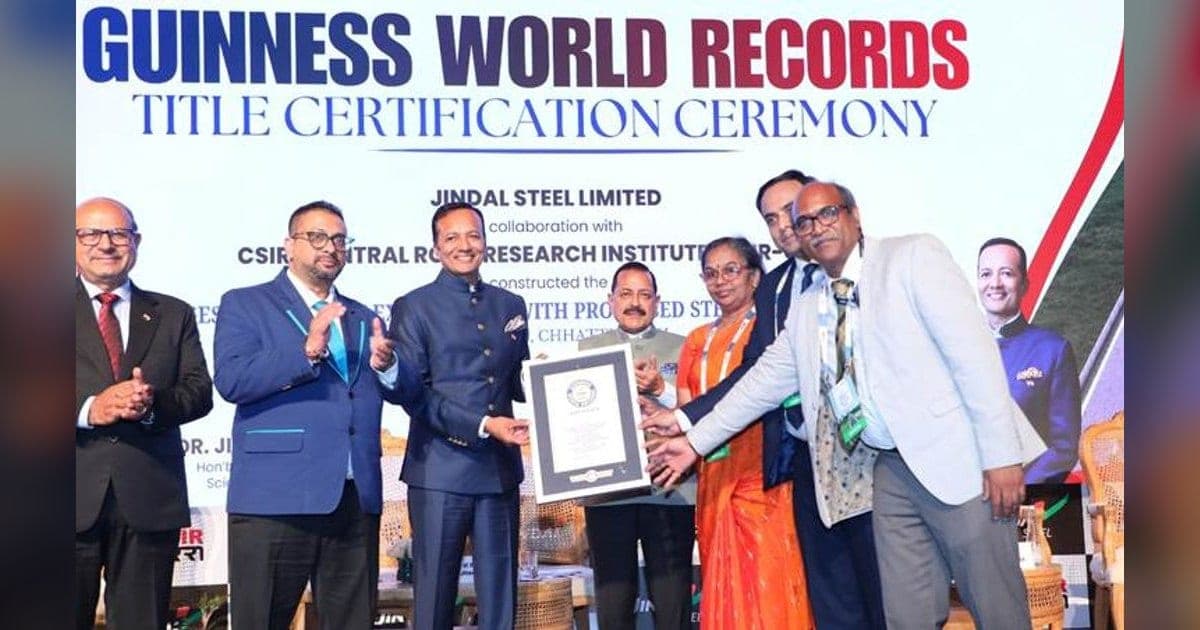
On 12 September 2026 the Guinness World Record for the world's longest road built with processed steel slag aggregates was conferred for a 1.85-km road at Raigarh in Chhattisgarh, built by CSIR-CRRI with Jindal Steel Limited.
India has set a Guinness World Record for the world's longest road built with processed steel slag aggregates. The road runs 1.85 km at Raigarh in Chhattisgarh. It was built jointly by the CSIR-Central Road Research Institute of New Delhi and Jindal Steel Limited. The record was conferred at an event on 12 September 2026. Union Minister of State (Independent Charge) for Science and Technology and Earth Sciences, Dr Jitendra Singh, spoke at the ceremony.
What steel slag road technology does
Steel slag is a by-product left behind when steel is made. The technology processes that waste into aggregates fit for road building. Dr Jitendra Singh said the method can cut the cost of building a road by about 40 per cent. He said such a road carries four times the strength of a conventional road. He said major maintenance may be needed only after about 15 years in suitable applications. He linked the work to the Prime Minister's call to turn waste into wealth.
Key figures
| Record | World's Longest Road Built with Processed Steel Slag Aggregates |
| Length and place | 1.85 km at Raigarh, Chhattisgarh |
| Built by | CSIR-CRRI, New Delhi, with Jindal Steel Limited |
| Cost saving | About 40 per cent |
| Strength | Four times that of a conventional road |
| Maintenance cycle | Major maintenance only after about 15 years |
| Next project | A 40-km road in Odisha, from Jindal Steel's Angul plant |
Where the technology has already travelled
The first big demonstration was at Hazira in Gujarat, on a six-lane road to Hazira Port. The technology then reached the NH-66 Mumbai-Goa Highway, where about 80,000 tonnes of steel slag were turned into processed aggregates for a one-kilometre, four-lane stretch. It was used for heavy-duty roads in Arunachal Pradesh, including a strategic border area. A 1.1-km slag road was also laid inside Hazira Port.
What was announced at the event
The programme saw the virtual inauguration of the record road. A scientific documentary was released. A Technology Transfer Agreement was signed between CSIR-CRRI and Jindal Steel. The Steel Grit brand was launched. Dr N. Kalaiselvi, Secretary of DSIR and Director General of CSIR, said the achievement comes as CSIR prepares to enter its 85th year. She announced that CSIR-CRRI has received a work order for a 40-km road in Odisha from Jindal Steel's Angul plant. Naveen Jindal, Member of Parliament and Chairman of Jindal Steel, was among those present.
Important Facts
| Record | Guinness World Record for the World's Longest Road Built with Processed Steel Slag Aggregates |
|---|---|
| Length and location | 1.85 km, Raigarh, Chhattisgarh |
| Partners | CSIR-Central Road Research Institute, New Delhi, and Jindal Steel Limited |
| Minister at the event | Dr Jitendra Singh, MoS (Independent Charge) for Science and Technology and Earth Sciences |
| Cost saving | About 40 per cent lower construction cost |
| Strength | Four times that of a conventional road |
| Maintenance | Major maintenance only after about 15 years |
| Brand launched | Steel Grit |
| Next project | A 40-km road in Odisha from Jindal Steel's Angul plant |
| Earlier application | About 80,000 tonnes of slag used on an NH-66 Mumbai-Goa Highway stretch |
| CSIR milestone | The organisation is entering its 85th year, said DG Dr N. Kalaiselvi |
Exam Point of View
Remember the record and its exact wording, the length (1.85 km) and place (Raigarh, Chhattisgarh), the two partners (CSIR-CRRI and Jindal Steel), the three performance claims of 40 per cent lower cost, four times strength and 15-year maintenance cycle, the 'Steel Grit' brand, and the next project of 40 km in Odisha from the Angul plant.
Practice Questions
The Guinness World Record for the world's longest road built with processed steel slag aggregates was set at which place?
- A.Angul, Odisha
- B.Raigarh, Chhattisgarh
- C.Hazira, Gujarat
- D.Bhilai, Chhattisgarh
Show answer
Correct answer: B. Raigarh, Chhattisgarh
Explanation
The correct answer is Raigarh, Chhattisgarh. The record road runs 1.85 km and was pursued jointly by the CSIR-Central Road Research Institute of New Delhi and Jindal Steel Limited, with the record conferred at an event addressed by Dr Jitendra Singh. Option A, Angul in Odisha, is a genuine part of the story but belongs to the next stage: CSIR-CRRI has received a work order for a 40-km road in Odisha from the Jindal Steel plant there, which is meant to take the technology well beyond the present record. Option C, Hazira in Gujarat, is where the technology was first demonstrated on a six-lane road to the port, and a 1.1-km slag road was later laid inside Hazira Port itself, but neither is the record stretch. Option D, Bhilai, is a well-known steel town used here only as a distractor. Keep the record with Raigarh and the future project with Angul.
According to Dr Jitendra Singh, steel slag road technology can reduce road construction cost by roughly how much?
- A.10 per cent
- B.25 per cent
- C.40 per cent
- D.60 per cent
Show answer
Correct answer: C. 40 per cent
Explanation
The correct answer is 40 per cent. The Minister said the technology can cut construction cost by around this share while delivering four times the strength of a conventional road, and can stretch the maintenance cycle so that major maintenance is needed only after about fifteen years in suitable applications. He described the result as a breakthrough not only for road engineering but for the wider infrastructure economy, since it saves money and conserves natural aggregates obtained through mining and quarrying at the same time. The other options are simply higher or lower shares offered to test whether the candidate has the exact figure. The three claims travel together in question papers, so it is worth memorising them as a set: about forty per cent cheaper, four times stronger, and maintenance pushed to about fifteen years.
Which two institutions jointly pursued the record road and signed a Technology Transfer Agreement at the event?
- A.CSIR-CRRI and Jindal Steel Limited
- B.IIT Roorkee and Steel Authority of India Limited
- C.CSIR-NML and Tata Steel
- D.NHAI and Rashtriya Ispat Nigam Limited
Show answer
Correct answer: A. CSIR-CRRI and Jindal Steel Limited
Explanation
The correct answer is CSIR-CRRI and Jindal Steel Limited. The CSIR-Central Road Research Institute in New Delhi supplied the scientific guidelines, processing protocols and quality-control framework, while the steel company supplied the processed slag and the site. At the same programme the road was inaugurated virtually, a scientific documentary was released, the Steel Grit brand was launched and the Technology Transfer Agreement between the two was signed. Dr N. Kalaiselvi, Secretary of DSIR and Director General of CSIR, said the achievement comes as the organisation enters its eighty-fifth year, and announced the work order for a 40-km road in Odisha from the company's Angul plant. Options B, C and D pair real research bodies and steel producers that were not the partners in this record, and are included precisely because each combination sounds plausible to a candidate who recalls only that a laboratory and a steel firm were involved.
Frequently Asked Questions
Where is the record-setting steel slag road located?
At Raigarh in Chhattisgarh. The 1.85-km stretch is the world's longest road built with processed steel slag aggregates.
How much can steel slag road technology save on construction cost?
About 40 per cent, said Dr Jitendra Singh, while also giving four times the strength of a conventional road and pushing major maintenance to about 15 years.
Which institutions built the record road?
CSIR-Central Road Research Institute, New Delhi, together with Jindal Steel Limited. The two also signed a Technology Transfer Agreement at the event.
Sources
Current Affairs 12 September 2026
- Two Commemorative Stamps Mark Two Decades of BRICS CooperationNational
- Colombo Security Conclave Table Top Exercise Ends at VisakhapatnamDefence
- Nadda Opens 10 Critical Care Blocks, 12 Labs in Andhra PradeshGovernment Schemes
- First Badri Calf Born Through OPU-IVF in UttarakhandScience & Technology
- Swachh Sagar Surakshit Sagar 5.0 Begins at Digha BeachEnvironment
- National Conference on Construction Workers Concludes in MumbaiNational
Related Current Affairs
- Science & Technology
First Badri Calf Born Through OPU-IVF in Uttarakhand
23 September 2026 · 2 min read
- Science & Technology
BRICS Bharat Innovates Expo Opens at Bharat Mandapam
23 September 2026 · 2 min read
- Science & Technology
RDI Fund of ₹1 Lakh Crore Needs Wider Awareness: Minister
23 September 2026 · 2 min read
- Science & Technology
TDB Clears Rs 285 Crore for Ubifly's Indigenous ePlane e200X
23 September 2026 · 2 min read
- Science & Technology
WAVES OTT and MyWAVES Turn Viewers Into Content Creators
23 September 2026 · 2 min read
- Science & Technology
KAVACH 4.0 Goes Live First Time on South Central Railway
23 September 2026 · 2 min read


Related GK
- Fundamental Rights (Articles 12–35): Notes, Writs and PYQs
23 September 2026 · Indian Polity
- Preamble of the Indian Constitution: Notes, Keywords and PYQs
22 September 2026 · Indian Polity
- Making of the Indian Constitution: Notes, Key Dates and PYQs
21 September 2026 · Indian Polity
Take the Quiz
- Current Affairs Quiz
State Exams Current Affairs Quiz: 12 September 2026
19 questions19 minutesStart Quiz