
NITI Aayog and TEXMiN Sign Critical Minerals Pact
NITI Aayog and TEXMiN at IIT (ISM) Dhanbad signed a Joint Statement of Intent to build indigenous technology and value chains in critical and strategic minerals.
Why in News
NITI Aayog and TEXMiN at IIT (ISM) Dhanbad signed a Joint Statement of Intent to strengthen India's critical minerals ecosystem, announced on 3 November 2026, with cooperation in research, studies, policy support and capacity building.
NITI Aayog and TEXMiN, the Technology Translation Research Park at IIT (ISM) Dhanbad, have signed a Joint Statement of Intent to work together in the critical and strategic minerals sector. TEXMiN is an initiative of the Department of Science and Technology. The collaboration is meant to advance indigenous technological capability, promote research and innovation, and support resilient and sustainable value chains for critical minerals in the country. It is aligned with the objectives of the National Critical Mineral Mission (NCMM) and with the goal of an Aatmanirbhar and Viksit Bharat.
Four areas of cooperation
- Collaborative research and technology development
- Technical and strategic studies
- Policy and institutional support
- Capacity building and knowledge exchange
Taken together, these are expected to strengthen home-grown capability, help carry research through to working technology, and build firmer links between government, academia, research institutions and industry.
Signed at a Dhanbad symposium
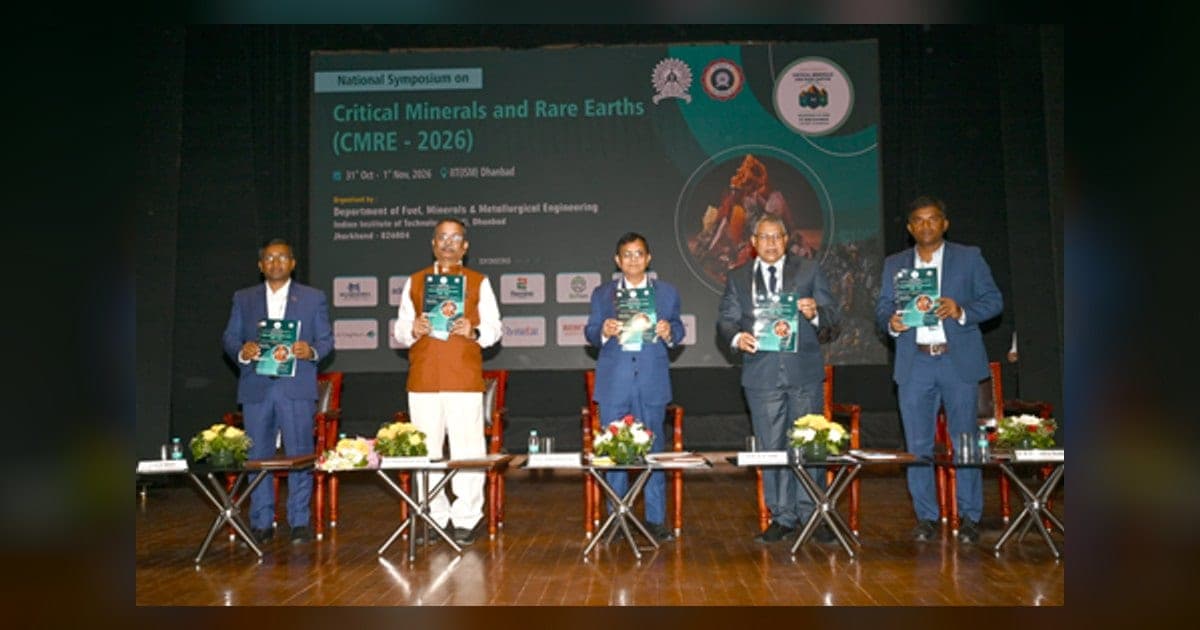
The document was signed during a visit by Prof. Gobardhan Das, Member of NITI Aayog, to IIT (ISM) Dhanbad. There he inaugurated the National Symposium on Critical Minerals and Rare Earths (CMRE 2026) on 31 October 2026, held as part of the 45th Annual National Conference of the Indian Council of Chemists. The symposium drew policymakers, researchers, technology developers and industry representatives to discuss how the country's critical minerals and rare earths ecosystem can be strengthened.
Beyond a mine-centric approach
Speaking at the symposium, Prof. Das described critical minerals as strategic enablers of national security, technological self-reliance and the vision of Viksit Bharat 2047. Drawing on the country's long metallurgical tradition, he argued for building indigenous capability through research, innovation and work with industry. His central point was that the sector must move beyond a mine-centric approach to an integrated value chain that covers exploration, processing, refining, advanced materials and recycling.
He also pointed to the scope for recovering critical minerals from secondary resources, naming coal fly ash, red mud, mine tailings and electronic waste as sources that are presently treated as discards. Translating laboratory research into commercially viable technology, and using resources sustainably, were held up as the tests of success. The initiative is expected to help the country build resilient supply chains for critical minerals and move further towards technological self-reliance.
Important Facts
| Agreement | Joint Statement of Intent on the critical and strategic minerals sector |
|---|---|
| Signatories | NITI Aayog and TEXMiN (Technology Translation Research Park), IIT (ISM) Dhanbad |
| TEXMiN's parent | An initiative of the Department of Science and Technology |
| Aligned with | National Critical Mineral Mission (NCMM) and the Aatmanirbhar and Viksit Bharat vision |
| Signed during | Visit of Prof. Gobardhan Das, Member, NITI Aayog, to IIT (ISM) Dhanbad |
| Symposium | National Symposium on Critical Minerals and Rare Earths (CMRE 2026), inaugurated 31 October 2026 |
| Host conference | 45th Annual National Conference of the Indian Council of Chemists |
| Four areas | Collaborative research and technology development; technical and strategic studies; policy and institutional support; capacity building and knowledge exchange |
| Secondary sources named | Coal fly ash, red mud, mine tailings and electronic waste |
Exam Point of View
Remember that TEXMiN stands for the Technology Translation Research Park at IIT (ISM) Dhanbad and is a Department of Science and Technology initiative, that the agreement with NITI Aayog is a Joint Statement of Intent on critical and strategic minerals aligned with the National Critical Mineral Mission, that NITI Aayog Member Prof. Gobardhan Das signed it, and that CMRE 2026 was inaugurated on 31 October 2026 within the 45th Annual National Conference of the Indian Council of Chemists.
Practice Questions
TEXMiN, which signed a Joint Statement of Intent with NITI Aayog on critical minerals, is located at which institute?
- A.IIT Kharagpur
- B.IIT (ISM) Dhanbad
- C.IIT Bombay
- D.IIT Madras
Show answer
TEXMiN is the Technology Translation Research Park at that institute and is an initiative of the Department of Science and Technology; the Joint Statement of Intent with NITI Aayog was signed during a visit by a Member of NITI Aayog to the campus.
Read the full explanation →The NITI Aayog-TEXMiN Joint Statement of Intent is aligned with the objectives of which mission?
- A.National Green Hydrogen Mission
- B.National Critical Mineral Mission
- C.National Quantum Mission
- D.Deep Ocean Mission
Show answer
The collaboration is stated to align with that mission's objectives and with the vision of an Aatmanirbhar and Viksit Bharat, as it seeks to advance indigenous technological capability and build resilient and sustainable value chains for critical minerals.
Read the full explanation →Which of the following was named as a secondary resource for recovering critical minerals?
- A.Coal fly ash
- B.River sand
- C.Limestone dust
- D.Sea salt
Show answer
Addressing the symposium on critical minerals and rare earths, the NITI Aayog Member highlighted the scope for recovering critical minerals from secondary resources, naming coal fly ash, red mud, mine tailings and electronic waste.
Read the full explanation →Frequently Asked Questions
What is TEXMiN?
The Technology Translation Research Park at IIT (ISM) Dhanbad, an initiative of the Department of Science and Technology. It has signed a Joint Statement of Intent with NITI Aayog on the critical and strategic minerals sector.
What does the NITI Aayog-TEXMiN pact cover?
Four areas: collaborative research and technology development, technical and strategic studies, policy and institutional support, and capacity building and knowledge exchange, aligned with the National Critical Mineral Mission.
From which secondary resources can critical minerals be recovered?
Prof. Gobardhan Das named coal fly ash, red mud, mine tailings and electronic waste, and stressed moving beyond a mine-centric approach to a value chain covering exploration, processing, refining, advanced materials and recycling.
Sources
- https://www.pib.gov.in/PressReleasePage.aspx?PRID=2332152 (opens in a new tab) — Press Information Bureau
Current Affairs 3 November 2026
- Indian Navy Frees Hijacked Fishing Vessel Azini Off SomaliaDefence
- Health Ministry Proposes New Import Gateways for DrugsNational
- PM Modi Opens Pune Metro Hinjawadi-Shivajinagar LineNational
- TRAI Issues Telecom Interconnection Third Amendment Rules 2026National
- Exercise Tiger Triumph 2026 Opens at VisakhapatnamDefence
- Rajnath Singh Chairs Defence Modernisation Meet in JaisalmerDefence
- India Sets USD 1 Trillion Export Target for Current YearEconomy
- Aditya-L1 VELC Finds Solar Eruption Expands AsymmetricallyScience & Technology
Related Current Affairs
- Reports & Indices
NITI Aayog Launches India S&T Scoreboard for States and UTs
3 November 2026 · 2 min read
- Science & Technology
ESTIC 2026 Session Takes Up Physical AI and Robotics
29 October 2026 · 2 min read
- Awards & Honours
Viksit Bharat Buildathon 2025 Enters Guinness World Records
28 October 2026 · 2 min read
- Awards & Honours
Viksit Bharat Buildathon 2025 Enters Guinness World Records
27 October 2026 · 2 min read
Related GK
- Sustainable Development and the SDGs: All 17 Goals
9 October 2026 · Environment & Ecology
- Planning in India and NITI Aayog: Plans, Models and Bodies
25 September 2026 · Indian Economy
Take the Quiz
- Current Affairs Quiz
State Exams Current Affairs Quiz: 3 November 2026
25 questions25 minutesStart Quiz