
NAPDDR Drives India’s Push for a Drug-Free Society
The National Action Plan for Drug Demand Reduction works on prevention, treatment and reintegration under the Article 47 mandate of the Constitution.
Why in News
On 18 November 2026 the Ministry of Social Justice and Empowerment explained how the National Action Plan for Drug Demand Reduction, backed by the Article 47 mandate and the 2018 national substance use survey, is being used to build a drug-free society.
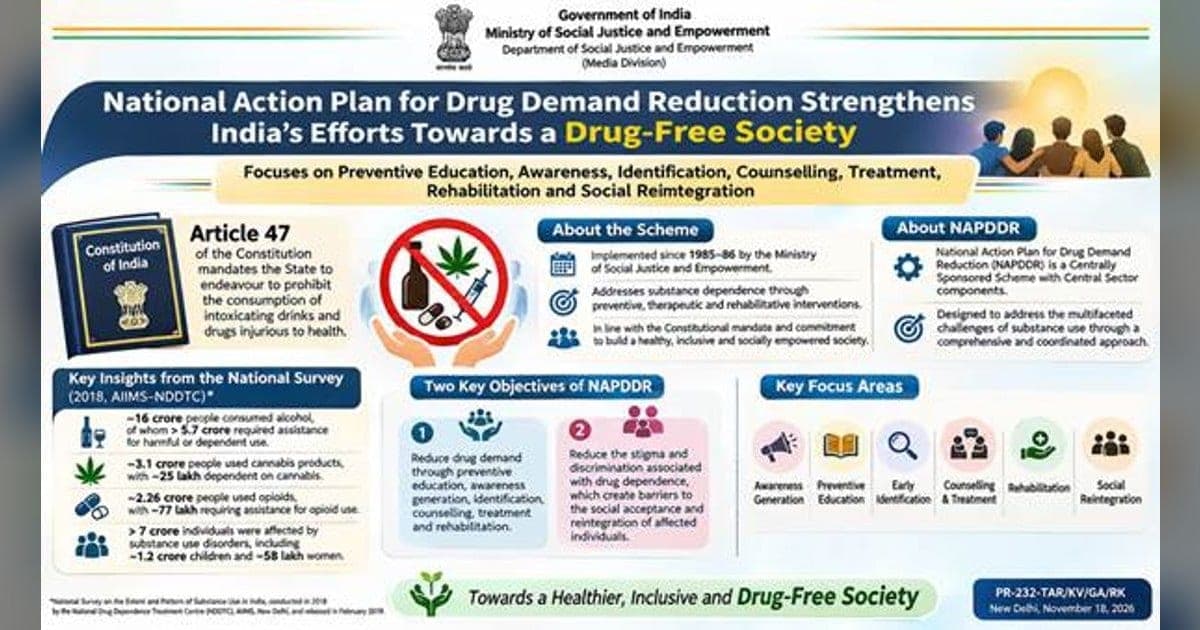
The Ministry of Social Justice and Empowerment has set out how the National Action Plan for Drug Demand Reduction (NAPDDR) is being used to move India towards a drug-free society. The plan rests on a constitutional foundation: Article 47 directs the State to endeavour to bring about prohibition of the consumption of intoxicating drinks and of drugs injurious to health, except for medicinal purposes. The Ministry has been running a scheme for the prevention of alcoholism and substance abuse since 1985-86, and NAPDDR carries that work forward in a coordinated form.
How big the problem is
A senior official pointed to the first National Survey on the Extent and Pattern of Substance Use in India, carried out in 2018 by the National Drug Dependence Treatment Centre (NDDTC), AIIMS, New Delhi, and released in February 2019. Its findings set the scale of the task.
| Substance | Users | Needing help |
| Alcohol | About 16 crore | More than 5.7 crore |
| Cannabis | About 3.1 crore | About 25 lakh dependent |
| Opioids | 2.26 crore | Nearly 77 lakh |
The survey also found that more than 7 crore people were living with substance use disorders, including nearly 1.2 crore children and 58 lakh women, which is why the Ministry stresses early intervention and accessible treatment.
What the plan tries to do
NAPDDR runs as a Centrally Sponsored Scheme with Central Sector components and has two objectives. The first is to cut drug demand through preventive education, awareness generation, early identification, counselling, treatment and rehabilitation. The second is to reduce the stigma and discrimination around drug dependence, which often block the social acceptance and reintegration of affected people.
Why stigma matters
The Ministry’s argument is that treatment alone is not enough. Unless families and communities allow a recovering person to come back without fear of exclusion, rehabilitation does not hold. Awareness work informs families and communities about the harm substances cause; early identification and timely counselling, backed by treatment and rehabilitation facilities, form the core of the national response. With prevention, awareness, treatment, rehabilitation and social reintegration together, the Ministry says it is working towards a healthier and drug-free society in line with the constitutional vision and the wider aim of inclusive socio-economic development.
Important Facts
| Plan | National Action Plan for Drug Demand Reduction (NAPDDR) |
|---|---|
| Ministry | Ministry of Social Justice and Empowerment |
| Scheme type | Centrally Sponsored Scheme with Central Sector components |
| Constitutional mandate | Article 47 of the Constitution |
| Scheme running since | 1985-86 |
| Survey | First National Survey on the Extent and Pattern of Substance Use in India, 2018 |
| Survey agency | NDDTC, AIIMS, New Delhi; released in February 2019 |
| Alcohol users | About 16 crore, of whom over 5.7 crore needed help |
| Cannabis and opioids | About 3.1 crore used cannabis and 2.26 crore used opioids |
| Substance use disorders | Over 7 crore people, including nearly 1.2 crore children and 58 lakh women |
| Two objectives | Cut drug demand; reduce stigma and discrimination around dependence |
Exam Point of View
Remember the plan (NAPDDR, a Centrally Sponsored Scheme with Central Sector components), the ministry (Social Justice and Empowerment), the constitutional article (Article 47), the scheme’s start year (1985-86), the survey (first National Survey on Extent and Pattern of Substance Use, 2018, NDDTC AIIMS New Delhi, released February 2019) and its key figures, including over 7 crore with substance use disorders.
Practice Questions
Which Article of the Constitution directs the State to endeavour to prohibit consumption of intoxicating drinks and injurious drugs?
- A.Article 41
- B.Article 44
- C.Article 47
- D.Article 51A
Show answer
The Ministry of Social Justice and Empowerment stated that this Article directs the State to endeavour to bring about prohibition of the consumption, except for medicinal purposes, of intoxicating drinks and of drugs that are injurious to health, and it is this mandate that underpins the National Action Plan for…
Read the full explanation →Which institution conducted India’s first National Survey on the Extent and Pattern of Substance Use?
- A.National Drug Dependence Treatment Centre, AIIMS, New Delhi
- B.National Institute of Mental Health and Neuro Sciences
- C.Indian Council of Medical Research
- D.National Sample Survey Office
Show answer
The survey was carried out in 2018 and its findings were released in February 2019, giving the first national picture of the extent and pattern of substance use in the country.
Read the full explanation →Which ministry implements the National Action Plan for Drug Demand Reduction?
- A.Ministry of Health and Family Welfare
- B.Ministry of Home Affairs
- C.Ministry of Social Justice and Empowerment
- D.Ministry of Women and Child Development
Show answer
It implements the National Action Plan for Drug Demand Reduction as a Centrally Sponsored Scheme with Central Sector components, and has been running a scheme for the prevention of alcoholism and substance abuse since 1985-86.
Read the full explanation →Frequently Asked Questions
Which Article of the Constitution underpins India’s drug demand reduction effort?
Article 47. It directs the State to endeavour to bring about prohibition of the consumption, except for medicinal purposes, of intoxicating drinks and of drugs that are injurious to health, and the Ministry of Social Justice and Empowerment cites it as the mandate for NAPDDR.
Who conducted India’s first national survey on substance use and when?
The National Drug Dependence Treatment Centre at AIIMS, New Delhi, conducted it in 2018, and the findings were released in February 2019. It estimated about 16 crore alcohol users and more than 7 crore people with substance use disorders.
What are the two objectives of NAPDDR?
First, to reduce drug demand through preventive education, awareness generation, identification, counselling, treatment and rehabilitation. Second, to reduce the stigma and discrimination attached to drug dependence, which obstruct social acceptance and reintegration.
Sources
- https://www.pib.gov.in/PressReleasePage.aspx?PRID=2337970 (opens in a new tab) — Press Information Bureau
Current Affairs 18 November 2026
- ICAR-NIHSAD Develops India's First Indigenous H5N1 VaccineScience & Technology
- Rural Development Ministry Issues VB-G RAM G Ombudsperson RulesGovernment Schemes
- Wind Energy: India at 59.20 GW, Eyes 156 GW by 2036Environment
- Indian Navy Marks 50 Years of Maritime Patrol FlyingDefence
- ICMR Crosses 100 Technology Transfer Deals at DHR SummitScience & Technology
- India Presses Climate Justice, CBDR-RC at COP31 AntalyaSummits & Conferences
- Export Promotion Mission: Niryat Disha Norms RelaxedEconomy
- IEPFA and SEBI Hold Niveshak Shivir in New DelhiBanking & Finance
Related Current Affairs
- Government Schemes
Rural Development Ministry Issues VB-G RAM G Ombudsperson Rules
18 November 2026 · 2 min read
- Government Schemes
Punjab Gets Rs 254.20 Crore Under PM-RKVY for 2026-27
17 November 2026 · 2 min read
- Government Schemes
National FRA Digital Platform Launched for Forest Rights Claims
16 November 2026 · 3 min read
- Government Schemes
EPFO Lounge and ESIC Pavilion Open at IITF 2026 in Delhi
15 November 2026 · 2 min read
- Government Schemes
Agriculture Pavilion at IITF 2026 Runs on Seed to Market
15 November 2026 · 2 min read
- Government Schemes
Lakhpati Didi Count Reaches 3.76 Crore Against 6 Crore Target
15 November 2026 · 2 min read

Related GK
- Famous Personalities of Rajasthan: Exam Notes
28 October 2026 · Rajasthan
- Districts and Divisions of Rajasthan: Exam Notes
28 October 2026 · Rajasthan
- Tourism and World Heritage Sites of Rajasthan Notes
27 October 2026 · Rajasthan
Take the Quiz
- Current Affairs Quiz
Teaching Current Affairs Quiz: 18 November 2026
13 questions13 minutesStart Quiz