
India's Non-Fossil Power Capacity Reaches 308 GW
India's non-fossil power capacity stood at 308 GW, or 55% of a total installed capacity of about 560 GW, a Press Information Bureau backgrounder says.
Why in News
A Press Information Bureau backgrounder released on 13 November 2026 compiled India's renewable energy position, including total capacity of about 560 GW and non-fossil capacity of 308 GW, along with scheme-wise progress.
A backgrounder issued on 13 November 2026 sets out where India's clean energy push has reached. Total installed power capacity is around 560 GW in October 2026, against 249 GW in 2014. Capacity that does not burn fossil fuel stood at 308 GW on 31 July 2026, which is 55% of the whole. The country ranks third in the world in renewable energy capacity and drew investment of USD 63.7 billion into the sector between July 2024 and June 2026.
Solar leads the mix
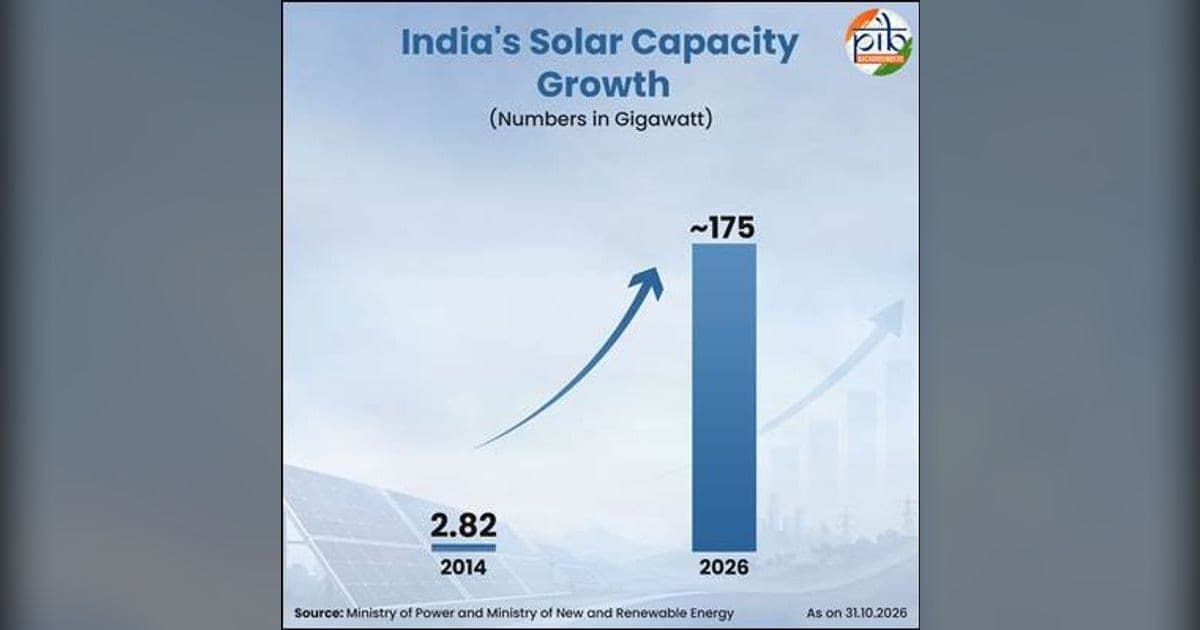
Solar capacity had climbed to about 175 GW by 31 October 2026, from 2.8 GW in 2014, and is now the largest single component of the renewable fleet. India became the second-largest solar growth market in 2025, adding over 37 GW while the United States added 34 GW. Under PM-Surya Ghar: Muft Bijli Yojana, launched in February 2024 with an outlay of Rs 75,021 crore for one crore households, 65.26 lakh homes now have rooftop systems, Rs 35,800 crore has gone out as subsidy and 19.1 GW has been commissioned. The Pradhan Mantri Surya Sarovar Yojana, cleared on 31 July 2026 with Rs 5,070 crore, will build 5,000 MW of floating solar projects backed by 10,000 MWh of storage.
Wind, bio-energy and hydro
Wind capacity reached 59.20 GW on 29 October 2026, placing India fourth in the world. The 6.05 GW added in the financial year 2025-26 was the highest annual addition ever recorded, and turbine manufacturing capacity is near 24 GW. Bio-power stands at 11.75 GW, with 839 compressed biogas plants registered. Hydro capacity, large and small together, is 57.49 GW.
New frontiers
The National Green Hydrogen Mission, approved in January 2023 with an outlay of Rs 19,744 crore, targets 5 MMT of production a year by 2030; Indian companies have signed offtake commitments of 5.5 lakh MTPA since 2023. The first indigenous hydrogen fuel cell train began running on the Jind-Sonipat section in July 2026. A national policy on geothermal energy was notified on 15 September 2025, and the Geological Survey of India puts the potential at about 10,600 MW across 381 hot springs. The Bharat Renewable Energy Summit and Expo was held in New Delhi from 2 to 5 November 2026.
Important Facts
| Total installed power capacity | About 560 GW in October 2026, up from 249 GW in 2014 |
|---|---|
| Non-fossil capacity | 308 GW as on 31 July 2026, 55% of the total |
| Global rank | Third in renewable energy installed capacity, fourth in wind |
| Solar capacity | About 175 GW as on 31 October 2026 |
| Wind capacity | 59.20 GW as on 29 October 2026 |
| Hydro capacity | 57.49 GW, large and small hydro together |
| Bio-power capacity | 11.75 GW, with 839 CBG plants registered |
| PM-Surya Ghar outlay | Rs 75,021 crore for one crore households |
| PM Surya Sarovar Yojana | Rs 5,070 crore for 5,000 MW of floating solar |
| National Green Hydrogen Mission | Rs 19,744 crore, target 5 MMT a year by 2030 |
| Investment in renewables | USD 63.7 billion between July 2024 and June 2026 |
Exam Point of View
Remember total capacity (about 560 GW in October 2026 against 249 GW in 2014), non-fossil capacity (308 GW, 55% of the total), India's ranks (third in renewable capacity, fourth in wind), solar (about 175 GW), wind (59.20 GW), hydro (57.49 GW), the PM-Surya Ghar outlay of Rs 75,021 crore and the green hydrogen target of 5 MMT by 2030.
Practice Questions
What was India's non-fossil installed power capacity as on 31 July 2026?
- A.175 GW
- B.249 GW
- C.308 GW
- D.560 GW
Show answer
The correct answer is 308 GW, which on that date made up 55% of the country's total installed power capacity.
Read the full explanation →What is the total outlay of PM-Surya Ghar: Muft Bijli Yojana?
- A.Rs 5,070 crore
- B.Rs 19,744 crore
- C.Rs 35,800 crore
- D.Rs 75,021 crore
Show answer
The rooftop solar scheme was launched in February 2024 with that outlay and a target of one crore households.
Read the full explanation →Where does India rank in the world in installed wind power capacity?
- A.Second
- B.Third
- C.Fourth
- D.Sixth
Show answer
Installed wind capacity in the country had reached 59.20 GW by 29 October 2026, and the sector added 6.05 GW during the financial year 2025-26, its highest annual addition so far.
Read the full explanation →Frequently Asked Questions
What is India's total installed power capacity and how much of it is non-fossil?
Total installed capacity is around 560 GW in October 2026, against 249 GW in 2014. Non-fossil capacity stood at 308 GW on 31 July 2026, which works out to 55% of the total. India ranks third in the world in renewable energy installed capacity.
How much progress has PM-Surya Ghar: Muft Bijli Yojana made?
The scheme was launched in February 2024 with an outlay of Rs 75,021 crore for one crore households. As on 2 November 2026, 65.26 lakh households had rooftop systems, about Rs 35,800 crore had been paid as subsidy and 19.1 GW of rooftop capacity had been commissioned.
What does the Pradhan Mantri Surya Sarovar Yojana provide for?
Approved on 31 July 2026 with an outlay of Rs 5,070 crore, it targets 5,000 MW of floating solar photovoltaic projects with co-located storage of at least two hours, equal to 10,000 MWh, to be sanctioned over five financial years.
Sources
- https://www.pib.gov.in/PressReleasePage.aspx?PRID=2335742 (opens in a new tab) — Press Information Bureau
Current Affairs 13 November 2026
- DIPAM Completes Special Campaign 6 for Swachhata and PendencyNational
- WHO Global TB Report 2026: India's TB Deaths Fall 38%Reports & Indices
- 57th IFFI in Goa to Open on Stories Without Borders ThemeNational
- India and Italy Plan New Joint Research Call in 2027International
- CCPA Fines Ola Rs 10 Lakh Over Pre-Ride Tip PromptsNational
- NPPA Orders Price Monitoring on 137 Anti-Cancer DrugsEconomy
Related Current Affairs
- Environment
India Seeks Fair, Ambitious Outcome at UNFCCC COP31 in Antalya
10 November 2026 · 2 min read


Related GK
- Famous Personalities of Rajasthan: Exam Notes
28 October 2026 · Rajasthan
- Districts and Divisions of Rajasthan: Exam Notes
28 October 2026 · Rajasthan
- Tourism and World Heritage Sites of Rajasthan Notes
27 October 2026 · Rajasthan
Take the Quiz
- Current Affairs Quiz
State Exams Current Affairs Quiz: 13 November 2026
21 questions21 minutesStart Quiz