
Namami Gange: 199 Sewerage Projects Worth Rs 31,327 Crore Taken Up
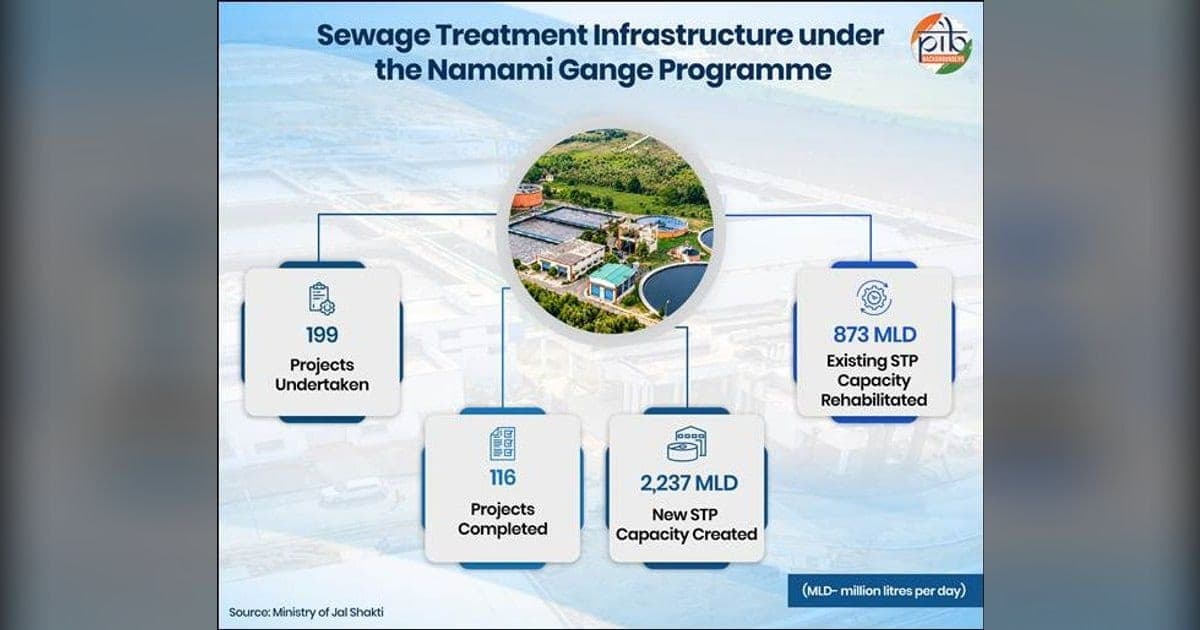
Under Namami Gange, 199 sewerage projects of about Rs 31,327 crore have been taken up, of which 116 are complete, with 2,237 MLD of new STP capacity built.
Why in News
A government note of 21 October 2026 detailed the technologies used for wastewater treatment under the Namami Gange Programme, along with the progress of its sewerage projects and treatment capacity.
A government note issued on 21 October 2026 sets out how sewage is being treated under the Namami Gange Programme, the integrated conservation mission launched in 2014 with the twin aims of cutting pollution in the National River Ganga and reviving it. Its pillars run from sewerage treatment infrastructure, river-front development and river-surface cleaning to biodiversity, afforestation, public awareness, industrial effluent monitoring and Ganga Gram.
How much has been built
Sewage treatment sits at the centre of the pollution control effort. The programme has taken up 199 sewerage infrastructure projects estimated at Rs 31,327 crore, and 116 of them are finished.
| New STP capacity planned | 5,270 MLD |
| New capacity created so far | 2,237 MLD |
| Old capacity to be rehabilitated | 925 MLD |
| Rehabilitation done | 873 MLD |
A technology-neutral mission
The mission does not tie itself to one process. Depending on the town, the land available and the nature of the sewage, it uses the conventional activated sludge process, the upflow anaerobic sludge blanket, sequential batch reactors, moving bed biofilm reactors, fluidized aerated beds and the food chain reactor, besides electrocoagulation, constructed wetlands and packaged units.
New technologies on the ground
The Food Chain Reactor came to India through this mission; it adds fixed artificial media and plant roots to the usual process and needs less land and less power. Five such plants are working, two at Bhatpara in West Bengal and three at Prayagraj in Uttar Pradesh, and one more is coming up at Bhagalpur in Bihar at about 175 square metres per MLD. In the hills of Uttarakhand, where cold and poor access rule out other methods, electrocoagulation units have been put up at places such as Badrinath and Chamoli.
Building upward and with nature
At Muni Ki Reti in Chandreshwar Nagar stands the country's first four-storey sewage treatment plant built for a municipality under the mission. Short of land, the 7.5 MLD plant was raised vertically on about 900 square metres, needing roughly 120 square metres per MLD against about 400 for the conventional option. At Bithoor in Uttar Pradesh, a town of about 20,000 people, six constructed wetlands built on the drains themselves treat close to 2 MLD and have pulled the biochemical oxygen demand down from around 75 mg per litre to under 10 mg per litre.
Important Facts
| Programme | Namami Gange Programme, launched 2014 |
|---|---|
| Objective | Pollution abatement and rejuvenation of the National River Ganga |
| Sewerage projects | 199 projects worth about Rs 31,327 crore, 116 completed |
| New STP capacity | 2,237 MLD created against a target of 5,270 MLD |
| Rehabilitation | 873 MLD done out of a target of 925 MLD |
| Food Chain Reactor plants | Two at Bhatpara, West Bengal and three at Prayagraj, Uttar Pradesh |
| First four-storey municipal STP | Muni Ki Reti, Chandreshwar Nagar, of 7.5 MLD on about 900 square metres |
| Constructed wetlands | Bithoor, Uttar Pradesh, six wetlands treating about 2 MLD |
Exam Point of View
Remember the launch year of Namami Gange (2014), the number and cost of its sewerage projects (199 projects, Rs 31,327 crore), capacity figures (5,270 MLD planned, 2,237 MLD created, 925 MLD and 873 MLD for rehabilitation), the Food Chain Reactor sites and the first four-storey municipal STP at Muni Ki Reti.
Practice Questions
In which year was the Namami Gange Programme launched?
- A.2011
- B.2014
- C.2016
- D.2019
Show answer
The Namami Gange Programme was launched in that year as an integrated conservation mission with the twin objectives of effective abatement of pollution and the conservation and rejuvenation of the National River Ganga.
Read the full explanation →Where is the country's first four-storey sewage treatment plant for a municipality built under Namami Gange?
- A.Prayagraj
- B.Bhatpara
- C.Muni Ki Reti
- D.Bithoor
Show answer
The plant was therefore raised vertically, and its land need works out to far less per unit of capacity than the conventional alternative.
Read the full explanation →Which technology, introduced in India through Namami Gange, uses fixed artificial media and plant roots and has operational plants at Bhatpara and Prayagraj?
- A.Food Chain Reactor
- B.Johkasou
- C.Electrocoagulation
- D.Upflow Anaerobic Sludge Blanket
Show answer
This technology was brought to India through the programme and improves upon the activated sludge process and the sequential batch reactor by adding fixed artificial media and plant roots, which gives it a smaller footprint, lower power use and nutrient removal.
Read the full explanation →Frequently Asked Questions
When was the Namami Gange Programme launched and what are its objectives?
It was launched in 2014 as an integrated conservation mission with the twin objectives of effective abatement of pollution and the conservation and rejuvenation of the National River Ganga.
How much sewage treatment capacity has been created under the programme?
Out of a planned 5,270 MLD of new sewage treatment plant capacity, 2,237 MLD has been created so far, and 873 MLD of the 925 MLD targeted for rehabilitation has been rehabilitated.
Where is the first four-storey municipal sewage treatment plant built under Namami Gange?
At Muni Ki Reti, Chandreshwar Nagar. The 7.5 MLD plant occupies about 900 square metres and needs roughly 120 square metres per MLD against about 400 for a conventional plant.
Sources
- https://www.pib.gov.in/PressReleasePage.aspx?PRID=2325989 (opens in a new tab) — Press Information Bureau
Current Affairs 21 October 2026
- SARAS Mela 2026: First National Edition Outside Delhi-NCRGovernment Schemes
- Police Commemoration Day 2026: Amit Shah Honours Fallen PoliceImportant Days
- SKOCH Gold Award 2026 for Coal Ministry SUVIKALP Mine ToolAwards & Honours
- Swachhata Campaign 6.0: ICAR Holds Nearly 4,000 Clean DrivesGovernment Schemes
- President Murmu Presents Lalit Kala Akademi Awards in New DelhiAwards & Honours
- Army Commanders Conference Begins; Land Warfare Doctrine ReleaseDefence
- Defence Ministry Inks Rs 770 Crore Deal for LLLR-I RadarsDefence
- Vummidi Ethiraj, Craftsman of the Historic Sengol, Passes AwayObituaries
Related Current Affairs
Related GK
- Handicrafts and GI Tags of Uttar Pradesh: District List
21 October 2026 · Uttar Pradesh
- Forts and Palaces of Rajasthan: Builders and Key Facts
21 October 2026 · Rajasthan
- Handicrafts and GI Tags of Madhya Pradesh: Chanderi, Bagh
21 October 2026 · Madhya Pradesh
Take the Quiz
- Current Affairs Quiz
State Exams Current Affairs Quiz: 21 October 2026
25 questions25 minutesStart Quiz