
World Congress on Nanomedicine 2026 Opens in New Delhi
Minister Jitendra Singh opened the World Congress on Nanomedicine 2026 in New Delhi and said DBT is backing 210 research projects with Rs 174 crore.
Why in News
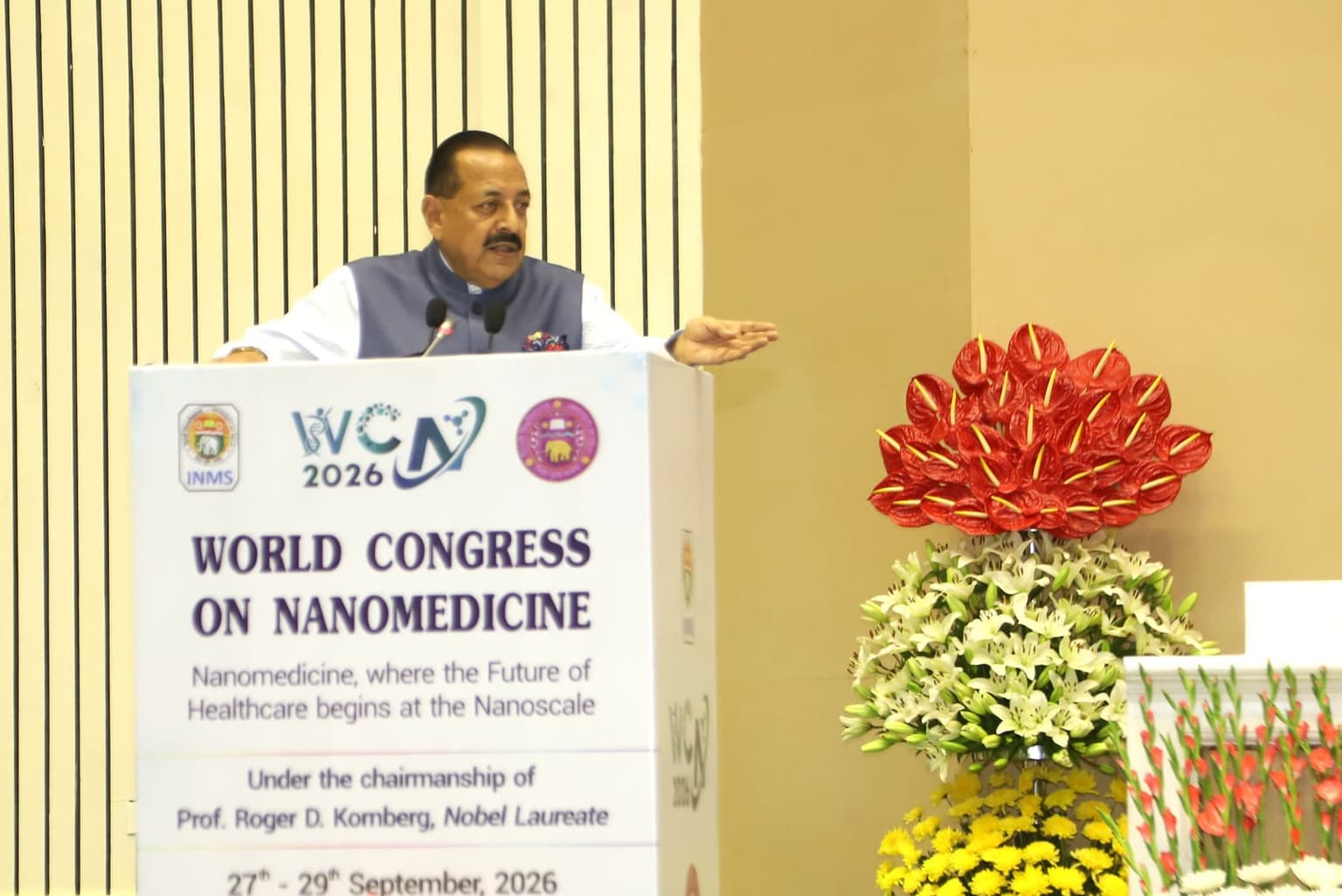
On 27 September 2026 Union Minister Dr Jitendra Singh inaugurated the World Congress on Nanomedicine 2026 at Vigyan Bhawan in New Delhi and disclosed that the Department of Biotechnology is supporting 210 nanomedicine research projects with Rs 174 crore.
The World Congress on Nanomedicine 2026 was inaugurated at Vigyan Bhawan, New Delhi, on 27 September 2026 by Dr Jitendra Singh, Union Minister of State (Independent Charge) for Science and Technology and Earth Sciences. He told the gathering that nanomedicine will carry forward the next stage of precision medicine and personalised healthcare, and that research done within India has worldwide value.
Who is hosting it
The congress is hosted by the Institute of Nano Medical Sciences (INMS) of the Faculty of Medical Sciences, University of Delhi, and runs under the umbrella of the International Society of Nano Medical Sciences and the International Society for Nano Medicine. More than 2,000 participants, among them senior scientists and young researchers, are taking part.
Who is leading the congress
| Chairperson | Nobel Laureate Prof. Roger D. Kornberg, Stanford University, USA |
| Honorary President | Prof. T. M. S. Chang, McGill University, Canada |
| Host institution head | Prof. Yogesh Singh, Vice-Chancellor, University of Delhi |
Prof. Gobardhan Das, a Member of NITI Aayog, along with Prof. G. P. Talwar, Prof. Ramesh Chandra and Prof. Indrajit Roy, attended the opening session. Prof. Kornberg called the field young and fast moving, saying its promise lies in placing the right quantity of a medicine at the right spot at the right moment, so that treatment works better and poisons the body less.
What the government is funding
- The Department of Biotechnology is supporting 210 research and development projects in nanomedicine with Rs 174 crore.
- The projects span targeted drug delivery, cancer nanomedicine, infectious-disease nanomedicine, nucleic-acid and vaccine delivery, nano-diagnostics and imaging, regenerative medicine, wound healing, nanotoxicology and regulatory science.
- Promising Indian work includes oral insulin nanoparticles, nanobots aimed at breast cancer and precision nanoinjection.
- Through BIRAC, young firms can draw on the Biotechnology Ignition Grant, PACE, the Small Business Innovation Research Initiative and the Biotechnology Industry Partnership Programme.
Rules for nanopharmaceuticals have been framed jointly by the Department of Biotechnology, the Indian Council of Medical Research and the Central Drugs Standard Control Organisation, covering the safety, quality and effect of such products. The minister said nanomedicine works at the scale of one-billionth of a metre and lets doctors treat patients differently according to genes, way of life, diet and surroundings. He cautioned that artificial intelligence and nanotechnology must support a doctor's clinical judgement rather than replace it, and called for medical teaching to be rethought without losing the old skills of observation and physical examination.
Important Facts
| Event | World Congress on Nanomedicine 2026 |
|---|---|
| Venue | Vigyan Bhawan, New Delhi |
| Inaugurated by | Dr Jitendra Singh, MoS Science and Technology |
| Host | Institute of Nano Medical Sciences, University of Delhi |
| Chairperson | Nobel Laureate Prof. Roger D. Kornberg, Stanford University |
| Honorary President | Prof. T. M. S. Chang, McGill University, Canada |
| Participants | More than 2,000 |
| DBT support | 210 projects with Rs 174 crore |
| Nanopharma guidelines by | DBT, ICMR and CDSCO |
Exam Point of View
Note the venue (Vigyan Bhawan, New Delhi), the host (Institute of Nano Medical Sciences, University of Delhi), the Chairperson (Nobel Laureate Roger D. Kornberg) and Honorary President (T. M. S. Chang), the participation of over 2,000 delegates, DBT support of 210 projects worth Rs 174 crore, and the three bodies behind the nanopharmaceutical guidelines: DBT, ICMR and CDSCO.
Practice Questions
Where was the World Congress on Nanomedicine 2026 inaugurated?
- A.Bharat Mandapam, New Delhi
- B.Vigyan Bhawan, New Delhi
- C.Vigyan Bhawan, Mumbai
- D.Indian Institute of Science, Bengaluru
Show answer
Correct answer: B. Vigyan Bhawan, New Delhi
Explanation
The correct answer is Vigyan Bhawan, New Delhi, where the Union Minister of State for Science and Technology opened the congress. The meeting is hosted by the Institute of Nano Medical Sciences of the Faculty of Medical Sciences at the University of Delhi, which is why the capital is the venue. Option A names a different Delhi venue that had no part in this congress. Option C is wrong because Vigyan Bhawan is in the capital and not in Mumbai, so the city makes the option false even though the hall is correctly named. Option D is wrong because no session of this congress was held in Bengaluru; the gathering, which drew more than 2,000 scientists and young researchers, ran under the umbrella of the International Society of Nano Medical Sciences and the International Society for Nano Medicine.
How many nanomedicine research projects is the Department of Biotechnology supporting, and with what amount?
- A.120 projects with Rs 210 crore
- B.210 projects with Rs 174 crore
- C.174 projects with Rs 210 crore
- D.310 projects with Rs 240 crore
Show answer
Correct answer: B. 210 projects with Rs 174 crore
Explanation
The correct answer is 210 projects with Rs 174 crore. The minister gave these numbers while setting out how the government funds nanomedicine, and said the work covers targeted drug delivery, cancer nanomedicine, infectious-disease nanomedicine, nucleic-acid and vaccine delivery, nano-diagnostics and imaging, regenerative medicine, wound healing and nanotoxicology with regulatory science. Options A and C swap the two figures or invent a fresh one, so they turn the count of projects into the money and the money into the count. Option D raises both numbers and matches nothing that was said. Aspirants should also link the funding to BIRAC, whose Biotechnology Ignition Grant, PACE, Small Business Innovation Research Initiative and Biotechnology Industry Partnership Programme help turn such research into enterprise.
Who is the Chairperson of the World Congress on Nanomedicine 2026?
- A.Prof. T. M. S. Chang
- B.Prof. Yogesh Singh
- C.Prof. Roger D. Kornberg
- D.Prof. Gobardhan Das
Show answer
Correct answer: C. Prof. Roger D. Kornberg
Explanation
The correct answer is Prof. Roger D. Kornberg, a Nobel Laureate from Stanford University in the United States, who chairs the congress and described nanomedicine as a young and quickly changing field whose promise is to deliver the right amount of a medicine to the right place at the right time, improving results while reducing toxicity. Option A is wrong because Prof. T. M. S. Chang of McGill University in Canada holds the separate post of Honorary President. Option B is wrong because Prof. Yogesh Singh attended as Vice-Chancellor of the University of Delhi, the host university, not as Chairperson. Option D is wrong because Prof. Gobardhan Das was present as a Member of NITI Aayog among the distinguished participants at the inaugural session.
Which three bodies jointly developed India's guidelines for nanopharmaceuticals?
- A.DBT, ICMR and CDSCO
- B.DST, CSIR and FSSAI
- C.DBT, BIRAC and NITI Aayog
- D.ICMR, AIIMS and CDSCO
Show answer
Correct answer: A. DBT, ICMR and CDSCO
Explanation
The correct answer is DBT, ICMR and CDSCO, that is the Department of Biotechnology, the Indian Council of Medical Research and the Central Drugs Standard Control Organisation. The minister said these three drew up a common framework for judging the safety, quality and effectiveness of nanopharmaceutical products, giving India a regulatory base alongside its research funding. Option B lists bodies that were not named in this context at all. Option C is wrong because BIRAC appeared in the speech as the route through which young biotechnology firms reach grants and partnership programmes, while NITI Aayog was mentioned only because one of its members attended the session. Option D is wrong because no hospital was named among the framers; the third partner with ICMR and CDSCO is the Department of Biotechnology.
Frequently Asked Questions
Who inaugurated the World Congress on Nanomedicine 2026?
Union Minister of State (Independent Charge) for Science and Technology Dr Jitendra Singh, at Vigyan Bhawan in New Delhi on 27 September 2026.
How many nanomedicine projects is the Department of Biotechnology supporting?
It is supporting 210 research and development projects in nanomedicine with financial support of Rs 174 crore.
Who is the Chairperson of the World Congress on Nanomedicine 2026?
Nobel Laureate Prof. Roger D. Kornberg of Stanford University. Prof. T. M. S. Chang of McGill University, Canada, is the Honorary President.
Sources
Current Affairs 27 September 2026
- Mann Ki Baat 138th Episode Marks Surgical Strike DecadeNational
- Waste-to-Energy Under Swachh Bharat: Prayagraj to GwaliorEnvironment
- Bharat Maritime Insurance Pool Gets Rs 13,906.50 Crore CapacityEconomy
- Defence Exports Reach Rs 38,424 Crore, Says Rajnath SinghDefence
- Uttar Pradesh Targets Rs 5 Lakh Crore Exports by 2030: GoyalState News
- India's First LNG-Powered Train Flagged Off at SabarmatiNational
- PM Mementos e-Auction 2026 Puts Rajasthan Heritage on ShowNational
Related Current Affairs
- Science & Technology
CSIR-NIScPR Launches Science Magazines in Five Languages
26 September 2026 · 2 min read
- Science & Technology
RRI Study Shows Black Hole Jets Choke Star Birth in Galaxies
25 September 2026 · 2 min read
- Science & Technology
TRAI Launches Digital Connectivity Rating Platform for Properties
25 September 2026 · 2 min read
- Science & Technology
Bio-based Biodegradable PLA Plastic Launched Under BioE3 Framework
24 September 2026 · 2 min read
- Science & Technology
TDB Gives GalaxEye Rs 63.84 Crore for OptoSAR Satellite
24 September 2026 · 2 min read
- Science & Technology
TDB Clears Rs 285 Crore for Ubifly's Indigenous ePlane e200X
23 September 2026 · 2 min read

Related GK
- State Symbols and Nicknames of Indian Cities and States
27 September 2026 · Static GK
- Gaganyaan and Human Spaceflight: Mission, Vehicle, Astronauts
27 September 2026 · Science & Technology
- Rajasthan GK: Geography, History, Culture and Economy
27 September 2026 · Indian States & UTs
Take the Quiz
- Current Affairs Quiz
State Exams Current Affairs Quiz: 27 September 2026
25 questions25 minutesStart Quiz