
MeghRaj 2.0 Cloud Now Serves 2,330 Government Departments
A PIB backgrounder on India's cloud ecosystem says MeghRaj 2.0 serves 2,330 government departments and 30 cloud service providers stand empanelled by September 2026.
Why in News
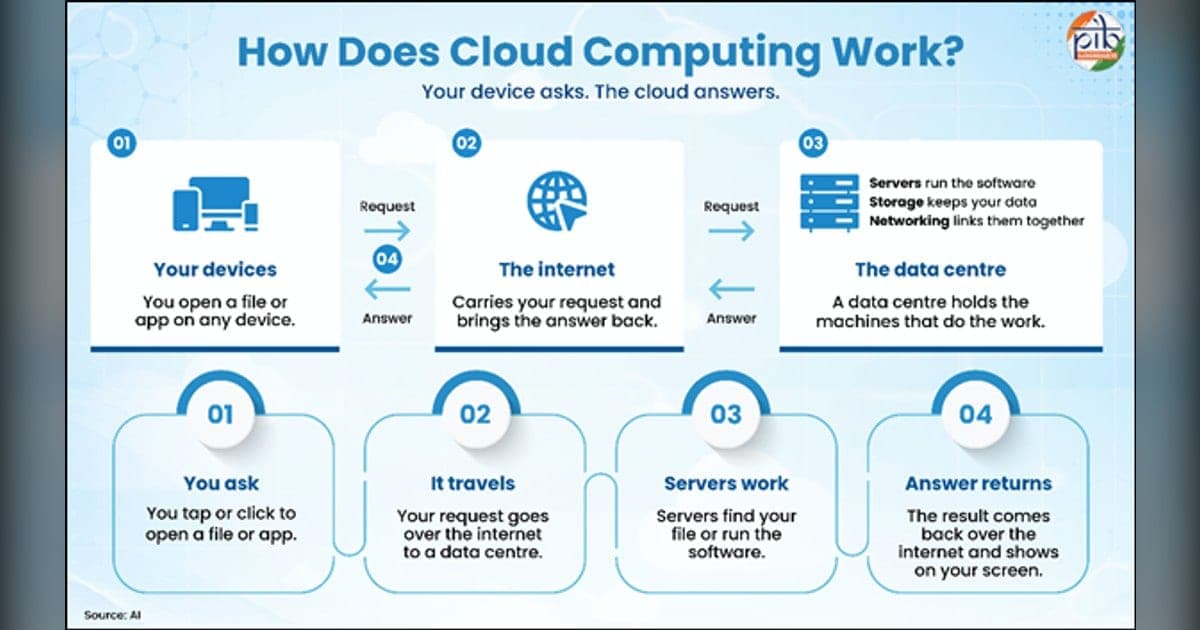
On 29 October 2026 the Press Information Bureau published a backgrounder on India's cloud ecosystem, reporting that MeghRaj 2.0 now serves 2,330 government departments, that 30 cloud service providers are empanelled and that data centre capacity has reached 1.57 GW.
The Press Information Bureau issued a backgrounder on 29 October 2026 on the state of cloud computing in India, setting out how the country is building its own capacity to store and process the data that digital governance now generates.
Why the demand is rising
India's internet subscriber base stood at 1,092.79 million in March 2026. Each wireless subscriber used an average of 25.51 GB of data a month, and total wireless data consumption touched 285,376 petabytes in the financial year 2025-26. Digital payments, online public services and artificial intelligence applications all leave records behind, and handling that volume needs computing power rather than mere storage space. Keeping such data on home soil is what the government calls data sovereignty.
MeghRaj and its second generation
MeghRaj, the government's own cloud ecosystem, was launched in 2014 by the Ministry of Electronics and Information Technology to speed up e-governance and trim public spending on hardware. Its second-generation version, MeghRaj 2.0, had been taken up by 2,330 government departments by September 2026. It offers infrastructure, platform and software as a service through a distributed design and hosts DigiLocker, MyGov, the National Scholarship Portal and the Advanced Postal Technology system of the Department of Posts.
Providers, data centres and chips
- India had empanelled 30 cloud service providers by September 2026, among them Jio Platforms, Tata Consultancy Services, BSNL, ITI Limited, RailTel, AdaniConneX and Yotta Data Services alongside foreign names.
- Data centre capacity reached 1.57 GW in August 2026 and is expected to approach 8 GW by 2030, with roughly USD 70 billion of investment under way and a further USD 90 billion announced.
- The National Informatics Centre runs 4 National Data Centres and 24 Mini Data Centres.
- The IndiaAI Mission, cleared with an outlay of Rs 10,371.92 crore, has brought more than 45,000 graphics processing units into a shared computing facility.
BHASHINI on an Indian cloud
In February 2026 the ministry reported that the Digital India BHASHINI platform had shifted to an Indian cloud run by Yotta Data Services, keeping its language datasets and AI models inside the country. The move gave up to 40 per cent better performance, 20 to 30 per cent lower cost and 99.99 per cent uptime. At Maha Kumbh 2025 the platform had offered live translation and voice help in more than 11 Indian languages.
Skills and policy
FutureSkills PRIME, started in 2021 by the ministry with NASSCOM, had 34 lakh registered candidates by August 2026, of whom over 23 lakh were enrolled or trained; it placed 3rd globally in the European Commission's Pact for Skills Report 2024. NIELIT works through 56 centres, 750 affiliated institutes and over 9,000 facilitation centres. A 2026 study by the Cloud Native Computing Foundation counts 2.25 million cloud-native developers in India, 44 per cent of whom use hybrid cloud. A Cloud Selection Framework issued in March 2026 and the Digital Personal Data Protection Act of 2023 guide where sensitive data may sit.
Important Facts
| Document | PIB backgrounder on the cloud ecosystem in India, 29 October 2026 |
|---|---|
| MeghRaj launched | 2014, by the Ministry of Electronics and Information Technology |
| Departments on MeghRaj 2.0 | 2,330 as of September 2026 |
| Empanelled cloud providers | 30 as of September 2026 |
| Data centre capacity | 1.57 GW in August 2026, projected near 8 GW by 2030 |
| NIC data centres | 4 National Data Centres and 24 Mini Data Centres |
| IndiaAI Mission outlay | Rs 10,371.92 crore, with over 45,000 GPUs onboarded |
| Internet subscribers | 1,092.79 million in March 2026 |
| Wireless data use | 25.51 GB per subscriber a month; 285,376 petabytes in FY 2025-26 |
| Cloud models | Public, private and hybrid; services are IaaS, PaaS, SaaS and serverless |
| Cloud-native developers | 2.25 million in India, 44 per cent using hybrid cloud |
Exam Point of View
Remember the launch year of MeghRaj (2014, by MeitY), the departments on MeghRaj 2.0 (2,330), the empanelled cloud service providers (30), the data centre capacity (1.57 GW in August 2026, nearing 8 GW by 2030), the IndiaAI Mission outlay (Rs 10,371.92 crore) and its GPU count (over 45,000), NIC's data centres (4 national, 24 mini), and the three cloud models along with IaaS, PaaS, SaaS and serverless computing.
Practice Questions
How many government departments had adopted MeghRaj 2.0 by September 2026?
- A.1,230
- B.2,330
- C.3,230
- D.4,330
Show answer
MeghRaj 2.0, the second generation of the Government of India's national cloud computing initiative, had been adopted by that many government departments by September 2026.
Read the full explanation →What is the approved outlay of the IndiaAI Mission?
- A.Rs 7,500 crore
- B.Rs 10,371.92 crore
- C.Rs 19,744 crore
- D.Rs 25,000 crore
Show answer
The IndiaAI Mission was approved with this outlay and its purpose is to widen access to computing power for artificial intelligence work.
Read the full explanation →Which platform was migrated to an Indian cloud operated by Yotta Data Services, as reported in February 2026?
- A.DigiLocker
- B.MyGov
- C.Digital India BHASHINI
- D.National Scholarship Portal
Show answer
The Ministry of Electronics and Information Technology reported in February 2026 that the BHASHINI language platform had been moved to an Indian cloud operated by Yotta Data Services, which keeps its language datasets, AI models and citizen interactions within India's own jurisdiction and therefore supports data sovereignty.
Read the full explanation →Frequently Asked Questions
What is MeghRaj 2.0?
It is the second generation of the Government of India's national cloud computing initiative. MeghRaj was launched in 2014 by MeitY, and by September 2026 MeghRaj 2.0 was being used by 2,330 government departments, hosting platforms such as DigiLocker, MyGov and the National Scholarship Portal.
What is the outlay of the IndiaAI Mission?
The IndiaAI Mission was approved with an outlay of Rs 10,371.92 crore. More than 45,000 graphics processing units have been onboarded for a common AI computing facility that start-ups and academic institutions can use.
What are the four main categories of cloud services?
Infrastructure as a Service, Platform as a Service, Software as a Service and serverless computing. They are described as a stack because each builds on the one below it, while the deployment models are public, private and hybrid cloud.
Sources
- https://www.pib.gov.in/PressReleasePage.aspx?PRID=2329978 (opens in a new tab) — Press Information Bureau
Current Affairs 29 October 2026
- ESIC Extends New Amnesty Scheme 2025 Till 31 December 2026Government Schemes
- Rajnath Singh Addresses 13th ADMM-Plus Meeting in CebuSummits & Conferences
- Rabi MSP for 2027-28: Safflower Gets the Biggest RiseEconomy
- ESTIC 2026 Session Takes Up Physical AI and RoboticsScience & Technology
- Cyclone Arnab: Amit Shah Speaks to Four Chief MinistersNational
- India Tops World in Green Hydrogen Offtake CommitmentsEnvironment
- Ganga Flood Control Board's 19th Meeting Launches Punah Bharan AppNational
- Rs 3.36 Crore Settlement for 217 UltraTech Bathinda WorkersEconomy
Related Current Affairs
- Science & Technology
ESTIC 2026 Session Takes Up Physical AI and Robotics
29 October 2026 · 2 min read
- Science & Technology
India's New-Age Space Technologies: NGLV, SpaDeX, NavIC
28 October 2026 · 2 min read
- Science & Technology
ESTIC 2026: Genetic Diversity Can Make India a Gene Research Hub
27 October 2026 · 2 min read
- Science & Technology
AIIA Ayurveda Study Screens 5,594 Elderly in Faridabad
27 October 2026 · 2 min read
- Science & Technology
TDB Funds Manastu Space Green Propulsion With Rs 116 Crore
26 October 2026 · 2 min read

Related GK
- Famous Personalities of Rajasthan: Exam Notes
28 October 2026 · Rajasthan
- Districts and Divisions of Rajasthan: Exam Notes
28 October 2026 · Rajasthan
- Tourism and World Heritage Sites of Rajasthan Notes
27 October 2026 · Rajasthan
Take the Quiz
- Current Affairs Quiz
State Exams Current Affairs Quiz: 29 October 2026
25 questions25 minutesStart Quiz