
First International Maize Conference Opens in Hyderabad
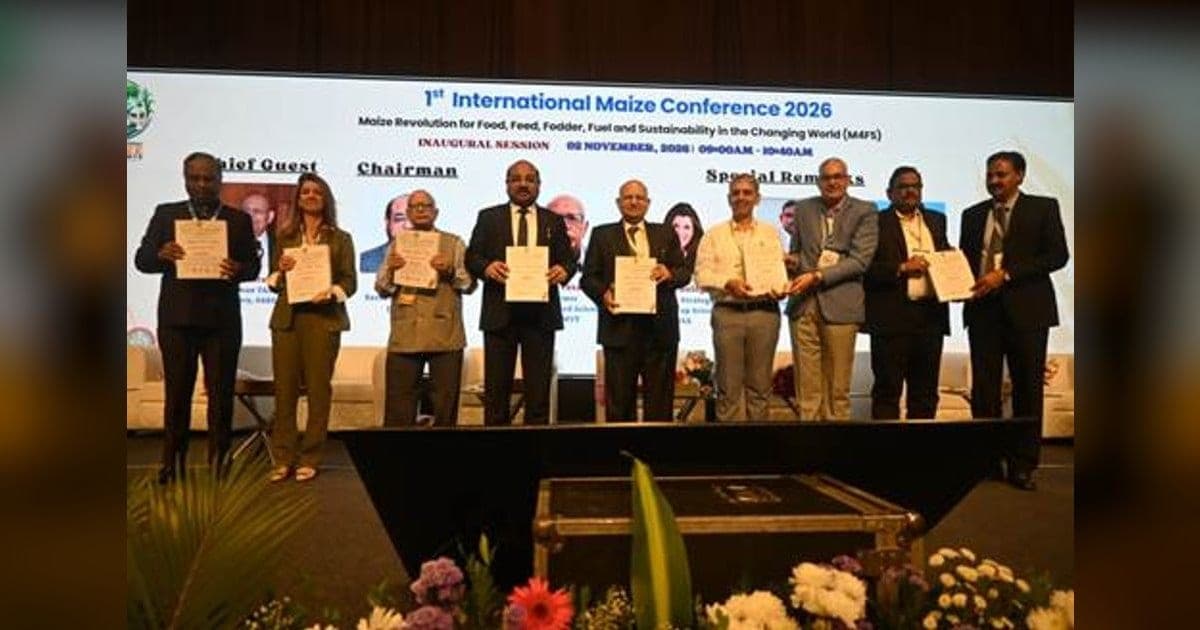
The 1st International Maize Conference began at Hyderabad on the theme of a maize revolution for food, feed, fodder, fuel and sustainability in a changing world.
Why in News
The 1st International Maize Conference opened on 2 November 2026 at Hyderabad, where the Secretary of the Department of Agricultural Research and Education called for India's maize production to rise from about 55 million tonnes to 75 million tonnes in a decade.
The 1st International Maize Conference opened at the JD Convention Centre in Hyderabad, bringing scientists, policymakers, agricultural institutions and industry together to work out how maize research, productivity and value chains should grow. Its theme is Maize Revolution for Food, Feed, Fodder, Fuel and Sustainability in the Changing World, shortened to M4FS. The conference runs from 2 to 4 November and gives Indian and foreign experts a platform to draw a roadmap for a productive and profitable maize sector.
A call to raise production
Dr M. L. Jat, Secretary of the Department of Agricultural Research and Education and Director General of the Indian Council of Agricultural Research, congratulated the maize research community on India's production reaching about 55 million tonnes with large productivity gains over the past decade. He asked for production to be lifted to 75 million tonnes over the next decade, along with a further one-and-a-half-fold rise in productivity through technology, better crop management and efficient use of resources.
From 4F to 5F
Dr Jat proposed widening the familiar vision of food, feed, fodder and fuel into a fifth F by putting farmers at the centre, arguing that research and extension must show up as higher farm profitability and better livelihoods. He pressed for a systems-science approach to closing yield gaps, especially those that come from crop management, and for placing maize carefully across seasons and agroecological zones without squeezing out other important crops, particularly oilseeds and pulses. Affordable quality seed, above all public sector hybrids, was called the base of any such effort.
Breeding, hybrids and ethanol
- Dr D. K. Yadav, Deputy Director General for Crop Science at the Council, called maize a model crop for food, nutritional and energy security and noted that 329 maize hybrids had been developed over the past five years
- He asked for the All India Coordinated Research Project on Maize to be strengthened, with breeding for yield, nutritional quality and resistance to living and non-living stresses
- He also urged research bodies, universities and industry to work together on maize as a feedstock for ethanol
- Scientific publications were released and awards given to scientists for their work on maize
The voices from the podium
Dr S. Vasal, a Padma Shri awardee, World Food Prize laureate and a scientist associated with CIMMYT, argued for simple and low-cost breeding methods to speed up new varieties and hybrids suited to what farmers need. Dr R. S. Paroda, a Padma Bhushan awardee and a former Secretary of the department and Director General of the Council, was the chief guest; he asked for advanced breeding techniques, systematic conservation and use of germplasm, stronger maize value chains and effective aflatoxin management so that maize stays safe for food and feed. Dr H. S. Jat, President of the Maize Technologists Association of India, welcomed the gathering and spoke of maize's place in India's agricultural change.
Important Facts
| Event | 1st International Maize Conference |
|---|---|
| Venue | JD Convention Centre, Hyderabad |
| Dates | 2 to 4 November |
| Theme | Maize Revolution for Food, Feed, Fodder, Fuel and Sustainability in the Changing World (M4FS) |
| Present production | About 55 million tonnes |
| Goal | 75 million tonnes in the next decade, with productivity up one-and-a-half times |
| New idea | 4F widened to 5F by adding farmers |
| Hybrids developed | 329 maize hybrids in the past five years |
| Chief guest | Dr R. S. Paroda, Padma Bhushan awardee and former DG, ICAR |
Exam Point of View
Remember that this is the first edition, the city Hyderabad, the dates 2 to 4 November, the theme and its short form M4FS, present production of about 55 million tonnes, the goal of 75 million tonnes, the 4F to 5F idea with farmers added, and the 329 maize hybrids of the past five years.
Practice Questions
In which city did the 1st International Maize Conference open?
- A.Ludhiana
- B.Hyderabad
- C.New Delhi
- D.Pune
Show answer
The first edition of the conference began at the JD Convention Centre in that city and runs from 2 to 4 November, drawing scientists, policymakers, agricultural institutions and industry to discuss maize research, productivity and value chain development.
Read the full explanation →What maize production figure did the Director General of ICAR ask India to reach over the next decade?
- A.55 million tonnes
- B.65 million tonnes
- C.75 million tonnes
- D.90 million tonnes
Show answer
Dr M. L. Jat, Secretary of the Department of Agricultural Research and Education and Director General of the Indian Council of Agricultural Research, congratulated the maize research community on production reaching about 55 million tonnes with sizeable productivity gains over the past decade, and then set out the next goal…
Read the full explanation →In the 5F vision proposed at the conference, which element was added to food, feed, fodder and fuel?
- A.Fertiliser
- B.Farmers
- C.Forests
- D.Finance
Show answer
Dr M. L. Jat proposed expanding the traditional four-part vision of food, feed, fodder and fuel by placing farmers at the centre, stressing that research and extension must translate into higher farm profitability and improved livelihoods rather than remaining confined to laboratories.
Read the full explanation →Frequently Asked Questions
What is the theme of the 1st International Maize Conference?
Maize Revolution for Food, Feed, Fodder, Fuel and Sustainability in the Changing World, shortened to M4FS. The conference is being held at the JD Convention Centre in Hyderabad from 2 to 4 November.
What maize production target was set at the conference?
Dr M. L. Jat, Secretary DARE and Director General ICAR, said India's production is about 55 million tonnes and asked for it to rise to 75 million tonnes over the next decade, with productivity rising one-and-a-half times.
What does the 5F idea proposed at the conference mean?
The traditional vision of food, feed, fodder and fuel is widened by adding farmers as the fifth F, so that research and extension translate into higher farm profitability and better livelihoods.
Sources
- https://www.pib.gov.in/PressReleasePage.aspx?PRID=2331603 (opens in a new tab) — Press Information Bureau
Current Affairs 2 November 2026
- India-EU Talks: Commerce Secretary Rajesh Agrawal Meets EC OfficialsInternational
- Sacred Piprahwa Buddha Relics Reach Tawang Monastery in ArunachalNational
- Sikkim Dairy Projects Worth Rs 251.56 Lakh Under White Revolution 2.0Government Schemes
- MoD Signs Rs 53,866.50 Crore Deal for 8 Next Generation CorvettesDefence
- Captive and Commercial Coal Mines Produce 22.03 MT in October 2026Economy
- VB-G RAM G Grievance Redressal Rules, 2026 Notified for Rural JobsGovernment Schemes
- Khet Bachaao Abhiyaan-Rabi 2026 Covers 700 Districts, 50 Lakh FarmersGovernment Schemes
- JanHIT: First National Orientation of Tribal Healers at HyderabadNational
Related Current Affairs
- Summits & Conferences
PM Modi Opens Bharat Renewable Energy Summit and Expo in Delhi
2 November 2026 · 2 min read
- Summits & Conferences
Bharat RE Summit 2026 to Open at Bharat Mandapam, New Delhi
1 November 2026 · 2 min read
- Summits & Conferences
14th International Tourism Mart Concludes in Tawang
30 October 2026 · 2 min read
- Summits & Conferences
CGIAR Science and Partnership Week 2027 to be Held in New Delhi
30 October 2026 · 2 min read
- Summits & Conferences
14th International Tourism Mart Opens in Tawang, Arunachal
29 October 2026 · 2 min read
- Summits & Conferences
Delhi Declaration 2026 Adopted at ARISE Cities Forum
29 October 2026 · 2 min read

Related GK
- Famous Personalities of Rajasthan: Exam Notes
28 October 2026 · Rajasthan
- Districts and Divisions of Rajasthan: Exam Notes
28 October 2026 · Rajasthan
- Tourism and World Heritage Sites of Rajasthan Notes
27 October 2026 · Rajasthan
Take the Quiz
- Current Affairs Quiz
NABARD Current Affairs Quiz: 2 November 2026
14 questions14 minutesStart Quiz