
Agri-Voltaics: India Has 36 Solar-Farming Projects of 37.54 MW
A PIB backgrounder on agri-voltaics says India had 36 operational projects of 37.54 MW as of August 2025, with national potential put between 3,000 and 14,000 GW.
Why in News
A Press Information Bureau backgrounder issued on 2 November 2026 set out India’s position on agri-voltaics, reporting 36 operational projects of 37.54 megawatts as of August 2025 and a national potential estimated between 3,000 GW and nearly 14,000 GW.
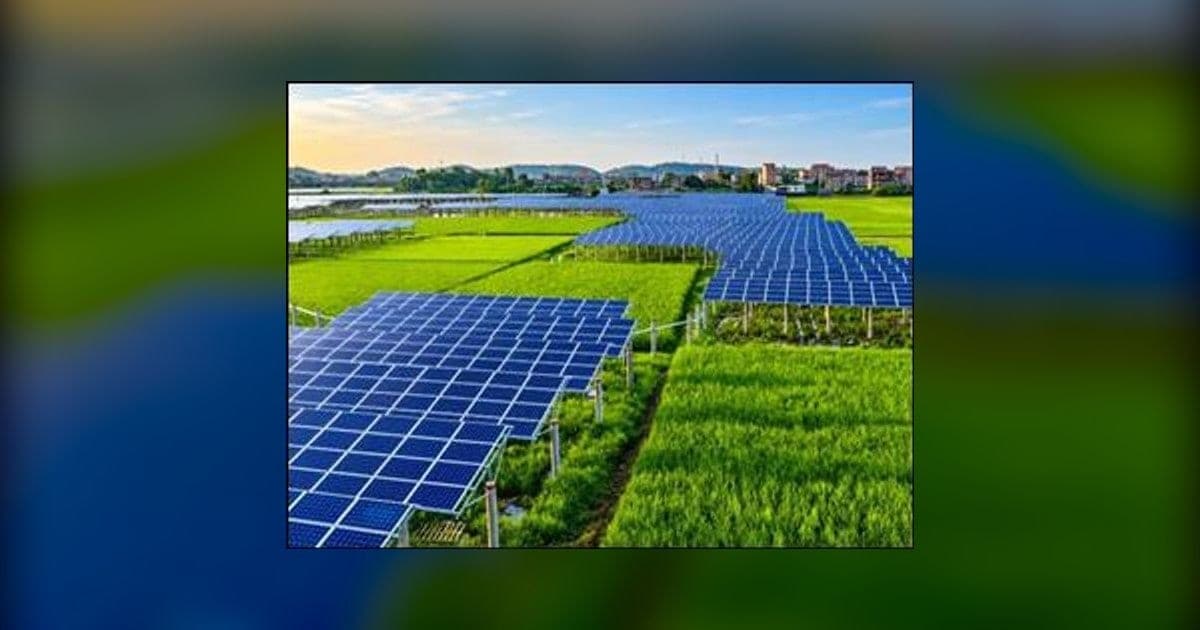
Agrivoltaics, also called agrisolar or dual-use solar, grows crops and generates solar electricity on the same piece of land. A backgrounder issued by the Press Information Bureau on 2 November 2026 sets out where India stands on this idea, which treats farmland as a source of both food and power rather than one or the other.
Why it matters for Indian farming
Agriculture supports roughly 46.1 per cent of the population, and the Gross Value Added of the agriculture and allied sector is estimated at Rs 52.08 lakh crore in 2025-26. Land Use Statistics for 2023-24 put the reported area at 306.96 million hectares, of which about 55 per cent is agricultural land. The net sown area is 138.99 million hectares and the gross cropped area 217.88 million hectares. That land base is what makes co-location worth attempting at scale.
How a system is built
- Elevated solar structures: panels are mounted high enough for sunlight and rain to reach the crop below, and for farm equipment to pass underneath
- Partial shading: the panels shield plants from extreme heat and cut evaporation from the soil, which helps in hot or dry regions
- Dual land productivity: the same plot yields a crop or supports livestock while supplying power for farm work, with surplus sold to the grid
Where India has reached
As of August 2025 the country had 36 operational agrivoltaic projects with an installed capacity of 37.54 megawatts, and 10 pilot projects under development across different agro-climatic zones, using elevated structures, interspace layouts and tracking systems. Estimates place national potential between 3,000 GW and nearly 14,000 GW. On income, annual earnings in some cases could rise from around Rs 60,000 an acre to more than Rs 1 lakh an acre. A GIS-based national screening identified 47.35 million hectares of restricted cropland as suitable after environmental, agronomic and technical filters.
Which states lead
Maharashtra, Rajasthan, Andhra Pradesh, Madhya Pradesh, Karnataka and Uttar Pradesh together account for nearly half of the estimated generation potential, helped by cropland availability, solar resource and agro-climatic conditions. Odisha, Tamil Nadu, Kerala, Telangana, Bihar and West Bengal show moderate potential. Fruits, vegetables, spices and medicinal plants are the crops judged most compatible with panels overhead.
Government support
| PM KUSUM | Launched in February 2019; central financial assistance of about Rs 34,422 crore for solarisation of farm pumps and decentralised generation |
| Centre of Excellence | Set up by the National Institute of Solar Energy with ICAR's Indian Agricultural Research Institute; includes a 100-kilowatt agrivoltaic system at IARI |
| India Agrivoltaics Alliance | Anchored by the National Solar Energy Federation of India, launched in 2023, now more than 40 members |
| Maharashtra | Mukhyamantri Saur Krushi Vahini Yojana 2.0, for 16,000 MW of solar projects over about 35,000 acres |
| Gujarat | Kisan Suryoday Yojana, daytime farm power for up to 16 hours, from 5 AM to 9 PM |
| Karnataka | Surya Raitha Scheme for solar irrigation pumps with earnings from surplus power |
Important Facts
| Concept | Agrivoltaics, also called agrisolar or dual-use solar: crops and solar power on the same land |
|---|---|
| Operational projects | 36 projects, 37.54 megawatts installed, as of August 2025 |
| Pilot projects | 10 under development |
| National potential | Between 3,000 GW and nearly 14,000 GW |
| Suitable land | 47.35 million hectares of restricted cropland, from a GIS-based screening |
| Farm income | Could rise from about Rs 60,000 an acre to more than Rs 1 lakh an acre |
| PM KUSUM | Launched February 2019; central financial assistance of about Rs 34,422 crore |
| Centre of Excellence | National Institute of Solar Energy with ICAR-IARI; 100-kilowatt system at IARI |
| India Agrivoltaics Alliance | Anchored by NSEFI, launched 2023, more than 40 members |
| Leading states | Maharashtra, Rajasthan, Andhra Pradesh, Madhya Pradesh, Karnataka, Uttar Pradesh |
| Agriculture base | Supports about 46.1 per cent of the population; sector GVA estimated at Rs 52.08 lakh crore in 2025-26 |
Exam Point of View
Remember that agrivoltaics is also called agrisolar or dual-use solar, the count of 36 operational projects and 37.54 MW as of August 2025, the 10 pilot projects, the potential range of 3,000 GW to 14,000 GW, the 47.35 million hectares of suitable restricted cropland, PM KUSUM of February 2019 with about Rs 34,422 crore of central assistance, the Centre of Excellence under NISE with ICAR-IARI and its 100-kilowatt system, the India Agrivoltaics Alliance anchored by NSEFI since 2023, and the state schemes of Maharashtra, Gujarat and Karnataka.
Practice Questions
As of August 2025, how many operational agrivoltaic projects did India have and of what installed capacity?
- A.26 projects of 27.54 megawatts
- B.36 projects of 37.54 megawatts
- C.46 projects of 47.54 megawatts
- D.36 projects of 137.54 megawatts
Show answer
That was India’s operational agrivoltaic fleet as of August 2025, and alongside it 10 pilot projects were under development. These projects are spread across different agro-climatic regions and use elevated structures, interspace layouts and tracking systems.
Read the full explanation →Which of the following is another name used for agrivoltaics?
- A.Floating solar
- B.Dual-use solar
- C.Concentrated solar power
- D.Rooftop solar
Show answer
Agrivoltaics is also known as agrisolar or dual-use solar, the names pointing to the same idea of one plot of land serving two purposes, growing a crop and generating electricity.
Read the full explanation →PM KUSUM, which promotes solar energy in agriculture, was launched in which month and year?
- A.February 2019
- B.February 2015
- C.August 2020
- D.January 2023
Show answer
The Pradhan Mantri Kisan Urja Suraksha evam Utthaan Mahabhiyan, shortened to PM KUSUM, was launched then to push solar adoption in farming, cut dependence on diesel and let farmers diversify their earnings.
Read the full explanation →Frequently Asked Questions
What is agrivoltaics?
The practice of growing crops and generating solar electricity on the same land, also called agrisolar or dual-use solar. Panels are raised on elevated structures so sunlight, rain and farm machinery can still reach the crop below.
How many agrivoltaic projects does India have?
As of August 2025 India had 36 operational agrivoltaic projects with an installed capacity of 37.54 megawatts, along with 10 pilot projects under development across different agro-climatic regions.
What is India’s estimated agrivoltaic potential?
Estimates place it between 3,000 GW and nearly 14,000 GW. A GIS-based national screening identified 47.35 million hectares of restricted cropland as suitable after environmental, agronomic and technical filters.
Which scheme supports solar energy in agriculture?
PM KUSUM, launched in February 2019, with central financial assistance of about Rs 34,422 crore for solarising agricultural pumps and decentralised generation. State schemes include Maharashtra’s Mukhyamantri Saur Krushi Vahini Yojana 2.0 and Gujarat’s Kisan Suryoday Yojana.
Sources
- https://www.pib.gov.in/PressReleasePage.aspx?PRID=2331552 (opens in a new tab) — Press Information Bureau
Current Affairs 2 November 2026
- India-EU Talks: Commerce Secretary Rajesh Agrawal Meets EC OfficialsInternational
- Sacred Piprahwa Buddha Relics Reach Tawang Monastery in ArunachalNational
- Sikkim Dairy Projects Worth Rs 251.56 Lakh Under White Revolution 2.0Government Schemes
- MoD Signs Rs 53,866.50 Crore Deal for 8 Next Generation CorvettesDefence
- Captive and Commercial Coal Mines Produce 22.03 MT in October 2026Economy
- VB-G RAM G Grievance Redressal Rules, 2026 Notified for Rural JobsGovernment Schemes
- Khet Bachaao Abhiyaan-Rabi 2026 Covers 700 Districts, 50 Lakh FarmersGovernment Schemes
- JanHIT: First National Orientation of Tribal Healers at HyderabadNational
Related Current Affairs
- Environment
PM Surya Ghar, PM-KUSUM Drive Solar Push Towards 500 GW Target
2 November 2026 · 2 min read
- Environment
Delhi Logs Best October Air Quality in Eight Years at AQI 166
31 October 2026 · 2 min read




Related GK
- Famous Personalities of Rajasthan: Exam Notes
28 October 2026 · Rajasthan
- Districts and Divisions of Rajasthan: Exam Notes
28 October 2026 · Rajasthan
- Tourism and World Heritage Sites of Rajasthan Notes
27 October 2026 · Rajasthan
Take the Quiz
- Current Affairs Quiz
Banking Current Affairs Quiz: 2 November 2026
25 questions25 minutesStart Quiz