
Delhi Winter Air Plan: 37 Hotspots and No PUCC, No Fuel Drive
Bhupender Yadav and Delhi CM Rekha Gupta reviewed the capital's air pollution plan and cleared winter curbs covering 37 hotspots and 500 fuel stations.
Why in News
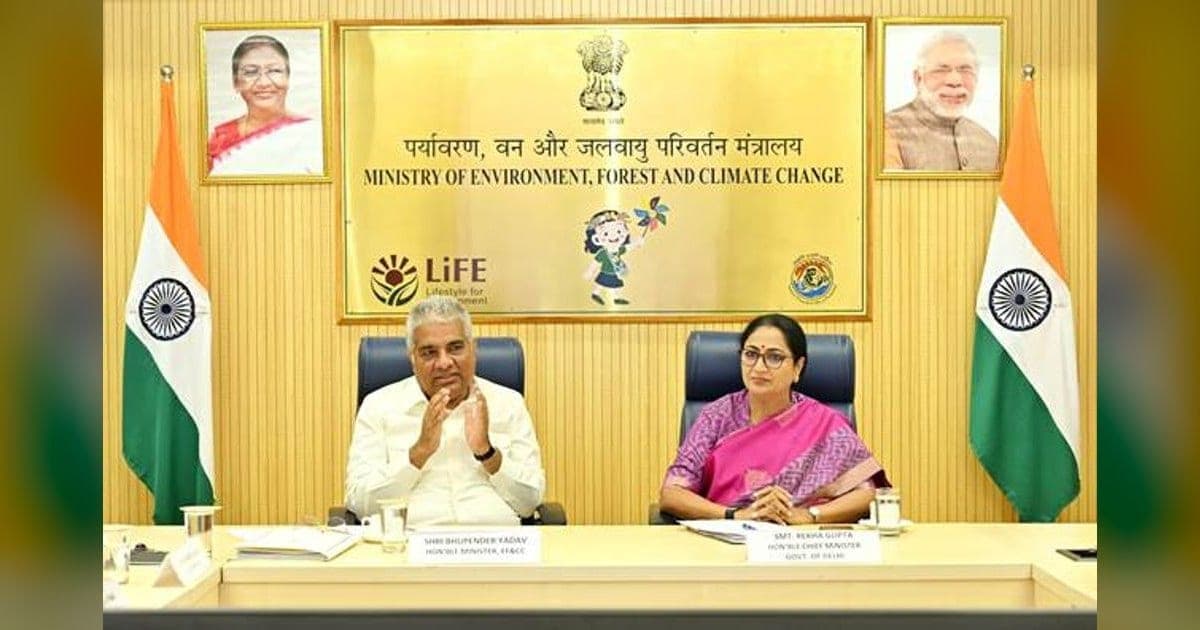
On 28 September 2026 the Union Environment Minister reviewed Delhi's air pollution plan with the Chief Minister and finalised an outcome-oriented strategy of winter curbs, hotspot action and citizen participation.
Union Minister for Environment, Forest and Climate Change Shri Bhupender Yadav chaired a high-level meeting with Delhi Chief Minister Smt. Rekha Gupta to go through the capital's Air Pollution Mitigation Action Plan and settle what more is needed before winter. Delhi's Environment Minister Sardar Manjinder Singh Sirsa and PWD Minister Shri Pravesh Sahib Singh also attended, along with the CAQM Chairman Shri Rajesh Verma and officials of CPCB, DPCC, MCD, NDMC, DDA and Delhi Metro.
Hotspots and fuel stations
Jan Bhagidari events are to be held at the 37 identified hotspots in the city by October 10, with action points drawn up for each and their progress watched closely. Of the air quality and traffic hotspots, 42 have already been set right and eight more are targeted this month. The 'No PUCC, No Fuel' rule will be enforced in mission mode at all 500 fuel stations fitted with automatic number plate recognition, with penalties for pumps that ignore it.
Transport and roads
A city-wide drive from October 1 to 10 will push the Delhi Metro Sarthi App, with download camps run alongside resident welfare associations. Last-mile connectivity is available at all 228 Metro stations, and the bus fleet has reached 6,840 vehicles, of which 5,088 are electric. Road redevelopment covers 1,193 km so far, with the rest due by November 15; complaints are to be shut within 72 hours. Eight road stretches have been made signal-free and seven more are targeted.
Waste, greening and industry
Material recovery and segregation facilities have gone up to 98 from 76 a year earlier, and ward-level teams are to be in place by October 15 to stop open burning. Delhi reported 71 lakh plantations and the greening of 433 of 434 acres of identified brown areas. Air quality monitoring stations will rise from 47 to 60, an AI-enabled command and control centre will be made operational, and 334 enforcement teams will act against polluting industries.
Winter curbs
Dust-generating demolition and outdoor civil construction will be barred from November 1 to January 31, with a complete ban on construction and demolition between December 10 and January 20. Parking charges will be doubled, office timings staggered and work from home allowed for half the staff. From 1 November, vehicles registered outside Delhi that fall below BS-VI standards will not be allowed in, except CNG and electric ones.
Important Facts
| Chaired by | Shri Bhupender Yadav, Union Minister for Environment, Forest and Climate Change |
|---|---|
| Delhi Chief Minister | Smt. Rekha Gupta |
| Identified hotspots | 37, with Jan Bhagidari events by October 10 |
| Hotspots rectified | 42, with eight more targeted |
| Fuel stations under 'No PUCC, No Fuel' | 500 ANPR-enabled stations |
| Bus fleet | 6,840 buses, including 5,088 e-buses |
| Metro stations with last-mile link | 228 |
| Road redevelopment | 1,193 km completed; rest by November 15 |
| Greening | 71 lakh plantations; 433 of 434 acres of brown areas greened |
| Monitoring stations | To rise from 47 to 60 |
| Enforcement teams | 334 teams against polluting industries |
| Construction ban | Complete ban from December 10 to January 20 |
Exam Point of View
Remember the two people who chaired and attended, the 37 hotspots and the October 10 deadline, the 500 ANPR fuel stations under 'No PUCC, No Fuel', the bus fleet of 6,840 with 5,088 e-buses, the 228 Metro stations, the construction bans and the rise in monitoring stations from 47 to 60.
Practice Questions
How many pollution hotspots have been identified in Delhi under the air pollution mitigation plan reviewed recently?
- A.13
- B.24
- C.37
- D.52
Show answer
Correct answer: C. 37
Explanation
The correct answer is 37. The Union Environment Minister asked that Jan Bhagidari events be organised at all thirty-seven identified hotspots in the capital by October 10, with relevant stakeholders taking part, and that a set of action points be drawn up for each one and its implementation watched closely. Public representatives are to visit these places and see for themselves how the measures are working on the ground. The options of thirteen, twenty-four and fifty-two are wrong because no such count was given for identified hotspots. A separate figure does appear in the plan, however: forty-two air quality and traffic hotspots have already been rectified, with eight more targeted during October, so the two numbers should not be confused with each other.
The 'No PUCC, No Fuel' rule is to be enforced in mission mode at how many fuel stations in Delhi?
- A.250
- B.350
- C.500
- D.750
Show answer
Correct answer: C. 500
Explanation
The correct answer is 500. The rule denies fuel to a vehicle that has no valid pollution under control certificate, and it is to be applied in mission mode through a city-wide awareness and enforcement campaign at every fuel station equipped with automatic number plate recognition, of which there are five hundred. Pumps that fail to apply the rule will face action. The options of two hundred and fifty, three hundred and fifty and seven hundred and fifty are all wrong because they do not match the count of camera-enabled stations named in the plan. Other transport measures cleared at the same meeting include a campaign for the Delhi Metro Sarthi App and last-mile connectivity at all 228 Metro stations.
How many electric buses are there in Delhi's bus fleet, as reported at the review meeting?
- A.3,420
- B.4,200
- C.5,088
- D.6,840
Show answer
Correct answer: C. 5,088
Explanation
The correct answer is 5,088. Delhi's bus fleet has grown to six thousand eight hundred and forty vehicles in all, and of these five thousand and eighty-eight run on electricity, which makes electric buses the larger part of the fleet. The option of six thousand eight hundred and forty is the trap here: that is the size of the whole fleet, not the count of electric buses alone, so a candidate who reads the question quickly is likely to pick it. The options of three thousand four hundred and twenty and four thousand two hundred are wrong because neither figure appears in the plan. Promoting public transport was listed among the measures, along with last-mile connectivity at every Metro station.
Frequently Asked Questions
How many pollution hotspots have been identified in Delhi?
37 hotspots have been identified, and Jan Bhagidari events are to be organised at each of them by October 10. Separately, 42 air quality and traffic hotspots have been rectified.
What is the 'No PUCC, No Fuel' measure?
It denies fuel to vehicles without a pollution under control certificate. It will be enforced in mission mode at all 500 fuel stations fitted with automatic number plate recognition, with action against defaulting pumps.
How large is Delhi's bus fleet?
The fleet has reached 6,840 buses, of which 5,088 are electric. Last-mile connectivity is available at all 228 Metro stations, and a campaign will promote the Delhi Metro Sarthi App.
Sources
Current Affairs 28 September 2026
- PM-AJAY: 18,093 Villages Declared Adarsh Gram by September 2026Government Schemes
- KAZIND-2026: Indian Contingent Departs for Kazakhstan ExerciseDefence
- PM-MKSSY Bears 40% of Aquaculture Insurance Premium CostGovernment Schemes
- Sadhana Shrinkhla 2026: Four Workshops on Training InstitutesSummits & Conferences
- PM E-DRIVE: GARC Gets Rs 221.13 Crore for EV TestingScience & Technology
- Swachhata Hi Seva 2026: 10th Edition Ends on 2 OctoberNational
- 46th FIDE Chess Olympiad: PM Hails Indian PlayersSports
- India-France Space Ties Widen to Gaganyaan, TRISHNA and Start-upsScience & Technology
Related Current Affairs
- Environment
India's First Port-Based e-Methanol Plant Comes Up at Kandla
26 September 2026 · 2 min read
- Environment
NRAA Holds REWARD Meeting on Watershed Guidelines for PMKSY
23 September 2026 · 2 min read
- Environment
Swachh Sagar Surakshit Sagar 5.0: 15 Lakh Take Ocean Pledge
21 September 2026 · 2 min read
Related GK
- International Organisations and Headquarters: Full List
28 September 2026 · Static GK
- Space Agencies and Missions of the World: Exam Notes
28 September 2026 · Science & Technology
- Haryana GK: Formation, Geography, History and Facts
28 September 2026 · Indian States & UTs
Take the Quiz
- Current Affairs Quiz
State Exams Current Affairs Quiz: 28 September 2026
25 questions25 minutesStart Quiz