
India-MERCOSUR PTA: Protocol Signed, Expansion Talks Begin
India and MERCOSUR signed the First Additional Protocol to their Preferential Trade Agreement for electronic Certificates of Origin and launched talks to expand the pact.
Why in News
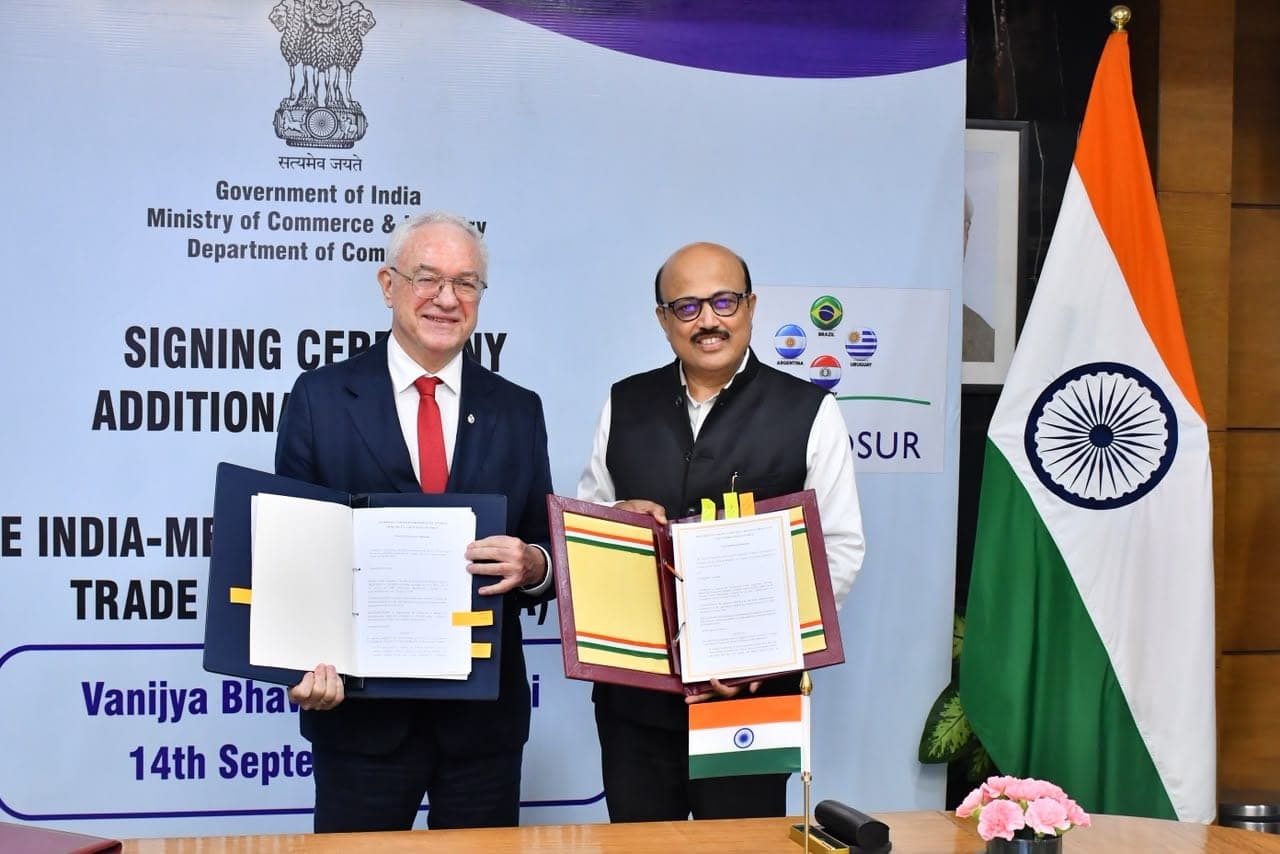
On 14 September 2026 India and MERCOSUR signed the First Additional Protocol to their Preferential Trade Agreement, allowing electronic Certificates of Origin, and announced the launch of negotiations to expand the agreement.
India and MERCOSUR took two steps on their trade pact on the same day. They signed the First Additional Protocol to the India-MERCOSUR Preferential Trade Agreement. They also announced the launch of negotiations to widen that agreement. MERCOSUR is the South American trade bloc whose members include Argentina, Brazil, Paraguay and Uruguay.
What the Protocol does
The Protocol allows Certificates of Origin issued in electronic form to be accepted. Such a certificate will now carry the same legal validity as one issued on paper. It must be issued and signed electronically by authorised officials under each side's own law. The Protocol amends Article 16 of Annex III of the agreement, which holds the Rules of Origin. The change is meant to cut the cost and the time taken to issue and verify these certificates. It will come into force once both sides finish their internal procedures and inform each other.
Who signed it
Commerce Secretary Rajesh Agarwal signed for India. Alberto Guani, the Ambassador of Uruguay to India, and Fleming Raul Duarte Ramos, the Ambassador of Paraguay to India, signed for the other side. Mario Lubetkin, Foreign Minister of Uruguay, was present in his capacity as holder of the Pro Tempore Presidency of MERCOSUR. Representatives of the embassies of Argentina and Brazil also attended.
Talks to expand the agreement
Union Commerce and Industry Minister Piyush Goyal and Mario Lubetkin announced the start of negotiations to expand the Preferential Trade Agreement. Both sides agreed to bring in areas of mutual interest so that economic ties deepen and their private sectors gain. They are now finalising the Terms of Reference, which will fix the scope and the structure of the wider agreement.
The agreement in brief
| Agreement | India-MERCOSUR Preferential Trade Agreement |
| Signed on | 25 January 2004 |
| In force from | 1 June 2009 |
| Concessions by India | 450 tariff lines |
| Concessions by MERCOSUR | 452 tariff lines |
| Article amended | Article 16 of Annex III, the Rules of Origin |
How the Protocol came about
The idea came out of the Joint Administrative Committee of the agreement. At its fourth meeting, held on 27 November 2025, both sides backed an update that would let digital Certificates of Origin be used. The proposal for the Additional Protocol was then adopted by mutual consent at the fifth meeting of the Committee, held on 9 April 2026.
Important Facts
| Agreement | India-MERCOSUR Preferential Trade Agreement (PTA) |
|---|---|
| New instrument | First Additional Protocol, for electronic Certificates of Origin |
| Signed for India by | Commerce Secretary Rajesh Agarwal |
| Signed for MERCOSUR by | Ambassadors of Uruguay and Paraguay to India |
| In the presence of | Mario Lubetkin, Foreign Minister of Uruguay |
| MERCOSUR Pro Tempore Presidency | Held by Uruguay |
| PTA signed on | 25 January 2004 |
| PTA in force from | 1 June 2009 |
| Tariff lines | 450 by India, 452 by MERCOSUR |
| Expansion talks | Announced by Piyush Goyal and Mario Lubetkin |
Exam Point of View
Remember that MERCOSUR is the South American bloc, the year the PTA was signed (2004) and entered into force (2009), the tariff lines on each side (450 and 452), the article amended (Article 16 of Annex III) and the names of the Commerce Secretary and the Commerce Minister.
Practice Questions
The First Additional Protocol signed between India and MERCOSUR relates mainly to which of the following?
- A.Acceptance of electronic Certificates of Origin
- B.Removal of all tariffs on farm produce
- C.A common currency for bilateral trade
- D.Mutual recognition of academic degrees
Show answer
Correct answer: A. Acceptance of electronic Certificates of Origin
Explanation
The correct answer is the acceptance of electronic Certificates of Origin. The Protocol provides that a Certificate of Origin issued in electronic form will carry the same legal validity and value as one issued on paper, provided it is issued and signed electronically by duly authorised entities and officials under each side's own domestic law. It does this by amending Article 16 of Annex III of the Preferential Trade Agreement, the annex that holds the Rules of Origin, and it is expected to cut transaction costs and the time spent on issuing and verifying such certificates. Option B is wrong because the Protocol does not touch tariff rates at all; the concessions under the agreement remain at 450 tariff lines on the Indian side and 452 on the MERCOSUR side. Option C is wrong because no currency arrangement was announced. Option D is wrong because education was not part of this trade instrument, which is concerned with paperless trade and modern customs procedures.
When did the India-MERCOSUR Preferential Trade Agreement enter into force?
- A.25 January 2004
- B.1 June 2009
- C.27 November 2025
- D.9 April 2026
Show answer
Correct answer: B. 1 June 2009
Explanation
The correct answer is 1 June 2009. Candidates must keep two dates apart here, because both appear in the same sentence of the release. Option A, 25 January 2004, is the date on which the Preferential Trade Agreement was signed, and a gap of more than five years separated signature from entry into force. Option C is wrong because 27 November 2025 was the date of the fourth meeting of the Joint Administrative Committee of the agreement, where both sides first supported the idea of allowing digital Certificates of Origin. Option D is wrong because 9 April 2026 was the date of the fifth meeting of the same Committee, at which the proposal for the Additional Protocol was adopted by mutual consent. Reading the four dates as a single sequence helps: signed in 2004, in force in 2009, idea supported in 2025, proposal adopted in 2026 and the Protocol signed in September 2026.
Who signed the First Additional Protocol on behalf of the Government of India?
- A.Commerce and Industry Minister Piyush Goyal
- B.Commerce Secretary Rajesh Agarwal
- C.Foreign Minister Mario Lubetkin
- D.Ambassador Alberto Guani
Show answer
Correct answer: B. Commerce Secretary Rajesh Agarwal
Explanation
The correct answer is Commerce Secretary Rajesh Agarwal, who signed for the Government of India. Option A is wrong, and it is the trap in this question: Piyush Goyal, the Union Minister of Commerce and Industry, features in the same day's news, but his role was to announce jointly with Uruguay the launch of negotiations for expanding the Preferential Trade Agreement, not to sign the Protocol. Option C is wrong because Mario Lubetkin, the Foreign Minister of Uruguay, was present in the exercise of the Pro Tempore Presidency of MERCOSUR and witnessed the signing rather than signing himself. Option D is wrong in a different way: Alberto Guani, the Ambassador of Uruguay to India, did sign, but for the MERCOSUR side and not for India, along with Fleming Raul Duarte Ramos, the Ambassador of Paraguay. Representatives from the embassies of Argentina and Brazil were also present at the ceremony.
Frequently Asked Questions
What does the First Additional Protocol between India and MERCOSUR do?
It allows Certificates of Origin issued in electronic format to have the same legal validity as paper ones, by amending Article 16 of Annex III of the Preferential Trade Agreement.
When was the India-MERCOSUR Preferential Trade Agreement signed?
It was signed on 25 January 2004 and entered into force on 1 June 2009. India gives concessions on 450 tariff lines and MERCOSUR on 452 tariff lines.
Who announced the launch of talks to expand the agreement?
Union Commerce and Industry Minister Piyush Goyal along with Mario Lubetkin, Foreign Minister of Uruguay, which holds the Pro Tempore Presidency of MERCOSUR.
Sources
Current Affairs 14 September 2026
- Indian Women's Cricket Team Wins the Asia Cup TitleSports
- Hindi Diwas 2026: Amit Shah Opens 6th Rajbhasha ConferenceImportant Days
- Retail Inflation at 4.82 Percent in August 2026: CPI DataEconomy
- WPI Inflation Rises to 9.92 Percent in August 2026Economy
- IAF Opens First Dronathon-2026 at Pokhran Firing RangeDefence
- INS Mysore Ends Exercise Samudra Laksamana in MalaysiaDefence
- Great Indian Bustard Soft Release Centre Opens in KachchhEnvironment
Related Current Affairs
- International
India-France Space Talks Ahead of Paris International Space Summit
23 September 2026 · 2 min read
- International
India-Belgium Joint Statement: Defence LoI and Investment Track
23 September 2026 · 2 min read
- International
India–New Zealand FTA to Enter into Force on 20 October 2026
22 September 2026 · 2 min read
Related GK
- Fundamental Rights (Articles 12–35): Notes, Writs and PYQs
23 September 2026 · Indian Polity
- Preamble of the Indian Constitution: Notes, Keywords and PYQs
22 September 2026 · Indian Polity
- Making of the Indian Constitution: Notes, Key Dates and PYQs
21 September 2026 · Indian Polity
Take the Quiz
- Current Affairs Quiz
Railway Weekly Current Affairs Quiz: 14–20 September 2026
30 questions30 minutesStart Quiz