
RRI Study Tunes Kinetic Magnetism Using Lattice Geometry
Raman Research Institute scientists showed that changing a lattice's connectivity can tune kinetic magnetism, opening a route to storing quantum information.
Why in News
On 20 November 2026 the Department of Science and Technology announced that Raman Research Institute scientists had shown how the magnetic ordering of a quantum network can be tuned by changing its connectivity, a finding published in Physical Review B.
Scientists at the Raman Research Institute (RRI), an autonomous institute of the Department of Science and Technology (DST), have found a way to control an exotic form of quantum magnetism simply by altering how a network of quantum objects is connected. The work was announced on 20 November 2026 and has been published in the journal Physical Review B.
The system studied
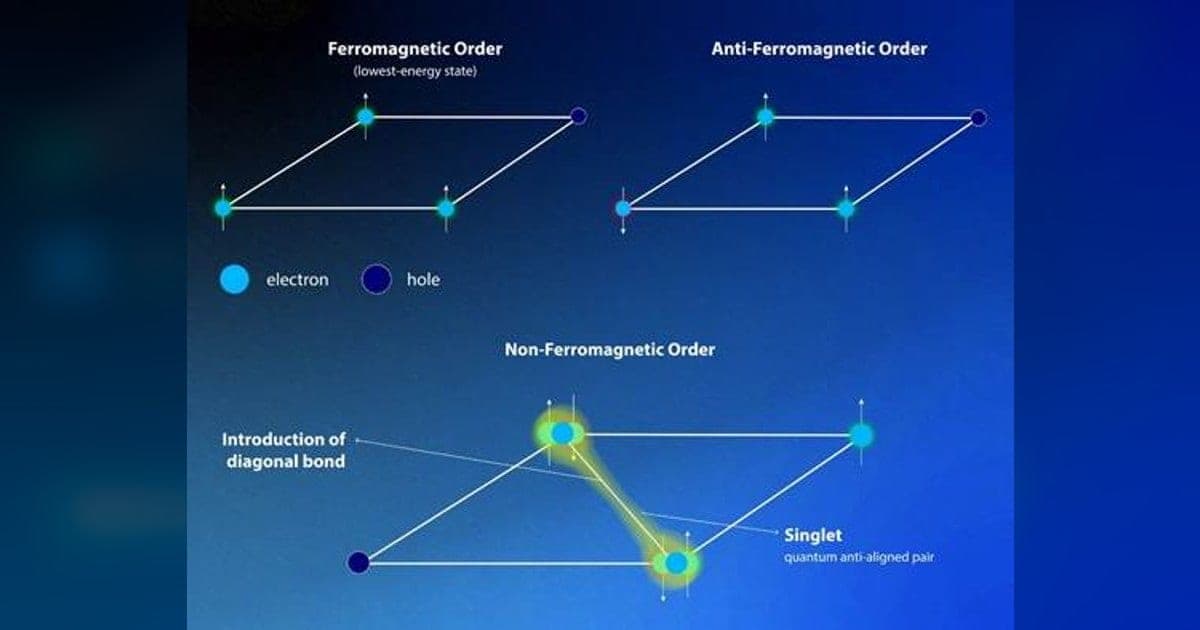
The team imagined a square lattice in which every site holds one electron except for a single vacant site, called a hole. Electrons carry an intrinsic property called spin, which may point up or down. As the hole hops from site to site, its motion decides how the surrounding spins line up. The magnetism that results is named kinetic magnetism, because it comes from the quantum motion, or kinetic energy, of the particles rather than from direct interaction between spins as in ordinary magnetism. It has no counterpart in classical physics.
What the researchers found
When all the spins point the same way the order is ferromagnetic, and when neighbouring spins point opposite ways it is antiferromagnetic. For a square lattice holding one hole, the lowest-energy state had already been shown to be ferromagnetic. Revathy B. S., a postdoctoral fellow at RRI and the lead author, and Shovan Dutta, assistant professor in the institute's Theoretical Physics group, showed that adding a single diagonal bond to the lattice forces the two electrons involved into anti-aligned spins, forming what physicists call a singlet. The rest of the lattice keeps its ferromagnetic order while the hole goes on hopping. By placing diagonal bonds the researchers could therefore engineer the global magnetic order through geometry alone, something that does not happen in a classical system.
Why it was hard
The sheer number of possibilities had kept physicists away from this problem for decades: a lattice of just 20 sites allows about two million configurations. The pair combined advanced numerical and analytical methods to uncover the microscopic patterns and explain their origin.
Why it matters
Ordinary hard drives use magnetic patterns to hold information, but only as classical bits. The singlets created in these networks are entangled quantum states, so they could be used to store quantum information. Although the study is theoretical, experiments are nearing the stage where such predictions can be tested.
Important Facts
| Institute | Raman Research Institute (RRI), an autonomous institute of the Department of Science and Technology |
|---|---|
| Researchers | Revathy B. S. (lead author) and Shovan Dutta, Theoretical Physics group, RRI |
| Journal | Physical Review B |
| Concept | Kinetic magnetism, which arises from the quantum motion of particles |
| System modelled | A square lattice with one vacant site (hole) and one electron on every other site |
| Key result | A diagonal bond forces two spins to anti-align, creating a singlet, while the rest stays ferromagnetic |
| Computational scale | A lattice of 20 sites allows about two million configurations |
| Possible use | Storing quantum information, since singlets are entangled quantum states |
| Ministry | Ministry of Science and Technology |
Exam Point of View
Remember the institute (Raman Research Institute, an autonomous institute of DST), the researchers (Revathy B. S. and Shovan Dutta), the journal (Physical Review B), the term kinetic magnetism and that it comes from quantum motion rather than spin interaction, and that a diagonal bond in a square lattice creates a singlet of anti-aligned, entangled spins.
Practice Questions
Scientists of which institute showed that quantum magnetism can be tuned by changing a network's connectivity?
- A.Raman Research Institute
- B.Indian Institute of Astrophysics
- C.Birbal Sahni Institute of Palaeosciences
- D.Saha Institute of Nuclear Physics
Show answer
Its researchers Revathy B. S., a postdoctoral fellow, and Shovan Dutta, assistant professor in the institute's Theoretical Physics group, showed that the magnetic ordering of a lattice of interacting electrons can be changed by altering the connectivity of the lattice, and published the result in Physical Review B. Option B…
Read the full explanation →Kinetic magnetism, as described in the study, arises from:
- A.Direct interaction between neighbouring spins
- B.The quantum motion of particles
- C.An external magnetic field
- D.Heating the lattice
Show answer
In the system the researchers modelled, a single vacant site, or hole, hops through a square lattice in which every other site carries one electron, and this motion decides how the electron spins arrange themselves.
Read the full explanation →What forms when a diagonal bond is introduced into the square lattice studied by the RRI team?
- A.A singlet, a pair of anti-aligned spins
- B.A fully antiferromagnetic lattice
- C.A second hole in the lattice
- D.A classical magnetic bit
Show answer
Adding a diagonal bond to the square lattice forces the two electrons it connects into opposite spin directions, and physicists call such a quantum-mechanically anti-aligned pair a singlet.
Read the full explanation →Frequently Asked Questions
What is kinetic magnetism?
It is a form of magnetism that arises from the quantum motion, or kinetic energy, of particles rather than from direct interaction between their spins, as happens in conventional magnetism. It is a purely quantum-mechanical effect with no classical counterpart, and in the RRI study it appears as a hole hops through a lattice of electrons.
What happens when a diagonal bond is added to the square lattice?
The two electrons involved take up anti-aligned spins and form a singlet, an anti-aligned pair, while the remaining sites keep their ferromagnetic order and the hole continues to hop. By placing such bonds the researchers could engineer the global magnetic order through geometry alone.
Which institute did the research and where was it published?
The Raman Research Institute, an autonomous institute of the Department of Science and Technology, carried out the work. Revathy B. S. was the lead author and Shovan Dutta the co-author, and the findings appeared in the journal Physical Review B.
Sources
- https://pib.gov.in/PressReleasePage.aspx?PRID=2339007 (opens in a new tab) — Press Information Bureau
Current Affairs 20 November 2026
- Swachh Shauchalay Garimamay Bhavishya Campaign Launched by DDWSGovernment Schemes
- CGST Faridabad Seizes Four Pan Masala Machines in RewariEconomy
- Cheetah KOMG 3 Has Four Cubs, India's Cheetah Count Hits 62Environment
- Basmati Rice Exports Rise 25.4% to US$ 1.60 Billion in Half-YearEconomy
- Aadi Mahotsav 2026 at Dilli Haat With 115 Tribal StallsNational
- World Television Day: India's Analogue to Digital TV JourneyImportant Days
- NFDC Ties Up With Svayam for Accessible 57th IFFI in GoaNational
- MeitY Holds Talks With UN Rapporteur Heba Hagrass on AccessInternational
Related Current Affairs
- Science & Technology
BRIC Targets $300 Billion Bioeconomy by 2030, $1 Trillion 2047
21 November 2026 · 2 min read
- Science & Technology
BHASHINI Shows Multilingual AI for Health at GDHS 2026
21 November 2026 · 2 min read
- Science & Technology
India's First Indigenous H5N1 Bird Flu Vaccine Released at Bhopal
20 November 2026 · 2 min read
- Science & Technology
BSIP Study Finds Climate Clues in Himalayan Marmot Droppings
19 November 2026 · 2 min read
- Science & Technology
BHASHINI Shows Voice-First Language AI at Dakshin Day 2026
19 November 2026 · 2 min read
- Science & Technology
CSIR Transfers Bio-Bitumen and UHPC Road Technologies to Industry
19 November 2026 · 2 min read


Related GK
- Famous Personalities of Rajasthan: Exam Notes
28 October 2026 · Rajasthan
- Districts and Divisions of Rajasthan: Exam Notes
28 October 2026 · Rajasthan
- Tourism and World Heritage Sites of Rajasthan Notes
27 October 2026 · Rajasthan
Take the Quiz
- Current Affairs Quiz
State Exams Current Affairs Quiz: 20 November 2026
25 questions25 minutesStart Quiz