
Retail Inflation Climbs to 5.54% in September 2026
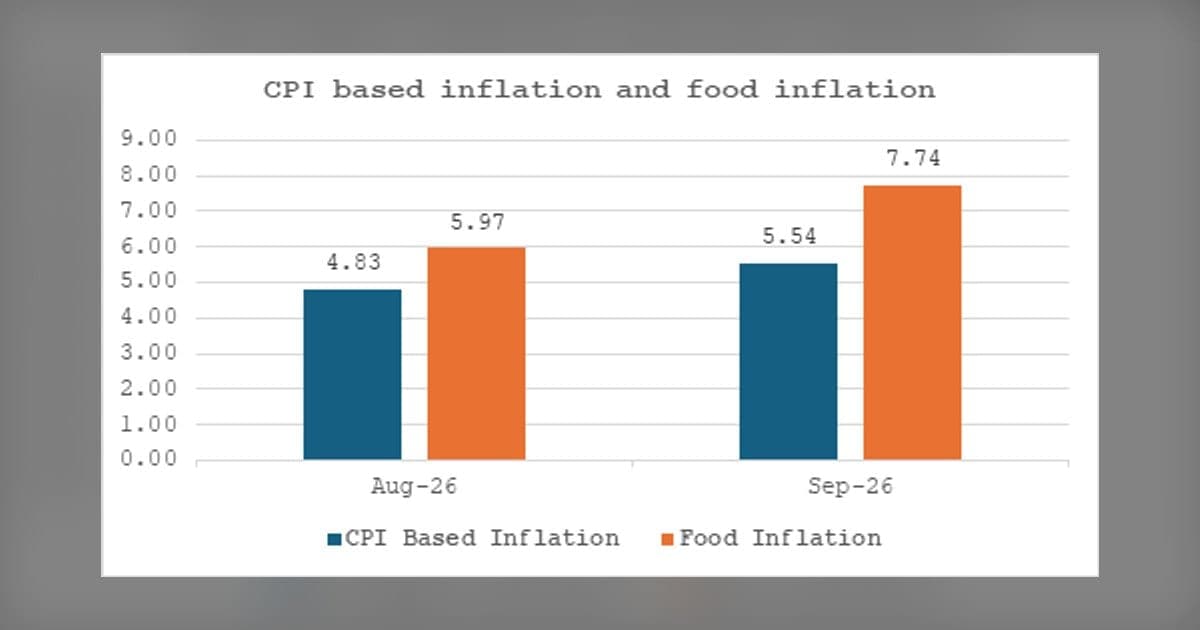
Retail inflation measured by the Consumer Price Index stood at 5.54% in September 2026, with food inflation at 7.74% and rural prices rising faster than urban.
Why in News
The Ministry of Statistics and Programme Implementation released the Consumer Price Index for September 2026 on 12 October 2026, showing retail inflation at 5.54 per cent and food inflation at 7.74 per cent.
The Ministry of Statistics and Programme Implementation released the Consumer Price Index (CPI) for September 2026 on 12 October 2026. Retail inflation, measured year on year against September 2025, stood at 5.54 per cent on a provisional basis, higher than the rate recorded for August 2026. The index is compiled on the revised base year 2024=100.
Rural and urban split
Villages saw sharper price pressure than cities. Rural inflation came in at 6.08 per cent against urban inflation of 4.88 per cent. The gap of more than a percentage point is the detail most often set as a question, because the rural rate is the higher of the two this month and the combined figure sits between them.
Food prices
Inflation measured by the Consumer Food Price Index (CFPI) reached 7.74 per cent, well above the headline rate, which makes food the main engine of the month's rise. Rural food inflation was 8.06 per cent and urban food inflation 7.18 per cent, so in villages the food basket rose above eight per cent. Among the key items tracked, onion recorded the sharpest increase, followed by silver jewellery, ginger, garlic and lemon. At the other end, prices fell for potato, tomato, motor car and jeep, lady's finger and coconut, with potato and tomato showing the steepest declines of the five.
Where prices rose fastest
Across the divisions of the index, personal care, social protection and miscellaneous goods and services showed the steepest rise, followed by restaurants and accommodation services; health recorded one of the mildest increases, and the purchase of vehicles actually turned cheaper. The release carries four annexures with division-wise, group-wise and state-wise indices, and among the larger states the higher headline rates were reported by Madhya Pradesh, Odisha, Tamil Nadu, Telangana and Puducherry, while Mizoram and Nagaland were at the lower end.
How the data is gathered
Field staff of the Field Operations Division of the National Statistical Office collect prices every week on a fixed roster from 1,407 urban markets, online markets included, and 1,465 villages spread across all states and union territories. The response rate in September 2026 was 100 per cent in both rural and urban markets. The reference date for petrol, diesel and LPG prices is the fifteenth of the month. Indices are worked out from unrounded values and published to two decimal places, so a higher-level index recalculated from the published figures may differ slightly. State-level item indices are available on the eSankhyiki portal and are to be read with care, since some items rest on thin samples of price quotations. The index for October 2026 is due on 12 November 2026.
Important Facts
| Month | September 2026 (provisional) |
|---|---|
| CPI inflation | 5.54 per cent, year on year over September 2025 |
| Rural and urban | 6.08 per cent and 4.88 per cent |
| Food inflation (CFPI) | 7.74 per cent |
| Rural and urban food inflation | 8.06 per cent and 7.18 per cent |
| Base year | 2024=100 |
| Highest item inflation | Onion, followed by silver jewellery, ginger, garlic and lemon |
| Items that got cheaper | Potato, tomato, motor car and jeep, lady's finger, coconut |
| Sample | 1,407 urban markets and 1,465 villages, all states and UTs |
| Response rate | 100 per cent in both rural and urban markets |
| Released by | National Statistical Office, Ministry of Statistics and Programme Implementation |
| Next release | 12 November 2026, for October 2026 |
Exam Point of View
Remember the headline rate (5.54 per cent), food inflation (7.74 per cent), the rural and urban rates (6.08 and 4.88 per cent), rural and urban food inflation (8.06 and 7.18 per cent), the base year (2024=100), the costliest item (onion), the sample (1,407 urban markets and 1,465 villages) and the compiling body (National Statistical Office under the Ministry of Statistics and Programme Implementation).
Practice Questions
What was India's retail inflation rate based on the Consumer Price Index in September 2026?
- A.4.83%
- B.5.54%
- C.6.08%
- D.7.74%
Show answer
Explanation
The correct answer is 5.54 per cent, the provisional year-on-year rate for September 2026 measured against September 2025 at the all-India combined level. Option A, 4.83 per cent, was the rate for the previous month, August 2026, so it is the classic trap for anyone who recalls the direction of the move but not the latest number. Option C, 6.08 per cent, is the rural rate for September 2026 rather than the combined rate; prices in villages rose faster than in cities, where the rate was 4.88 per cent, and the combined figure sits between the two. Option D, 7.74 per cent, is food inflation measured by the Consumer Food Price Index, a separate series that ran above the headline number this month. Candidates should also note that the index is compiled on the revised base year of 2024 equal to 100.
Which item recorded the highest rate of inflation at the all-India combined level in September 2026?
- A.Garlic
- B.Silver jewellery
- C.Onion
- D.Ginger
Show answer
Explanation
The correct answer is onion, which topped the list of key items by inflation rate for the month, with prices roughly doubling over the year. Option B, silver jewellery, came second and had been ahead of onion a month earlier, which makes it the strongest distractor of the four. Option D, ginger, was third and option A, garlic, fourth, while lemon completed the list of the five costliest items. It is worth remembering the other side of the table as well, because questions are set on both: potato and tomato prices fell the most, and motor car and jeep, lady's finger and coconut also turned cheaper over the year. These item movements help explain why food inflation, measured by the Consumer Food Price Index at 7.74 per cent, outran the headline rate of 5.54 per cent for the month.
Which organisation collects the price data used to compile India's Consumer Price Index?
- A.Reserve Bank of India
- B.Field Operations Division of the National Statistical Office
- C.Labour Bureau, Shimla
- D.NITI Aayog
Show answer
Explanation
The correct answer is the Field Operations Division of the National Statistical Office, which works under the Ministry of Statistics and Programme Implementation. Its field staff visit selected markets and villages on a weekly roster, covering 1,407 urban markets, including online markets, and 1,465 villages spread across all states and union territories; the response rate in September 2026 was 100 per cent in both the rural and the urban sample. Option A is wrong because the Reserve Bank uses the CPI as the basis for its inflation target but does not compile it. Option C names the office associated with other price index series rather than this one. Option D is wrong because NITI Aayog is a policy body with no role in price collection. Candidates should also note that state and item level indices are published on the eSankhyiki portal and the next release falls on 12 November 2026.
Frequently Asked Questions
What was retail inflation in September 2026?
5.54 per cent year on year, provisional, measured by the Consumer Price Index on base 2024=100 against September 2025. It was higher than the rate for August 2026.
How high was food inflation in September 2026?
The Consumer Food Price Index rose 7.74 per cent year on year, with rural food inflation at 8.06 per cent and urban food inflation at 7.18 per cent.
Which item saw the sharpest price rise?
Onion topped the list of key items, ahead of silver jewellery, ginger, garlic and lemon. Potato and tomato recorded the steepest falls in price.
Who compiles the Consumer Price Index in India?
The National Statistical Office under the Ministry of Statistics and Programme Implementation, using weekly price data from 1,407 urban markets and 1,465 villages.
Sources
- https://www.pib.gov.in/PressReleasePage.aspx?PRID=2322244 (opens in a new tab) — Press Information Bureau
Current Affairs 12 October 2026
- Coal Stocks at Power Plants Stay Above 18 MT in October 2026Economy
- TDB Backs Peptris VIGOR Programme With Rs 86 Crore RDI SupportScience & Technology
- MY Bharat Holds Youth Parliaments at 1,469 Locations in 34 StatesGovernment Schemes
- IGNFA Begins IFS Mid-Career Training for 68 OfficersEnvironment
- Asian Games 2026: Services Athletes Win Record 27 MedalsSports
- Indian Army Launches Bharat Rice for Troops, Signs FCI MoUDefence
- PM GatiShakti at Five: 58 Ministries, 23,493 Data LayersGovernment Schemes
- PM-SETU: Rs 440 Crore Cleared for Nine Government ITIsGovernment Schemes
Related Current Affairs
Related GK
- Uttar Pradesh Location and Physical Divisions for Exams
12 October 2026 · Uttar Pradesh
- Rajasthan Location and Physical Divisions: Extent, Aravalli, Thar
12 October 2026 · Rajasthan
- Madhya Pradesh Location and Physical Divisions for Exams
12 October 2026 · Madhya Pradesh
Take the Quiz
- Current Affairs Quiz
State Exams Current Affairs Quiz: 12 October 2026
25 questions25 minutesStart Quiz