
PLFS Bulletin August 2026: LFPR Rises to 55.6 Per Cent
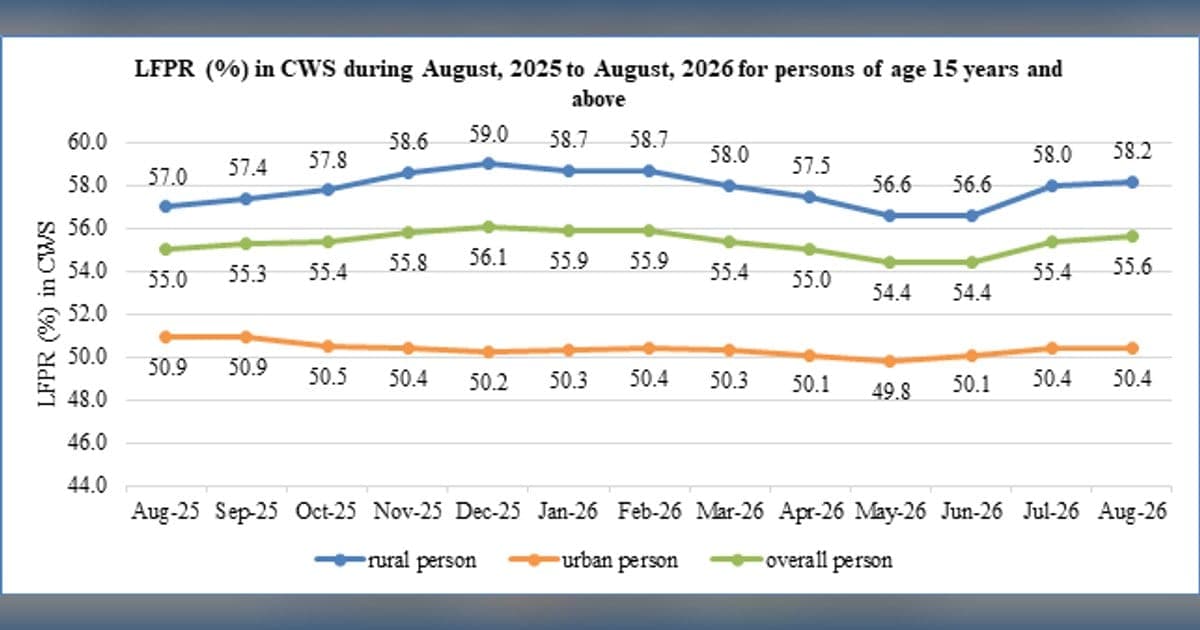
The Periodic Labour Force Survey bulletin for August 2026 put the overall LFPR at 55.6 per cent, the WPR at 52.8 per cent and the unemployment rate at 5.0 per cent.
Why in News
On 15 September 2026 the Ministry of Statistics and Programme Implementation released the Periodic Labour Force Survey monthly bulletin for August 2026, showing a higher participation rate and a lower rural unemployment rate.
The Ministry of Statistics and Programme Implementation issued the Periodic Labour Force Survey monthly bulletin for August 2026 on 15 September 2026. The survey is carried out by the National Statistical Office. It is the main source of data on how many people work and how many are looking for work. This bulletin is the seventeenth in the monthly series.
The three indicators
The bulletin reports three rates for persons aged 15 years and above. The Labour Force Participation Rate counts those working or seeking work. The Worker Population Ratio counts those actually working. The Unemployment Rate counts the share of the labour force without work. All are measured by the Current Weekly Status approach at the all-India level.
What the August numbers show
Participation rose again. Workforce participation strengthened in villages and held steady in towns. Rural joblessness fell. Female participation went up for a second month in a row. The headline figures are set out below.
| Indicator | August 2026 | July 2026 |
| Overall LFPR | 55.6% | 55.4% |
| Rural LFPR | 58.2% | 58.0% |
| Urban LFPR | 50.4% | 50.4% |
| Female LFPR | 34.8% | 34.4% |
| Overall WPR | 52.8% | 52.5% |
| Rural WPR | 55.8% | 55.4% |
| Overall UR | 5.0% | 5.1% |
| Rural UR | 4.1% | 4.5% |
The records in the month
Two of these readings are marked as turning points. The overall Worker Population Ratio of 52.8% is the highest since March 2026. The rural Unemployment Rate of 4.1% is the lowest since January 2026. The urban Unemployment Rate stood at 6.8%, a shade above the earlier month.
The size of the survey
The monthly estimates rest on a large sample. In all, 3,70,160 persons were surveyed across the country. Of these, 2,11,353 were in rural areas and 1,58,807 in urban areas. Remember that the survey method was changed from January 2025 so that monthly and quarterly estimates could be produced, and that the bulletin is placed on the ministry's website.
Important Facts
| Report | Periodic Labour Force Survey monthly bulletin, August 2026 |
|---|---|
| Released on | 15 September 2026 |
| Conducted by | National Statistical Office, MoSPI |
| Position in series | Seventeenth monthly bulletin |
| Overall LFPR | 55.6% (from 55.4% in July 2026) |
| Overall WPR | 52.8%, highest since March 2026 |
| Overall UR | 5.0% |
| Rural UR | 4.1%, lowest since January 2026 |
| Female LFPR | 34.8% |
| Sample | 3,70,160 persons (2,11,353 rural and 1,58,807 urban) |
Exam Point of View
Learn the three indicators (LFPR, WPR and UR) and the August 2026 readings of 55.6%, 52.8% and 5.0%. Also note the conducting agency (NSO under MoSPI), the Current Weekly Status approach, the age group of 15 years and above, and the sample of 3,70,160 persons.
Practice Questions
According to the PLFS bulletin for August 2026, what was the overall Labour Force Participation Rate for persons aged 15 years and above?
- A.52.8 per cent
- B.55.6 per cent
- C.58.2 per cent
- D.50.4 per cent
Show answer
Correct answer: B. 55.6 per cent
Explanation
The correct answer is 55.6 per cent, which is the overall Labour Force Participation Rate reported for the month, up from the reading of the previous month. The distractors here are all real numbers from the same bulletin, which is exactly how a paper setter builds a question on a statistical release, so each one has to be placed correctly. Option A is the overall Worker Population Ratio, not the participation rate, and it is described in the bulletin as the highest level since March of the same year. Option C is the rural participation rate, which is always higher than the national figure because village participation is stronger. Option D is the urban participation rate, which stayed unchanged from the previous month. Learn the three headline numbers as a set and attach each to the right label.
Which organisation conducts the Periodic Labour Force Survey?
- A.Reserve Bank of India
- B.NITI Aayog
- C.National Statistical Office under MoSPI
- D.Labour Bureau under the Ministry of Labour
Show answer
Correct answer: C. National Statistical Office under MoSPI
Explanation
The correct answer is the National Statistical Office under the Ministry of Statistics and Programme Implementation. The bulletin describes the survey as the primary source of data on activity participation and on employment and unemployment conditions of the population. Option A is wrong because the central bank publishes monetary and banking statistics, not this labour survey, though the bulletin does note that the latest services sector data comes from that source in trade releases. Option B is wrong because the policy think tank does not run household surveys of this kind. Option D is a strong distractor, since that body has historically compiled labour statistics, but the survey in question is not its product. Remember the pairing of survey and agency along with the monthly bulletin series, which reached its seventeenth issue with the August reading.
What was the rural unemployment rate in August 2026 as per the PLFS bulletin?
- A.4.1 per cent
- B.4.5 per cent
- C.5.0 per cent
- D.6.8 per cent
Show answer
Correct answer: A. 4.1 per cent
Explanation
The correct answer is 4.1 per cent, and the bulletin adds the detail that makes it memorable: this is the lowest rural reading since January of the same year. Option B is the rural rate of the previous month, from which the figure declined, so it is the trap for anyone who remembers the direction of change but not the endpoint. Option C is the overall unemployment rate for the month, covering rural and urban areas together, which stayed broadly stable. Option D is the urban rate, which was slightly above the previous month and is always higher than the rural one in this series. A useful way to hold these numbers is to rank them: rural lowest, overall in the middle and urban highest, with the gap between village and town explaining much of the national average.
Frequently Asked Questions
Who conducts the Periodic Labour Force Survey?
The National Statistical Office under the Ministry of Statistics and Programme Implementation. The August 2026 monthly bulletin, released on 15 September 2026, is the seventeenth in the monthly series.
What was the unemployment rate in August 2026?
The overall unemployment rate for persons aged 15 years and above was 5.0%. The rural rate fell to 4.1%, its lowest since January 2026, while the urban rate was 6.8%.
What approach is used for the monthly PLFS estimates?
The Current Weekly Status approach, applied at the all-India level for persons of age 15 years and above. The survey method was changed from January 2025 to allow monthly and quarterly estimates.
Sources
- Press Note on Periodic Labour Force Survey (PLFS) Monthly Bulletin August 2026 (opens in a new tab) — Press Information Bureau
Current Affairs 15 September 2026
- India-US Exercise Yudh Abhyas 2026 Begins at Auli and MahajanDefence
- VIMARSH 2026: DRDO Hands Nine Technology Transfer LicencesDefence
- India's Exports Reach 399.27 Billion Dollars in April-AugustEconomy
- UPI Stays Free for P2P and 96% of Merchant PaymentsBanking & Finance
- World Circular Economy Forum 2026 Opens in GandhinagarSummits & Conferences
- India Sends Largest-Ever Team to WorldSkills Shanghai 2026National
- CCPA Fines Rapido 10 Lakh Rupees for Dark PatternsNational
Related Current Affairs
- Reports & Indices
NSO Releases First District-Level Estimates of Unincorporated Sector
23 September 2026 · 2 min read

Related GK
- Fundamental Rights (Articles 12–35): Notes, Writs and PYQs
23 September 2026 · Indian Polity
- Preamble of the Indian Constitution: Notes, Keywords and PYQs
22 September 2026 · Indian Polity
- Making of the Indian Constitution: Notes, Key Dates and PYQs
21 September 2026 · Indian Polity
Take the Quiz
- Current Affairs Quiz
State Exams Current Affairs Quiz: 15 September 2026
24 questions24 minutesStart Quiz