
National Anti-Drug Addiction Day Marked in Rajasthan Opium Belt
The Central Bureau of Narcotics, Rajasthan Unit observed National Anti-Drug Addiction Day on Gandhi Jayanti with awareness drives across opium-growing districts.
Why in News
On 3 October 2026 the Press Information Bureau reported that the Central Bureau of Narcotics, Rajasthan Unit had observed National Anti-Drug Addiction Day with awareness and cleanliness programmes across the state's opium cultivation areas.
The Central Bureau of Narcotics (CBN), the agency under the Union Ministry of Finance that licenses and supervises legal poppy farming in India, used National Anti-Drug Addiction Day to carry an anti-addiction message straight into Rajasthan's opium-growing countryside. The bureau's Rajasthan Unit ran the observance on the birth anniversary of Mahatma Gandhi, which falls on 2 October, and paired several of the events with village cleanliness drives.
Which districts were covered
Instead of holding one event in a city, the unit spread its programmes across the tracts where licensed poppy is actually grown. Divisional opium offices in Kota, Jhalawar, Bhilwara, Chittorgarh, Pratapgarh and Udaipur districts each organised their own gathering for cultivators and the families living around the fields.
- At Jhalawar the meeting was held in a poppy-growing village near Babrikhda in Jhalrapatan tehsil.
- At Bhilwara the gathering on the Sawaipur-Badala bypass highway drew hundreds of residents and cultivators.
- At Menar village in Vallabhnagar tehsil of Udaipur district, the Chittorgarh-I office combined awareness with a sanitation drive.
- At Mangrol, another poppy village, the discussion was formally recorded in the proceedings of the Gram Sabha.
- At Gomana in Chhoti Sadri, Pratapgarh-II ran a joint cleanliness and anti-addiction programme.
Operation Yuva Raksha reaches the University of Kota
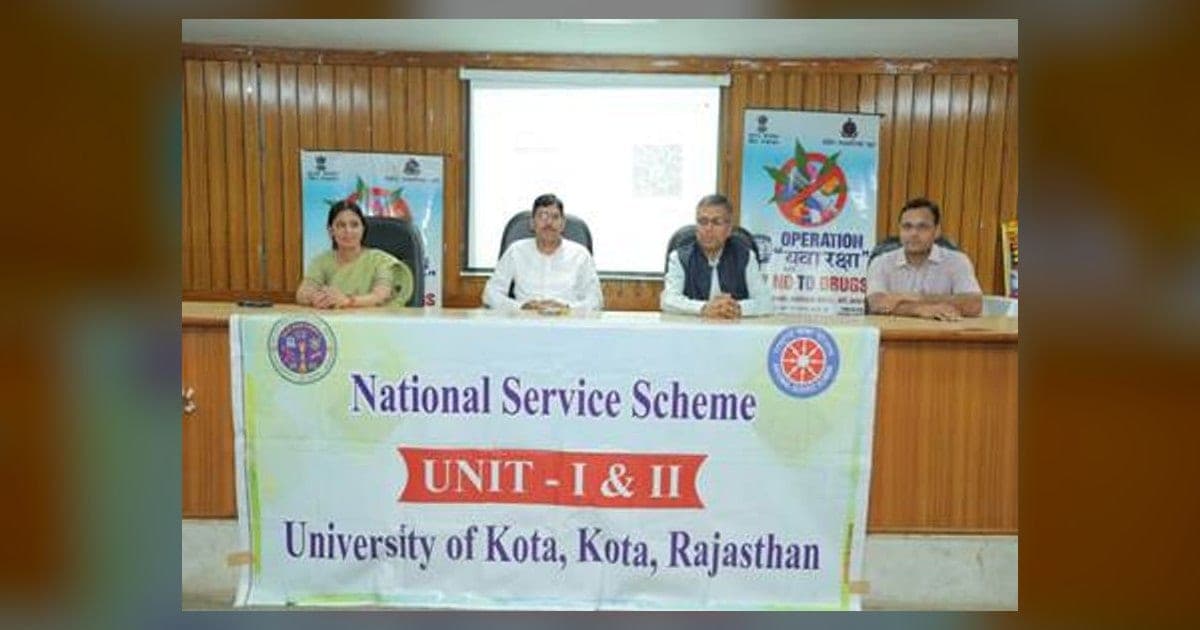
The student-facing part of the day was held at the University of Kota under Operation Yuva Raksha. Naresh Bundel, Deputy Narcotics Commissioner at Kota, was the chief guest, and the university's Registrar Murlidhar Pratihar and its NSS head attended with faculty and students. Bundel argued that education alone is no shield: manipulation, pressure from friends and social habit can pull even well-informed young people towards narcotics. Using the ideas of a fast-reacting mind and a slow, deliberate mind, he traced how a single first use can harden into repetition, habit and finally dependence, and urged students to refuse at the very first offer.
Pledges taken
Sessions closed with collective oaths. Students at Kota took the Nasha Mukti Pledge, while cultivators at the divisional programmes swore an oath for an addiction-free India and promised to spread the message in their own villages. The Chittorgarh-I programme was run under the banner of Yuva Raksha and Nasha Mukt Bharat Abhiyan, linking the day to the wider national campaign against substance abuse. CBN framed the whole exercise around Gandhi's emphasis on self-discipline and social responsibility, and said prevention works only when cultivators and local communities take part rather than leaving enforcement to officials alone.
Important Facts
| Occasion | National Anti-Drug Addiction Day, observed on the birth anniversary of Mahatma Gandhi (2 October) |
|---|---|
| Agency | Central Bureau of Narcotics (CBN), Rajasthan Unit |
| Parent ministry | Ministry of Finance |
| Student campaign | Operation Yuva Raksha |
| Venue of student session | University of Kota |
| Chief guest at Kota | Naresh Bundel, Deputy Narcotics Commissioner, Kota |
| Districts covered | Kota, Jhalawar, Bhilwara, Chittorgarh, Pratapgarh and Udaipur |
| Pledge administered | Nasha Mukti Pledge (Oath for an Addiction-Free India) |
| Wider campaign | Nasha Mukt Bharat Abhiyan |
Exam Point of View
Remember that National Anti-Drug Addiction Day is tied to Gandhi Jayanti on 2 October, that the Central Bureau of Narcotics comes under the Ministry of Finance, the name Operation Yuva Raksha, the Nasha Mukt Bharat Abhiyan link, and the Rajasthan districts where licensed opium poppy is grown.
Practice Questions
National Anti-Drug Addiction Day is observed on the birth anniversary of which leader?
- A.Sardar Vallabhbhai Patel
- B.Mahatma Gandhi
- C.Lal Bahadur Shastri
- D.Dr B. R. Ambedkar
Show answer
Correct answer: B. Mahatma Gandhi
Explanation
The correct answer is Mahatma Gandhi. National Anti-Drug Addiction Day falls on 2 October, the birth anniversary of Mohandas Karamchand Gandhi, and the Central Bureau of Narcotics tied its Rajasthan programmes to Gandhi’s message of self-discipline and social responsibility. Option A is wrong because Sardar Vallabhbhai Patel’s birth anniversary is marked separately as a day of national unity and has no link to this observance. Option C is wrong because Lal Bahadur Shastri, though also born on 2 October, is not the leader the anti-addiction day is named after; the bureau’s programmes referred specifically to the Father of the Nation. Option D is wrong because Dr B. R. Ambedkar’s anniversary is observed on a different date and is associated with social justice commemorations rather than the anti-drug campaign described here.
The Central Bureau of Narcotics (CBN) functions under which Union ministry?
- A.Ministry of Home Affairs
- B.Ministry of Health and Family Welfare
- C.Ministry of Finance
- D.Ministry of Agriculture and Farmers Welfare
Show answer
Correct answer: C. Ministry of Finance
Explanation
The correct answer is the Ministry of Finance. The release on the Rajasthan Unit’s anti-addiction programmes was issued under the Ministry of Finance, which is the parent ministry of the Central Bureau of Narcotics; the bureau licenses and supervises legal opium poppy cultivation. Option A is wrong because, although the Home Ministry handles policing and the Narcotics Control Bureau, the CBN itself is not placed under it. Option B is wrong because the Health Ministry deals with treatment and de-addiction services rather than the licensing of poppy farming. Option D is wrong because, even though poppy is an agricultural crop, its cultivation is controlled as a narcotics and revenue matter, not by the agriculture ministry. Candidates should remember the CBN and its revenue-side parentage as a standing fact.
Under which campaign did the Central Bureau of Narcotics hold its drug-awareness session at the University of Kota?
- A.Operation Yuva Raksha
- B.Operation Sagar Manthan
- C.Operation Clean Campus
- D.Operation Nasha Bandhan
Show answer
Correct answer: A. Operation Yuva Raksha
Explanation
The correct answer is Operation Yuva Raksha. The student session at the University of Kota was organised by CBN Kota under this campaign, with Deputy Narcotics Commissioner Naresh Bundel as chief guest and the university Registrar Murlidhar Pratihar present; participants ended the session by taking the Nasha Mukti Pledge. Option B is wrong because that name belongs to a separate maritime anti-narcotics effort and was not the banner for this campus programme. Options C and D are wrong because no such campaigns were named in connection with the observance; the only other banner mentioned was Yuva Raksha and Nasha Mukt Bharat Abhiyan, used for the Chittorgarh awareness and cleanliness drive. The youth-focused name is the one worth memorising here.
The anti-addiction programmes of the CBN Rajasthan Unit were held mainly in areas growing which licensed crop?
- A.Sugarcane
- B.Opium poppy
- C.Cotton
- D.Mustard
Show answer
Correct answer: B. Opium poppy
Explanation
The correct answer is opium poppy. The bureau deliberately took its programmes into the licensed poppy-growing tracts of Rajasthan, holding meetings for cultivators in Kota, Jhalawar, Bhilwara, Chittorgarh, Pratapgarh and Udaipur districts, including villages such as Mangrol and one near Babrikhda in Jhalrapatan tehsil. Option A is wrong because sugarcane is not a narcotics crop and falls outside the bureau’s licensing remit. Option C is wrong because cotton, though widely grown in parts of the state, has no bearing on narcotics regulation. Option D is wrong because mustard is an ordinary oilseed crop of Rajasthan and is not licensed or supervised by the Central Bureau of Narcotics. The link between the bureau and poppy cultivation is the point of the question.
Frequently Asked Questions
When is National Anti-Drug Addiction Day observed in India?
It is observed on 2 October, the birth anniversary of Mahatma Gandhi. In 2026 the Central Bureau of Narcotics, Rajasthan Unit marked it with awareness programmes and cleanliness drives in opium cultivation areas.
Which ministry controls the Central Bureau of Narcotics?
The Central Bureau of Narcotics functions under the Union Ministry of Finance. It licenses and supervises legal opium poppy cultivation, and its Rajasthan Unit ran the anti-addiction programmes reported on 3 October 2026.
What is Operation Yuva Raksha?
It is the Central Bureau of Narcotics campaign aimed at young people. Under it, CBN Kota held a drug-awareness session at the University of Kota where students took the Nasha Mukti Pledge.
Sources
- https://www.pib.gov.in/PressReleasePage.aspx?PRID=2318810 (opens in a new tab) — Press Information Bureau
Current Affairs 3 October 2026
- Navpreet Singh Deported from Türkiye in Narco Trafficking CaseNational
- Vice-President Opens 5th Kautilya Economic Conclave in DelhiSummits & Conferences
- NABKISAN Raises ₹180 Crore Through India's First WASH BondBanking & Finance
- Harivansh to Lead India at 153rd IPU Assembly in TanzaniaInternational
- Swachh Bharat Diwas 2026 Marked by Special Gram SabhasGovernment Schemes
- Great Indian Bustard Rewilding Begins at Desert National ParkEnvironment
- PM-SETU Completes One Year: 850 ITIs Identified for UpgradeGovernment Schemes
- DARE and ICAR Begin Special Campaign 6.0 at Farm InstitutesNational
Related Current Affairs
- Important Days
11th Ayurveda Day on 23 September: Theme, Facts and Schemes
22 September 2026 · 2 min read
- Important Days
World Patient Safety Day 2026 Theme is Safe Care for NCDs
17 September 2026 · 2 min read


Related GK
- Supercomputers of India: PARAM Series, NSM and PYQs
4 October 2026 · Science & Technology
- Telangana GK: Formation, Rivers, Culture and Exam Facts
4 October 2026 · Indian States & UTs
- Abbreviations and Full Forms: Exam List for GK Papers
4 October 2026 · Static GK
Take the Quiz
- Current Affairs Quiz
SSC CHSL Current Affairs Quiz: 3 October 2026
25 questions25 minutesStart Quiz