
NAMASTE Scheme Trains Sanitation Workers on Bandicoot Robots
A Mysuru sanitation worker trained under the NAMASTE scheme in 2026, in a batch of 45, now operates the Bandicoot robotic sanitation system.
Why in News
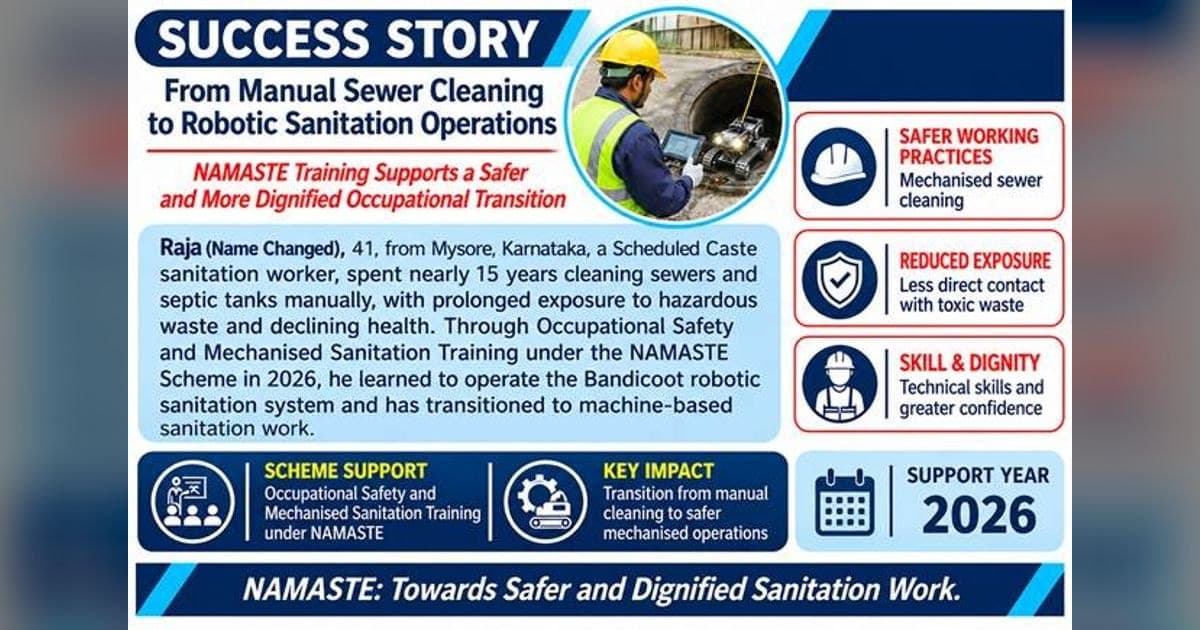
A case study released on 23 November 2026 describes how the NAMASTE scheme trained a sanitation worker from Mysuru in 2026, in a batch of 45, to operate the Bandicoot robotic sanitation system instead of cleaning sewers and septic tanks by hand.
The government's answer to the most dangerous job in Indian cities is a machine and a certificate. A case study released on 23 November 2026 shows how the NAMASTE scheme, short for National Action for Mechanised Sanitation Ecosystem, is moving sanitation workers out of sewers and into the operator's seat of a cleaning robot.
The worker and the work
The study follows a 41-year-old Scheduled Caste sanitation worker from Mysuru in Karnataka. For close to fifteen years he cleaned sewers and septic tanks by hand, in prolonged and direct contact with hazardous waste. Machinery and training were out of reach, the toxic exposure told on his health, his schooling had been limited and his family depended on what he earned, so safer work stayed beyond him.
What the training gave him
In 2026 he took the Occupational Safety and Mechanised Sanitation Training offered under the scheme, as one of a batch of 45 sanitation workers. The course covered three things:
- the occupational health hazards that come with sanitation work;
- safe practices at the work site;
- operating the Bandicoot robotic sanitation system.
He now works as a Bandicoot operator. The change is not cosmetic: a robot goes into the manhole in his place, so his direct contact with hazardous waste is far lower and the work is done in safer and more dignified conditions.
Why the scheme is built this way
Hand cleaning of sewers and septic tanks exposes workers to toxic gases and waste, and the shift to mechanised operation is treated as a step in occupational safety, health and dignity rather than only a technology upgrade. Two things have to arrive together for that shift to work, as this case shows. One is training, which turns an unskilled hazardous task into a technical skill. The other is access to the machine itself, since a certificate is of little use if no robot is available on the ground. Put together, they let a worker keep his livelihood while leaving the manhole behind, which is the result the scheme is designed to produce for sanitation workers across the country.
Important Facts
| Scheme | NAMASTE - National Action for Mechanised Sanitation Ecosystem |
|---|---|
| Training | Occupational Safety and Mechanised Sanitation Training, given in 2026 |
| Batch size | 45 sanitation workers |
| Technology | Bandicoot robotic sanitation system |
| Beneficiary profile | A 41-year-old Scheduled Caste sanitation worker from Mysuru, Karnataka |
| Earlier work | Nearly fifteen years of manual sewer and septic tank cleaning |
| Course content | Occupational health hazards, safe work practices and operation of the Bandicoot system |
| Outcome | Now employed as a Bandicoot robotic sanitation system operator |
| Objective | Shift from hazardous manual cleaning to mechanised sanitation with better safety, health and dignity |
Exam Point of View
Learn the full form of NAMASTE, that is National Action for Mechanised Sanitation Ecosystem; the name of the training, Occupational Safety and Mechanised Sanitation Training; the batch size of 45; the technology, the Bandicoot robotic sanitation system; and the purpose, shifting workers from manual sewer and septic tank cleaning to mechanised sanitation with better safety, health and dignity.
Practice Questions
What is the full form of the NAMASTE scheme in the news for training sanitation workers?
- A.National Mission for Safe Sanitation and Technology
- B.National Action for Mechanised Sanitation Ecosystem
- C.National Accord for Manual Scavenging Termination
- D.National Agency for Municipal Sanitation and Training
Show answer
The word ecosystem is the part candidates tend to lose, and it matters, because the scheme is not only about machines: it brings together training in occupational safety, access to mechanised equipment such as the Bandicoot robotic sanitation system, and employment as an operator afterwards.
Read the full explanation →Bandicoot, mentioned in connection with the NAMASTE scheme, is which of the following?
- A.A protective suit for sewer workers
- B.A mobile application for reporting blocked drains
- C.A robotic sanitation system for cleaning work
- D.A subsidy for buying sanitation vehicles
Show answer
Operating it is one of the three components of the Occupational Safety and Mechanised Sanitation Training under the scheme, and the worker featured in the case study now earns his living as a Bandicoot operator rather than by entering sewers and septic tanks himself.
Read the full explanation →Which three areas did the Occupational Safety and Mechanised Sanitation Training under NAMASTE cover?
- A.Occupational health hazards, safe work practices and operation of the Bandicoot system
- B.Accounting, tendering and municipal law
- C.Waste segregation, composting and recycling
- D.Water testing, pipe fitting and meter reading
Show answer
Those were the three strands of the training, and together they explain why the worker could move from manual sewer and septic tank cleaning to a machine operator’s role.
Read the full explanation →Frequently Asked Questions
What does NAMASTE stand for?
NAMASTE stands for National Action for Mechanised Sanitation Ecosystem. Under it, sanitation workers receive training and access to technology so they can move from hazardous manual cleaning of sewers and septic tanks to mechanised sanitation work.
What is the Bandicoot robotic sanitation system?
It is the robotic system that sanitation workers are trained to operate under the NAMASTE scheme. Instead of a worker entering a manhole, the robot does the cleaning, which sharply reduces direct exposure to hazardous waste and makes the work safer and more dignified.
What does the Occupational Safety and Mechanised Sanitation Training cover?
Three areas: the occupational health hazards of sanitation work, safe work practices at the site, and operation of the Bandicoot robotic sanitation system. In the case reported on 23 November 2026, a worker from Mysuru took this training in 2026 as one of a batch of 45.
Sources
- https://www.pib.gov.in/PressReleasePage.aspx?PRID=2340462 (opens in a new tab) — Press Information Bureau
Current Affairs 23 November 2026
- Nayi Chetna 5.0 Gender Campaign to Begin on 25 NovemberGovernment Schemes
- Ayush Pavilion Draws Crowds at 45th IITF 2026 in New DelhiNational
- India-Nepal Talks: Saryu-Kamla Express and Vision DocumentInternational
- 92nd NBWL Standing Committee Meeting Themed on Marine LifeEnvironment
- National HPV Vaccination Campaign Crosses One Crore DosesNational
- 1st SCO Civilization Dialogue Forum Holds Gyan Bharatam SessionSummits & Conferences
- MY Bharat Yuva Samvad on Constitution Day in 600+ DistrictsGovernment Schemes
- Floriculture Exports Rise to USD 258.26 Million in FY 2025-26Economy
Related Current Affairs
- Government Schemes
SAMAVESH Portal to Unify Social Justice Schemes, e-Anudaan Too
24 November 2026 · 2 min read
- Government Schemes
Skilling Push: PM-SETU to Upgrade ITIs, WorldSkills Asia 2027
24 November 2026 · 2 min read
- Government Schemes
Agriculture Minister Holds Kisan Chaupal in Tarn Taran, Punjab
24 November 2026 · 2 min read
- Government Schemes
Shivraj Chouhan Chairs Joint Poverty Eradication Workshop
23 November 2026 · 2 min read
- Government Schemes
Saras Shakti Food Festival 2026 Opens at Sundar Nursery
23 November 2026 · 2 min read




Related GK
- Famous Personalities of Rajasthan: Exam Notes
28 October 2026 · Rajasthan
- Districts and Divisions of Rajasthan: Exam Notes
28 October 2026 · Rajasthan
- Tourism and World Heritage Sites of Rajasthan Notes
27 October 2026 · Rajasthan
Take the Quiz
- Current Affairs Quiz
RRB Group D Current Affairs Quiz: 23 November 2026
10 questions10 minutesStart Quiz