
GST Council's 57th Meeting Scraps Arrest Powers Under GST
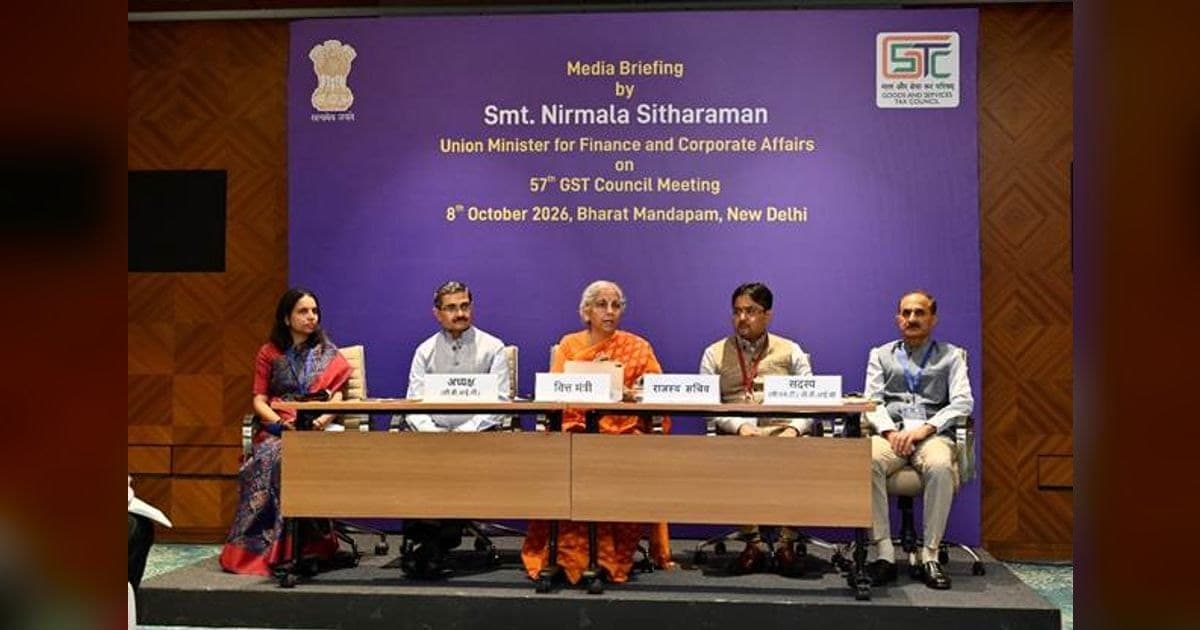
The 57th GST Council meeting, chaired by Nirmala Sitharaman in New Delhi on 8 October 2026, recommended ending arrest powers and automating GST refunds.
Why in News
The 57th meeting of the GST Council, held in New Delhi on 8 October 2026 under Union Finance Minister Nirmala Sitharaman, recommended withdrawing arrest powers under GST, raising the prosecution threshold to five crore rupees and letting the portal sanction refunds on its own.
The 57th meeting of the GST Council was held in New Delhi on 8 October 2026 under the chairpersonship of Union Finance and Corporate Affairs Minister Nirmala Sitharaman. Chief Ministers of Delhi, Goa, Haryana, Jammu and Kashmir, Karnataka, Kerala, Maharashtra and Meghalaya attended, along with the Deputy Chief Ministers of Manipur and Telangana, state finance ministers, the Revenue Secretary and the Chairman of the Central Board of Indirect Taxes and Customs. Where the 56th meeting had reworked tax rates, this one turned to procedure: registration, returns, refunds, adjudication and the powers a tax officer may use.
Arrest powers withdrawn
The Council recommended doing away with the power of arrest altogether, by deleting section 69 of the CGST Act, 2017. The money threshold for launching a prosecution rises from one crore rupees to five crore rupees, and several offence clauses in section 132 are to be trimmed so that the fraudulent claiming of input tax credit, without any supply or any invoice behind it, stays the core offence. The maximum general penalty under section 125 falls from 25,000 rupees to 10,000 rupees.
Fewer notices, cheaper appeals
No show cause notice is to be issued where the tax at stake is under 10,000 rupees, counting central, state and integrated tax together with cess; notices and appeals already pending below that amount will be settled as though the floor had always been there. In cases that do not involve fraud, a taxpayer who clears the tax with interest within 30 days of the adjudication order pays a penalty of only five per cent. Where an order carries a penalty but demands no tax, the pre-deposit for filing an appeal is capped at 40 crore rupees.
Refunds and registration
An excess balance sitting in the electronic cash ledger will be refunded by the portal itself, with no officer in the loop, and the window for an acknowledgement or a deficiency memo shrinks from 15 days to 10 days. On export and inverted duty claims the system will release 90 per cent of the amount provisionally after its own risk check. Small sellers who supply goods through e-commerce platforms may name the platform's warehouse as their principal place of business in a state where they keep no premises of their own.
Credit, e-way bills and rates
Blocked credit is being opened up on outdoor catering, health and life insurance, telecom towers, pipelines laid outside factory premises, free samples and stock written off on expiry. A goods vehicle may be stopped only on specific intelligence and with clearance from an officer of at least Joint Commissioner rank, and a state the consignment is merely passing through may not stop it at all. On rates, operators running electric vehicles may pay five per cent with restricted credit on passenger transport and vehicle rental; delivery services booked through an e-commerce platform attract five per cent without credit; and helicopter travel on a seat-sharing basis to or from the north-eastern states, Sikkim and Bagdogra is exempt, as are the warehousing of seeds meant for sowing and the curing of coffee.
Important Facts
| Event | 57th Meeting of the GST Council |
|---|---|
| Date and venue | 8 October 2026, New Delhi |
| Chairperson | Union Finance and Corporate Affairs Minister Nirmala Sitharaman |
| Arrest powers | Section 69 of the CGST Act, 2017 to be omitted |
| Prosecution threshold | Raised from one crore rupees to five crore rupees |
| General penalty | Cut from 25,000 rupees to 10,000 rupees under section 125 |
| Show cause notice floor | 10,000 rupees of tax, counting CGST, SGST, IGST and cess |
| Appeal pre-deposit cap | 40 crore rupees where an order carries penalty but no tax demand |
| Refund acknowledgement | Window cut from 15 days to 10 days |
| Focus of the meeting | Process reforms in registration, returns, refunds and adjudication |
Exam Point of View
Remember the meeting number (57th), the date (8 October 2026), the chairperson (Finance Minister Nirmala Sitharaman), the section omitted to end arrest powers (section 69 of the CGST Act, 2017), the prosecution threshold (one crore to five crore rupees), the general penalty cut under section 125 (25,000 to 10,000 rupees), the show cause notice floor (10,000 rupees), the appeal pre-deposit cap (40 crore rupees) and the Joint Commissioner rank now needed to intercept goods.
Practice Questions
The 57th GST Council meeting recommended raising the monetary threshold for launching prosecution under GST to which amount?
- A.Rs 1 crore
- B.Rs 2 crore
- C.Rs 5 crore
- D.Rs 10 crore
Show answer
Among the decriminalisation measures taken at the 57th meeting of the GST Council, the money threshold at which a prosecution may be launched was lifted to five crore rupees, so that criminal proceedings are reserved for large cases of fraud and evasion rather than ordinary disputes over tax.
Read the full explanation →Which section of the CGST Act, 2017 is to be omitted so that the power of arrest under GST ends?
- A.Section 69
- B.Section 74
- C.Section 125
- D.Section 132
Show answer
The Council recommended the complete withdrawal of arrest powers under the goods and services tax by deleting this section from the CGST Act, 2017, a step presented as part of a trust-based tax system that still keeps deterrence against fraud.
Read the full explanation →The maximum general penalty under the CGST Act has been recommended to be reduced from Rs 25,000 to which amount?
- A.Rs 5,000
- B.Rs 10,000
- C.Rs 15,000
- D.Rs 20,000
Show answer
The Council recommended cutting the ceiling on the general penalty under section 125 of the CGST Act from 25,000 rupees to 10,000 rupees.
Read the full explanation →Under the e-way bill changes recommended by the 57th GST Council meeting, a goods vehicle can be intercepted only with the authorisation of an officer not below which rank?
- A.Inspector
- B.Superintendent
- C.Joint Commissioner
- D.Principal Chief Commissioner
Show answer
The Council recommended changes to sections 68, 129 and 130 of the CGST Act so that a vehicle carrying goods may be stopped only when there is specific intelligence about it and an officer of at least this rank has cleared the action.
Read the full explanation →Frequently Asked Questions
What did the 57th GST Council meeting decide on arrest powers?
It recommended their complete withdrawal, by omitting section 69 of the CGST Act, 2017. The threshold for launching a prosecution was also raised from one crore rupees to five crore rupees.
Who chaired the 57th GST Council meeting and where was it held?
Union Finance and Corporate Affairs Minister Nirmala Sitharaman chaired it in New Delhi on 8 October 2026, with eight chief ministers, two deputy chief ministers and state finance ministers taking part.
How much is the general penalty under GST after the 57th meeting?
The maximum general penalty under section 125 of the CGST Act comes down from 25,000 rupees to 10,000 rupees. A show cause notice will not be issued at all where the tax involved is under 10,000 rupees.
Sources
- https://www.pib.gov.in/PressReleasePage.aspx?PRID=2320934 (opens in a new tab) — Press Information Bureau
Current Affairs 8 October 2026
- GMPCS Licensing: Government Calls Satcom Rules Non-DiscriminatoryScience & Technology
- Women Form 43% of Ayush Services Workforce: RIS ReportReports & Indices
- India Seeks Balanced COP31 Outcome at Pre-COP in Nadi, FijiEnvironment
- National SC-ST Hub Procurement Rises Nearly 39-Fold in a DecadeGovernment Schemes
- Veteran Hindi and Marathi Actor Nana Patekar Passes AwayObituaries
- PM Modi Opens 10th India Mobile Congress at YashobhoomiScience & Technology
- Nadda Launches JOSH Teams for Youth-Led TB EliminationGovernment Schemes
- C.R. Paatil Chairs 20th Ganga Empowered Task Force MeetingEnvironment
Related Current Affairs
Related GK
- Famous Personalities of Rajasthan: Exam Notes
28 October 2026 · Rajasthan
- Districts and Divisions of Rajasthan: Exam Notes
28 October 2026 · Rajasthan
- Tourism and World Heritage Sites of Rajasthan Notes
27 October 2026 · Rajasthan
Take the Quiz
- Current Affairs Quiz
State Exams Current Affairs Quiz: 8 October 2026
25 questions25 minutesStart Quiz