
MATSYA-6000 Progress Reviewed at ESSC Meeting
Jitendra Singh chaired the second general body meeting of the Earth System Sciences Council and reviewed Deep Ocean Mission progress, including MATSYA-6000 dives.
Why in News
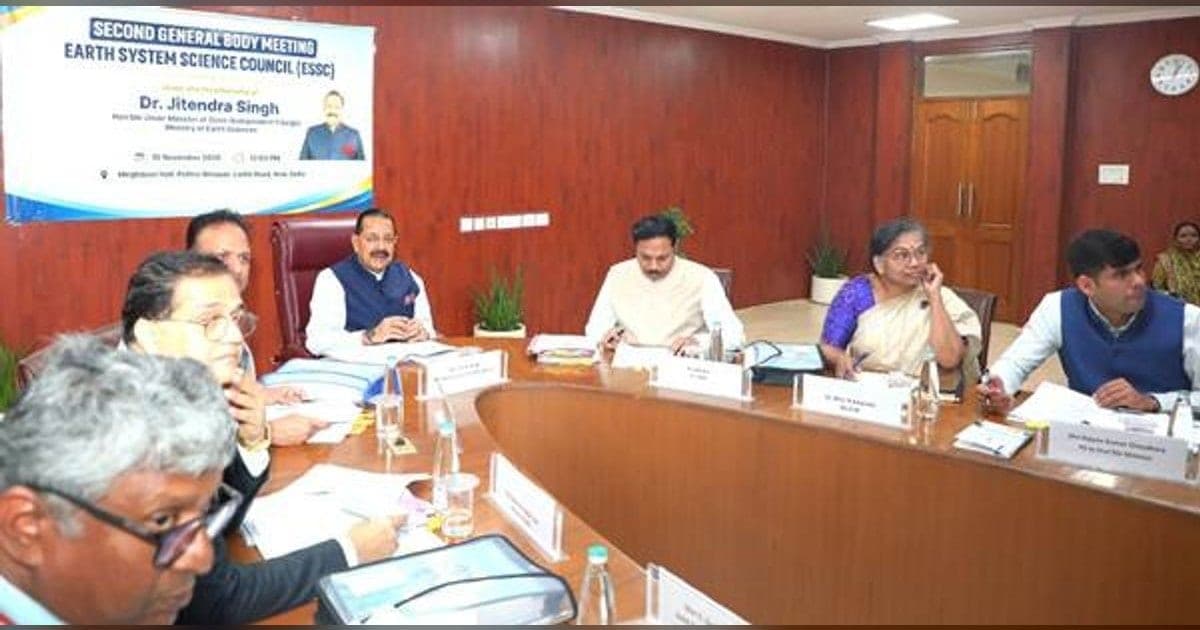
On 10 November 2026 Dr Jitendra Singh chaired the second General Body Meeting of the Earth System Sciences Council, reviewing the Deep Ocean Mission, MATSYA-6000 and the work of five earth science institutions.
Union Minister of State (Independent Charge) for Science and Technology and Earth Sciences Dr Jitendra Singh chaired the second General Body Meeting of the Earth System Sciences Council (ESSC) on 10 November 2026. He asked the ministry’s institutions to carry their findings to ordinary citizens in plain language, saying research outcomes deserve to be told as stories people can follow.
Five institutions under review
The meeting went through the annual reports and audited accounts for 2025-26 of the five bodies that make up the council: the National Institute of Ocean Technology (NIOT), the Indian National Centre for Ocean Information Services (INCOIS), the National Centre for Earth Science Studies (NCESS), the Indian Institute of Tropical Meteorology (IITM) and the National Centre for Polar and Ocean Research (NCPOR). Secretary of the Ministry of Earth Sciences Dr T. Srinivasa Kumar and CSIR Director General Dr N. Kalaiselvi were among those present.
Deep Ocean Mission and MATSYA-6000
The minister was briefed on India’s human deep-sea programme, built around MATSYA-6000, the country’s submersible rated for a depth of 6,000 metres. Indian aquanauts completed dives of 4,025 metres and 5,002 metres during an Indo-French expedition aboard the French submersible Nautile, a step towards crewed descent in Indian waters.
| Item | Detail |
| Submersible | MATSYA-6000, rated for 6,000 metres |
| Dives achieved | 4,025 metres and 5,002 metres |
| Partner vessel | Nautile, in the Indo-French expedition |
| Antarctic expedition | 45th Indian expedition with 95 members |
Work across the ministry
- NIOT reported desalination solutions for Lakshadweep, offshore fish cage technology, deep-sea mineral exploration and ocean thermal energy conversion.
- IITM presented advances under Mission Mausam and the PRITHVI programme, including the Bharat Forecasting System and the use of artificial intelligence and machine learning in prediction.
- INCOIS described multilingual marine advisories and swell-surge inundation forecasts for fishermen and coastal communities.
- NCESS reported research on landslides, tectonic processes, atmospheric aerosols and rainfall over the Western Ghats.
NCPOR placed before the meeting its 45th Indian Antarctic Expedition, which had 95 members, the 16th Indian Arctic Expedition, glacier monitoring in the Himalayas and studies in the Southern Ocean. Dr Jitendra Singh proposed that polar and solid earth sciences be pursued in mission mode so that results come faster, and he called the institutions an extended scientific family that should keep sharing ideas outside formal meetings as well.
Important Facts
| Meeting | Second General Body Meeting of the Earth System Sciences Council (ESSC) |
|---|---|
| Chaired by | Dr Jitendra Singh, MoS (IC) Science and Technology and Earth Sciences |
| Institutions reviewed | NIOT, INCOIS, NCESS, IITM and NCPOR |
| Submersible | MATSYA-6000, depth-rated for 6,000 metres |
| Dives completed | 4,025 metres and 5,002 metres aboard the French submersible Nautile |
| Polar expeditions | 45th Indian Antarctic Expedition with 95 members; 16th Indian Arctic Expedition |
| Weather programmes | Mission Mausam, PRITHVI programme and the Bharat Forecasting System |
Exam Point of View
Remember the council (Earth System Sciences Council, second general body meeting), its five institutions (NIOT, INCOIS, NCESS, IITM, NCPOR), the submersible MATSYA-6000 rated for 6,000 metres, the dives of 4,025 and 5,002 metres aboard Nautile, and the 45th Antarctic expedition with 95 members.
Practice Questions
MATSYA-6000, reviewed at the ESSC meeting, is rated to dive to what depth?
- A.3,000 metres
- B.4,500 metres
- C.6,000 metres
- D.11,000 metres
Show answer
MATSYA-6000 is India’s human submersible under the Deep Ocean Mission and is depth-rated for six thousand metres, as the Ministry of Earth Sciences confirmed at the Earth System Sciences Council meeting of 10 November 2026.
Read the full explanation →Aboard which submersible did Indian aquanauts complete their deep dives in the Indo-French expedition?
- A.Nautile
- B.Alvin
- C.Shinkai
- D.Jiaolong
Show answer
The briefing to Dr Jitendra Singh said Indian aquanauts dived to 4,025 metres and 5,002 metres during an Indo-French expedition aboard this submersible, which marked a notable advance in India’s crewed deep-sea capability.
Read the full explanation →How many institutions make up the Earth System Sciences Council whose reports were reviewed?
- A.Three
- B.Four
- C.Five
- D.Seven
Show answer
The annual reports and audited accounts for 2025-26 of five constituent institutions were placed before the council: the National Institute of Ocean Technology, the Indian National Centre for Ocean Information Services, the National Centre for Earth Science Studies, the Indian Institute of Tropical Meteorology and the National Centre for Polar…
Read the full explanation →How many members took part in the 45th Indian Antarctic Expedition reported to the council?
- A.45
- B.66
- C.95
- D.120
Show answer
The National Centre for Polar and Ocean Research told the meeting that the forty-fifth Indian Antarctic Expedition involved ninety-five members, and it also reported the sixteenth Indian Arctic Expedition, glacier monitoring in the Himalayas and scientific work in the Southern Ocean.
Read the full explanation →Frequently Asked Questions
What is MATSYA-6000?
It is India’s human submersible under the Deep Ocean Mission, rated to work at a depth of 6,000 metres. Its progress was reviewed at the Earth System Sciences Council meeting chaired by Dr Jitendra Singh on 10 November 2026.
How deep have Indian aquanauts dived so far?
They completed dives of 4,025 metres and 5,002 metres during an Indo-French expedition aboard the French submersible Nautile, which the ministry called a significant advance in India’s deep-sea exploration capability.
Which institutions come under the Earth System Sciences Council?
Five: the National Institute of Ocean Technology, the Indian National Centre for Ocean Information Services, the National Centre for Earth Science Studies, the Indian Institute of Tropical Meteorology and the National Centre for Polar and Ocean Research. Their 2025-26 reports and audited accounts were reviewed at the meeting.
Sources
- https://www.pib.gov.in/PressReleasePage.aspx?PRID=2334718 (opens in a new tab) — Press Information Bureau
Current Affairs 10 November 2026
- Island Fisheries Anchor India's Blue Economy Growth PlanEconomy
- Mushroom Cultivation Powers Rural Livelihoods Across IndiaGovernment Schemes
- Buddha's Sacred Relics Draw 11,969 Devotees at BomdilaNational
- MoSPI Wraps Up Special Campaign 6 With 1,522 E-Files ShutNational
- Anuj Shrivatri Becomes India's 100th Chess GrandmasterSports
- India Seeks Fair, Ambitious Outcome at UNFCCC COP31 in AntalyaEnvironment
- MY Bharat Deepotsav Draws 1.19 Lakh Youth in Week 8 DriveGovernment Schemes
- PLFS Bulletin: LFPR Climbs to 55.5% in July-September 2026Reports & Indices
Related Current Affairs
- Science & Technology
BRIC Third Foundation Day: India-UK Biomanufacturing LoI
10 November 2026 · 2 min read
- Science & Technology
TRAI Caps IP Port Charges in Third Amendment Regulations 2026
9 November 2026 · 2 min read
- Science & Technology
I-STEM and Startup India Portals Linked Through API Integration
6 November 2026 · 2 min read
- Science & Technology
Semicon 2.0 Portal Opens; 12 More Units Cleared Under ECMS
6 November 2026 · 2 min read
- Science & Technology
Indian Astronomers Find Star Cluster UBC 63 Is Really Two
5 November 2026 · 2 min read
- Science & Technology
TRAI Recommends New Satellite Network Provider Authorisation
5 November 2026 · 2 min read
Related GK
- Famous Personalities of Rajasthan: Exam Notes
28 October 2026 · Rajasthan
- Districts and Divisions of Rajasthan: Exam Notes
28 October 2026 · Rajasthan
- Tourism and World Heritage Sites of Rajasthan Notes
27 October 2026 · Rajasthan
Take the Quiz
- Current Affairs Quiz
Banking Current Affairs Quiz: 10 November 2026
25 questions25 minutesStart Quiz