
FRI Blocks Cyber Fraud Worth Over Rs 5,000 Crore
The Financial Fraud Risk Indicator of the Department of Telecommunications has stopped suspected cyber fraud of over Rs 5,000 crore since its launch in May 2025.
Why in News
On 8 September 2026 the Department of Telecommunications said its Financial Fraud Risk Indicator had prevented suspected cyber fraud transactions of more than Rs 5,000 crore in the fifteen months since its launch on 22 May 2025.
The Department of Telecommunications (DoT) has reported a milestone for its fraud shield. The tool is called the Financial Fraud Risk Indicator (FRI). It was launched on 22 May 2025. In fifteen months it has helped stop suspected cyber fraud transactions worth more than Rs 5,000 crore. The announcement was made on 8 September 2026. The money was never lost, so it did not have to be traced, frozen or recovered.
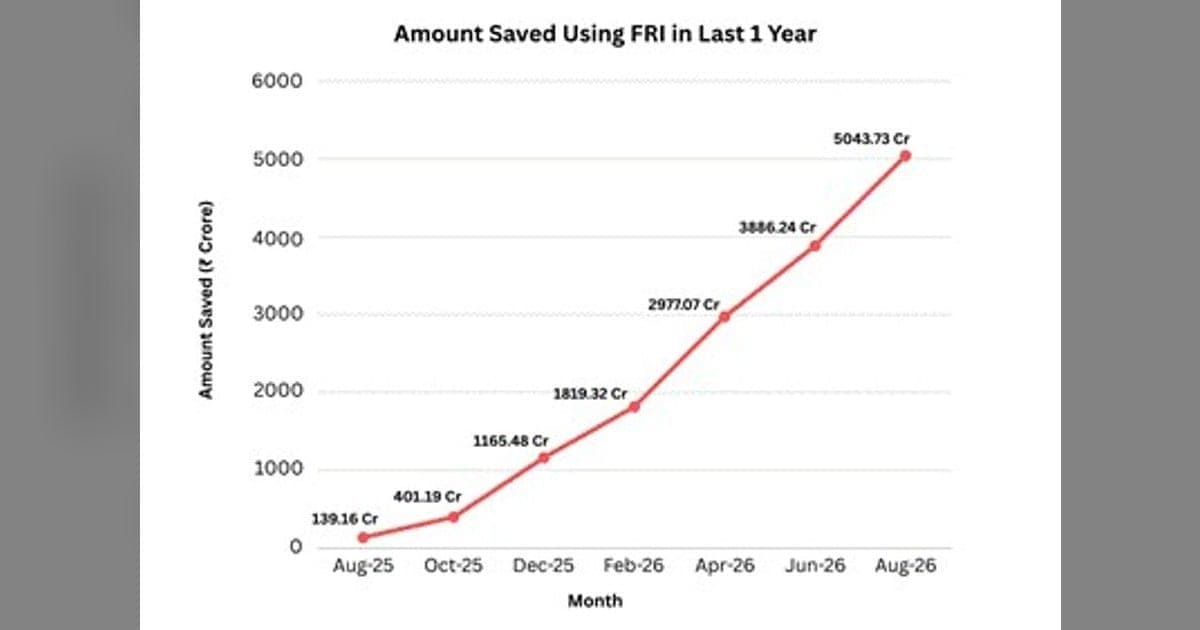
How fast the savings grew
| Stage | Amount prevented |
| August 2025 | Rs 139.16 crore |
| First six months of working | Rs 660 crore |
| Four months from April 2026 | Over Rs 2,000 crore |
| Cumulative up to August 2026 | Rs 5,043.73 crore |
Prevention has grown nearly eight-fold because more financial institutions now use the indicator. The jump from Rs 660 crore in the first six months to Rs 5,043.73 crore by August 2026 is the figure a paper setter is most likely to pick.
What the indicator actually does
The FRI is a risk assessment framework. It tells a bank, in real time, how likely it is that a mobile number is linked to cyber crime or financial fraud. It works under the DoT's Digital Intelligence Platform (DIP). Mobile numbers are sorted into three risk classes: Medium, High and Very High. The classification draws on citizen reports made on the Sanchar Saathi platform, on the National Cybercrime Reporting Portal of the Indian Cybercrime Coordination Centre, and on inputs from telecom operators, banks and other financial institutions.
Who uses the signal
The intelligence is shared through the DIP with banks, payment service providers, insurers, securities intermediaries and pension sector entities. Banks and UPI service providers already stop or flag payments to high and very high risk numbers as they happen. The Reserve Bank of India, the National Payments Corporation of India and the Securities and Exchange Board of India are partners in the effort. Protection is being widened to trading and demat accounts, to insurance policy issue and claims, and to pension accounts.
The reach of the platform
More than 1,600 organisations are now on the Digital Intelligence Platform. The department has held over twenty five training sessions for about 1,500 banks, financial institutions and regulators, because an alert is useful only if the receiving institution can act on it.
Important Facts
| Tool | Financial Fraud Risk Indicator (FRI) |
|---|---|
| Developed by | Department of Telecommunications |
| Launched on | 22 May 2025 |
| Platform | Digital Intelligence Platform (DIP) |
| Risk categories | Medium, High, Very High |
| Fraud prevented | Rs 5,043.73 crore up to August 2026 |
| First six months | Rs 660 crore |
| Organisations on DIP | More than 1,600 |
| Key partners | RBI, NPCI and SEBI |
Exam Point of View
Learn that FRI belongs to the Department of Telecommunications, was launched on 22 May 2025, runs on the Digital Intelligence Platform, grades mobile numbers as Medium, High or Very High risk, and has prevented Rs 5,043.73 crore of suspected fraud up to August 2026.
Practice Questions
The Financial Fraud Risk Indicator (FRI) has been developed by which department?
- A.Department of Financial Services
- B.Department of Telecommunications
- C.Department of Revenue
- D.Department of Consumer Affairs
Show answer
Correct answer: B. Department of Telecommunications
Explanation
The correct answer is the Department of Telecommunications. The FRI is a telecom intelligence framework built by that department and offered to financial institutions through its Digital Intelligence Platform, and on 8 September 2026 it was reported to have prevented suspected cyber fraud of more than five thousand crore rupees since its launch on 22 May 2025. Option A is a tempting distractor because banks are the users of the signal and the Department of Financial Services handles banking policy, but the indicator is built on telecom data such as the behaviour of mobile numbers. Option C is wrong because the Department of Revenue deals with taxation and not with cyber fraud prevention of this kind. Option D is wrong because consumer affairs work on grievance redress is a different track altogether. The logic to remember is that a fraud usually begins with the misuse of a mobile connection, which is why the telecom department owns the tool.
Under which platform of the Department of Telecommunications does the Financial Fraud Risk Indicator work?
- A.Sanchar Saathi
- B.Digital Intelligence Platform
- C.National Cybercrime Reporting Portal
- D.Unified Payments Interface
Show answer
Correct answer: B. Digital Intelligence Platform
Explanation
The correct answer is the Digital Intelligence Platform. The FRI is developed under this platform, which classifies mobile numbers as medium, high or very high risk and securely shares the result with banks, payment service providers, insurers, securities intermediaries and pension entities. Option A, Sanchar Saathi, is a genuine part of the story but plays a different role: citizens report suspicious numbers there, and those reports become one of the inputs for the classification. Option C, the National Cybercrime Reporting Portal, belongs to the Indian Cybercrime Coordination Centre and is likewise an input source rather than the platform that carries the indicator. Option D, the Unified Payments Interface, is the payment system whose service providers use the signal to stop or flag transactions in real time. Keep the roles separate: inputs, platform and users are three different layers of this story.
How much suspected cyber fraud had been prevented through the FRI up to August 2026?
- A.Rs 660 crore
- B.Rs 2,043.73 crore
- C.Rs 5,043.73 crore
- D.Rs 9,043.73 crore
Show answer
Correct answer: C. Rs 5,043.73 crore
Explanation
The correct answer is Rs 5,043.73 crore. That is the cumulative amount of suspected fraud stopped through the indicator up to August 2026, which is why the announcement speaks of more than five thousand crore rupees saved in fifteen months. Option A is the figure for the first six months of working, and the growth from that level to the present one is described as a nearly eight-fold rise, so it is a real number in the story but answers a different question. Option B and option D are built by changing the leading digit of the correct figure and do not appear in the announcement at all. A related figure worth holding is the starting point of the climb: the cumulative saving stood at a little over one hundred and thirty nine crore rupees in August 2025, so the whole scale-up happened within a single year as banks and payment platforms adopted the tool.
Frequently Asked Questions
What is the Financial Fraud Risk Indicator?
It is a risk assessment framework of the Department of Telecommunications that tells financial institutions in real time how likely a mobile number is to be linked with cyber crime or financial fraud.
How much suspected fraud has FRI prevented?
More than Rs 5,000 crore in fifteen months. The cumulative figure reached Rs 5,043.73 crore by August 2026, against Rs 660 crore in the first six months of working.
Into how many risk categories does FRI place mobile numbers?
Three, namely Medium, High and Very High risk. The classification uses Sanchar Saathi reports, the National Cybercrime Reporting Portal and inputs from telecom operators and banks.
Sources
Current Affairs 8 September 2026
- PM Opens 7th Global Fintech Fest 2026 in MumbaiSummits & Conferences
- 9th Rashtriya Poshan Maah Begins from VaranasiGovernment Schemes
- Kharif Sowing Reaches 1086.31 Lakh Hectares This SeasonEconomy
- Coal Sector Gets India's First Sector-Wide CSR FrameworkGovernment Schemes
- Exercise Veer Guardian-2026 Begins at Jodhpur with JapanDefence
- India-Morocco Hold First Joint Defence Committee MeetingDefence
- 503-Member Indian Contingent Sent Off for Asian Games 2026Sports
Related Current Affairs
- Banking & Finance
UIDAI Launches Aadhaar Face Authentication SDK and Sandbox
24 September 2026 · 2 min read
- Banking & Finance
IPPB Marks 9th Foundation Day, Launches DakPay Sound Box
23 September 2026 · 2 min read
- Banking & Finance
ECLGS 5.0 Explained: ₹2.55 Lakh Crore Credit Guarantee Push
24 September 2026 · 2 min read
- Banking & Finance
GIFT IFSC Banks Disburse $52.82 Billion Under RBI Swap Facility
23 September 2026 · 2 min read
- Banking & Finance
Bankers' Books Evidence Act 2026 in Force from 1 October
23 September 2026 · 2 min read

Related GK
- Fundamental Rights (Articles 12–35): Notes, Writs and PYQs
23 September 2026 · Indian Polity
- Preamble of the Indian Constitution: Notes, Keywords and PYQs
22 September 2026 · Indian Polity
- Making of the Indian Constitution: Notes, Key Dates and PYQs
21 September 2026 · Indian Polity
Take the Quiz
- Current Affairs Quiz
RBI Weekly Current Affairs Quiz: 7–13 September 2026
15 questions15 minutesStart Quiz