
Nadda Launches De-addiction Training for 10,000 Providers
Union Health Minister J.P. Nadda launched a capacity building programme to train 10,000 service providers in drug de-addiction care by March 2029, at New Delhi.
Why in News
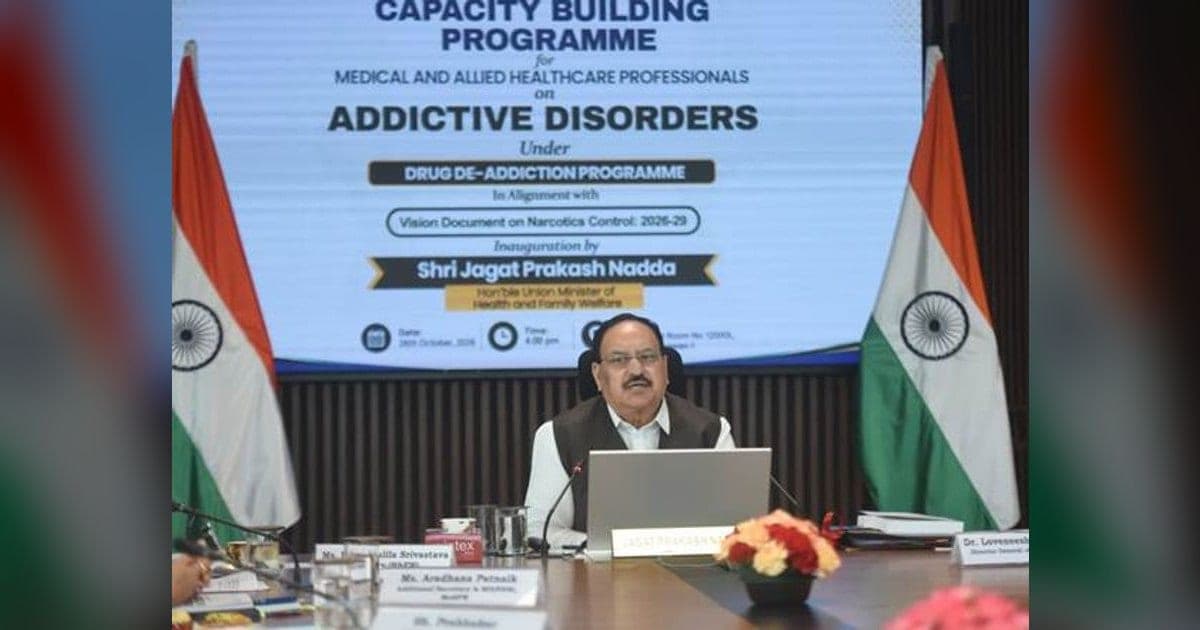
On 26 October 2026 Union Health Minister J.P. Nadda launched, at Kartavya Bhawan-1 in New Delhi, a capacity building training programme for medical and allied healthcare professionals working in drug de-addiction services.
Union Minister of Health and Family Welfare Shri J.P. Nadda launched the Capacity Building Training Programme for Medical and Allied Healthcare Professionals engaged in drug de-addiction services on 26 October 2026. The launch took place in hybrid mode at Kartavya Bhawan-1, New Delhi, with officers of the Ministries of Health and Family Welfare, Social Justice and Empowerment, and Home Affairs present. The programme is meant to strengthen the hands of healthcare staff who prevent, identify, assess, treat and manage substance use disorders.
The target and the mandate
The Ministry of Health and Family Welfare has been asked to build the capacity of 10,000 service providers by March 2029. The mandate comes from the Vision Document on Narcotic Control: 2026-2029, unveiled in June 2026 by Union Home Minister and Minister of Cooperation Shri Amit Shah, which sets out how the entire drug trade ecosystem is to be tackled over three years. The training is phased: 2,000 providers in the current financial year, 3,000 in 2027-28 and 5,000 in 2028-29. Shri Nadda said a Nasha Mukt Bharat by 2029 needs a whole-of-government approach, since departments working in silos had left gaps in coordination and service delivery.
Who will run the training
Six central institutions under the Drug De-addiction Programme (DDAP) will conduct it: the National Drug Dependence Treatment Centre (NDDTC), AIIMS New Delhi, located at Ghaziabad; NIMHANS, Bengaluru; PGIMER, Chandigarh; the Central Institute of Psychiatry, Ranchi; Dr. Ram Manohar Lohia Hospital, New Delhi; and AIIMS Bhubaneswar. NDDTC, AIIMS will coordinate the whole initiative.
How the course is built
A blended design is being used. Online live training for doctors and medical officers runs as weekly sessions over a 12-week period, mixing lectures with clinical case discussions; all six institutions hold these at the same time, with a combined capacity of 300 participants per week. In-person training is given as five-day programmes on a common curriculum. Self-paced modules cover doctors through the NDDTC's NAAT course, counsellors and psychologists through NIMHANS e-learning, and nurses, Community Health Officers and Auxiliary Nurse Midwives through an NDDTC course. The Addiction Rx application built by NIMHANS supports prescribing. The curriculum covers alcohol, cannabis, opioids, sleeping tablets and inhalants, and the treatment of women and adolescents.
Reach and the physician's manual
States nominate candidates through the National Health Mission, and central services including the Armed Forces, Central Armed Police Forces and Railways also send staff. More than 800 nominations have already come in, and about 150 personnel from de-addiction centres funded by the Ministry of Social Justice and Empowerment are expected at offline training over the next two months. At the event the Minister also released the second edition of Substance Use Disorder: Manual for Physicians (Management of Addictive Disorders), first published in 2005 and now heavily revised. Dr. Anju Dhawan of NDDTC, AIIMS presented the implementation plan, and Health Secretary Smt. Punya Salila Srivastava also spoke.
Important Facts
| Programme | Capacity Building Training Programme for Medical and Allied Healthcare Professionals in drug de-addiction services |
|---|---|
| Launched by | Union Health Minister Shri J.P. Nadda |
| Venue and date | Kartavya Bhawan-1, New Delhi, 26 October 2026, in hybrid mode |
| Target | 10,000 service providers by March 2029 |
| Mandate from | Vision Document on Narcotic Control: 2026-2029, unveiled by Home Minister Shri Amit Shah in June 2026 |
| Phasing | 2,000 in the current financial year, 3,000 in 2027-28, 5,000 in 2028-29 |
| Goal | Nasha Mukt Bharat by 2029 |
| Institutions | NDDTC AIIMS New Delhi, NIMHANS Bengaluru, PGIMER Chandigarh, CIP Ranchi, Dr. RML Hospital New Delhi, AIIMS Bhubaneswar |
| Coordinating centre | National Drug Dependence Treatment Centre (NDDTC), AIIMS, New Delhi |
| Online live training | Weekly sessions over 12 weeks, combined capacity 300 participants per week |
| Nominations | More than 800 received; about 150 from Social Justice Ministry centres expected offline |
| Book released | Second edition of Substance Use Disorder: Manual for Physicians, first published in 2005 |
Exam Point of View
Remember the launching Minister (J.P. Nadda, Health and Family Welfare), the venue (Kartavya Bhawan-1, New Delhi), the target (10,000 service providers by March 2029), the parent document (Vision Document on Narcotic Control: 2026-2029, unveiled by Amit Shah in June 2026), the phasing (2,000, 3,000, 5,000), the six DDAP institutions with NDDTC AIIMS as coordinator, and the manual released, first published in 2005.
Practice Questions
How many service providers is the Ministry of Health and Family Welfare to train in de-addiction services by March 2029?
- A.5,000
- B.10,000
- C.20,000
- D.50,000
Show answer
Under the Vision Document on Narcotic Control for the period 2026 to 2029, the Ministry of Health and Family Welfare has been entrusted with building the capacity of this many service providers, including medical and allied healthcare personnel engaged in de-addiction services, by March 2029.
Read the full explanation →Which institution will coordinate the capacity building programme for professionals in drug de-addiction services?
- A.NIMHANS, Bengaluru
- B.PGIMER, Chandigarh
- C.NDDTC, AIIMS, New Delhi
- D.Central Institute of Psychiatry, Ranchi
Show answer
The training will be delivered through six central government institutions under the Drug De-addiction Programme, and the NDDTC at AIIMS, which is located at Ghaziabad, will coordinate the overall implementation of the initiative.
Read the full explanation →Who unveiled the Vision Document on Narcotic Control: 2026-2029, under which this training mandate was given?
- A.The Union Health Minister
- B.The Union Home Minister
- C.The Union Social Justice Minister
- D.The Union Education Minister
Show answer
Shri Amit Shah, Union Home Minister and Minister of Cooperation, unveiled the Vision Document on Narcotic Control for 2026 to 2029 in June 2026.
Read the full explanation →Frequently Asked Questions
How many service providers will the Health Ministry train in de-addiction services, and by when?
10,000 service providers by March 2029. The target is set under the Vision Document on Narcotic Control: 2026-2029, with 2,000 to be trained in the current financial year, 3,000 in 2027-28 and 5,000 in 2028-29.
Who unveiled the Vision Document on Narcotic Control: 2026-2029?
Union Home Minister and Minister of Cooperation Shri Amit Shah, in June 2026. It lays out the government's strategy against the whole drug trade ecosystem over three years and fixes the duties of various Ministries.
Which institution coordinates the capacity building programme?
The National Drug Dependence Treatment Centre, AIIMS, New Delhi. It is one of six institutions under the Drug De-addiction Programme, along with NIMHANS Bengaluru, PGIMER Chandigarh, CIP Ranchi, Dr. RML Hospital New Delhi and AIIMS Bhubaneswar.
Which book was released at the launch?
The second edition of Substance Use Disorder: Manual for Physicians (Management of Addictive Disorders). The manual was first published in 2005 and has been revised to take in two decades of advances in addiction treatment.
Sources
- https://www.pib.gov.in/PressReleasePage.aspx?PRID=2328634 (opens in a new tab) — Press Information Bureau
Current Affairs 26 October 2026
- Lula da Silva Re-elected President of BrazilInternational
- ESTIC 2026 Curtain Raiser Held at ICGEB New DelhiScience & Technology
- Jal Sanchay Jan Bhagidari Crosses 1.55 Crore StructuresGovernment Schemes
- Immersive Tech Push: Rs 250 Crore for AVGC Creator LabsScience & Technology
- 12th BRICS Parliamentary Forum Under India's ChairshipSummits & Conferences
- TDB Funds Manastu Space Green Propulsion With Rs 116 CroreScience & Technology
- RELIEF Export Scheme Extended Till 31 March 2027Economy
- 13th ADMM-Plus at Cebu: Rajnath Singh to Lead IndiaDefence
Related Current Affairs
- Government Schemes
First National SARAS Mela at Vijayawada Till 31 October
26 October 2026 · 2 min read
- Government Schemes
Jal Sanchay Jan Bhagidari Crosses 1.55 Crore Structures
26 October 2026 · 2 min read
- Government Schemes
Special Campaign 6: NLC India Earns 3.12 Crore From Scrap
25 October 2026 · 3 min read
- Government Schemes
NSS Marks Gram Seva evam Parampragat Khel Diwas in Villages
24 October 2026 · 2 min read
- Government Schemes
Shilp Samagam Mela 2026 Underway at Khanapara in Guwahati
24 October 2026 · 2 min read
Related GK
- Districts, Divisions and Firsts of Haryana: Facts and MCQs
26 October 2026 · Haryana
- Sports and State Awards of Madhya Pradesh: Facts and PYQs
26 October 2026 · Madhya Pradesh
- Transport and Tourism of Madhya Pradesh: Routes and Sites
26 October 2026 · Madhya Pradesh
Take the Quiz
- Current Affairs Quiz
State Exams Current Affairs Quiz: 26 October 2026
25 questions25 minutesStart Quiz