
Jal Sanchay Jan Bhagidari Crosses 1.55 Crore Structures
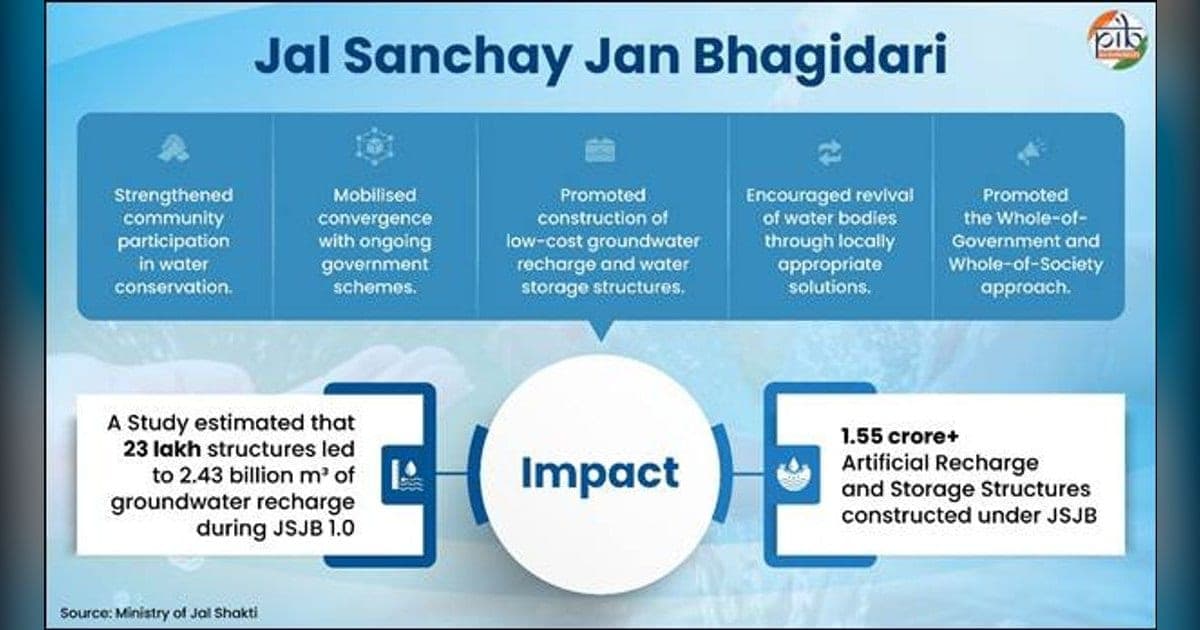
Over 1.55 crore recharge and storage structures have come up under Jal Sanchay Jan Bhagidari, and a study credits them with 2.43 billion cubic metres of recharge.
Why in News
A PIB backgrounder issued on 26 October 2026 set out the record of the Catch the Rain campaign and the Jal Sanchay Jan Bhagidari initiative, under which over 1.55 crore recharge and storage structures have been built and 2.43 billion cubic metres of groundwater recharge has been estimated.
Catch the Rain is the country's standing call for water conservation, built around rainwater harvesting, groundwater recharge and the repair of water bodies. The campaign asks households, housing societies, workplaces and institutions to fit harvesting systems, sink recharge pits and shafts, mend disused borewells, bring back baolis and old wells, desilt ponds and reservoirs, and plant trees where water collects and seeps in.
Jal Sanchay Jan Bhagidari and its figures
Jal Sanchay Jan Bhagidari (JSJB) 1.0 ran from 1 April 2024 to 31 May 2025 on the principle of the 3Cs - Community, CSR and Cost - and drew on existing government schemes for funds and manpower. More than 10 lakh groundwater recharge structures were built during it, and over 27 lakh artificial recharge structures were reported. JSJB 2.0 followed on 1 June 2025, aimed at over-exploited and critical districts through low-cost, hyper-local work. Taken together, the initiative has produced over 1.55 crore artificial recharge and storage structures.
What the impact study found
An impact evaluation of JSJB 1.0 assessed 23 lakh structures against rainfall data for 1 June 2025 to 31 December 2025. It put the gain at 2.43 billion cubic metres of groundwater recharge. In November 2025 the standout work under JSJB 1.0 was honoured at the 6th National Water Awards.
The 2026 version
JSJB: Catch the Rain began on 1 June 2026 and merged the earlier approach with the Jal Shakti Abhiyan: Catch the Rain campaign. It pulls money and effort from VB-G RAM G, Per Drop More Crop and the Repair, Renovation and Restoration of Water Bodies components of the Pradhan Mantri Krishi Sinchayee Yojana, CAMPA, Finance Commission Grants and state schemes, and works through Panchayati Raj institutions, urban local bodies, women's groups, youth, schools and colleges. A portal and a mobile application carry the monitoring and public feedback.
Jal Shakti Abhiyan: Catch the Rain
The parent campaign was launched on 22 March 2021, World Water Day, with the slogan "Catch the Rain, Where It Falls, When It Falls". It grew out of Jal Shakti Abhiyan of 2019, which reached 1,592 water-stressed blocks in 256 districts. Each year since has had its own focus.
| 2022 | Expanding Water Conservation Activities |
| 2023 | Source Sustainability for Drinking Water, in 150 water-stressed districts |
| 2024 | Nari Shakti se Jal Shakti, led by women |
Women's work of that year is still recognised through the Swachh Sujal Shakti Samman. At the district level, Jal Shakti Kendras act as knowledge and facilitation hubs, offering information on harvesting methods, technical help and support in planning.
Important Facts
| Campaign | Jal Sanchay Jan Bhagidari: Catch the Rain (JSJB: CTR) |
|---|---|
| Structures built | Over 1.55 crore artificial recharge and storage structures |
| JSJB 1.0 period | 1 April 2024 to 31 May 2025 |
| The 3Cs | Community, CSR and Cost |
| JSJB 2.0 launch | 1 June 2025, for over-exploited and critical districts |
| Impact study | 23 lakh structures, 2.43 billion cubic metres of groundwater recharge |
| JSA: CTR launch | 22 March 2021, on World Water Day |
| JSA: CTR slogan | Catch the Rain, Where It Falls, When It Falls |
| Jal Shakti Abhiyan 2019 | 1,592 water-stressed blocks in 256 districts |
| District hubs | Jal Shakti Kendras |
Exam Point of View
Carry the figures: 1.55 crore structures in all, over 10 lakh recharge structures and 27 lakh artificial recharge structures under JSJB 1.0, 23 lakh structures studied, 2.43 billion cubic metres of recharge, 1,592 blocks in 256 districts under Jal Shakti Abhiyan 2019 and 150 districts in 2023. Also the dates: JSJB 1.0 from 1 April 2024, JSJB 2.0 on 1 June 2025, JSJB: Catch the Rain on 1 June 2026, and JSA: Catch the Rain on 22 March 2021, World Water Day. The 3Cs are Community, CSR and Cost.
Practice Questions
How many artificial recharge and storage structures have been constructed under the Jal Sanchay Jan Bhagidari initiative?
- A.Over 55 lakh
- B.Over 1.55 crore
- C.Over 2.43 crore
- D.Over 3.55 crore
Show answer
That is the total number of artificial recharge and storage structures built under the Jal Sanchay Jan Bhagidari initiative taken as a whole.
Read the full explanation →Jal Shakti Abhiyan: Catch the Rain was launched on 22 March 2021, which is observed as which day?
- A.World Environment Day
- B.World Water Day
- C.World Wetlands Day
- D.World Earth Day
Show answer
Jal Shakti Abhiyan: Catch the Rain was launched on 22 March 2021, which falls on World Water Day, and its guiding slogan was 'Catch the Rain, Where It Falls, When It Falls'.
Read the full explanation →What do the 3Cs of the Jal Sanchay Jan Bhagidari initiative stand for?
- A.Community, CSR and Cost
- B.Catchment, Conservation and Convergence
- C.Citizen, Credit and Capacity
- D.Canal, Check dam and Culvert
Show answer
Jal Sanchay Jan Bhagidari 1.0, which ran from 1 April 2024 to 31 May 2025, followed these three principles while strengthening public participation in water conservation, and it also mobilised convergence with running government schemes to speed the work up.
Read the full explanation →Frequently Asked Questions
How many structures have been built under Jal Sanchay Jan Bhagidari?
Over 1.55 crore artificial recharge and storage structures. An impact study of 23 lakh of them estimated 2.43 billion cubic metres of groundwater recharge.
When was Jal Shakti Abhiyan: Catch the Rain launched and with what slogan?
On 22 March 2021, World Water Day, with the slogan 'Catch the Rain, Where It Falls, When It Falls'. It built on Jal Shakti Abhiyan of 2019, which covered 1,592 blocks in 256 districts.
What are the 3Cs of Jal Sanchay Jan Bhagidari?
Community, CSR and Cost. JSJB 1.0 followed these principles from 1 April 2024 to 31 May 2025 and converged with running government schemes.
Sources
- https://www.pib.gov.in/PressReleasePage.aspx?PRID=2328335 (opens in a new tab) — Press Information Bureau
Current Affairs 26 October 2026
- Lula da Silva Re-elected President of BrazilInternational
- ESTIC 2026 Curtain Raiser Held at ICGEB New DelhiScience & Technology
- Immersive Tech Push: Rs 250 Crore for AVGC Creator LabsScience & Technology
- 12th BRICS Parliamentary Forum Under India's ChairshipSummits & Conferences
- TDB Funds Manastu Space Green Propulsion With Rs 116 CroreScience & Technology
- RELIEF Export Scheme Extended Till 31 March 2027Economy
- 13th ADMM-Plus at Cebu: Rajnath Singh to Lead IndiaDefence
- Army Seminar MTS 2.0 Themed CHAKRA: Curtain Raiser HeldDefence
Related Current Affairs
- Government Schemes
Special Campaign 6: NLC India Earns 3.12 Crore From Scrap
25 October 2026 · 3 min read
- Government Schemes
NSS Marks Gram Seva evam Parampragat Khel Diwas in Villages
24 October 2026 · 2 min read
- Government Schemes
Shilp Samagam Mela 2026 Underway at Khanapara in Guwahati
24 October 2026 · 2 min read
- Government Schemes
Shram Samvad Campaign Covers 316 Districts on Labour Codes
24 October 2026 · 2 min read
- Government Schemes
VB-G RAM G Guarantees 125 Days of Rural Wage Employment
24 October 2026 · 2 min read





Related GK
- Districts, Divisions and Firsts of Haryana: Facts and MCQs
26 October 2026 · Haryana
- Sports and State Awards of Madhya Pradesh: Facts and PYQs
26 October 2026 · Madhya Pradesh
- Transport and Tourism of Madhya Pradesh: Routes and Sites
26 October 2026 · Madhya Pradesh
Take the Quiz
- Current Affairs Quiz
State Exams Current Affairs Quiz: 26 October 2026
25 questions25 minutesStart Quiz