
Green Diwali Campaign 2026 Covers 130 NCAP Cities
WWF-India's EIACP centre, backed by the Environment Ministry, ran the Green Diwali Campaign 2026 under Mission LiFE across 130 cities covered by the NCAP.
Why in News
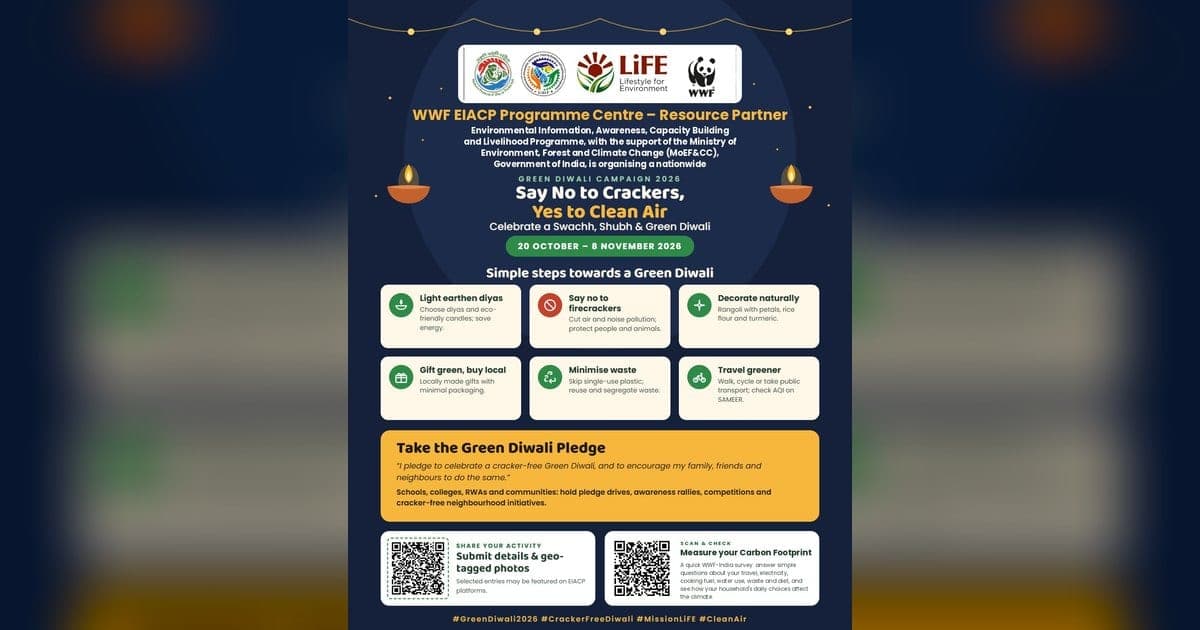
On 8 November 2026 the Environment Ministry supported appeal of WWF-India's EIACP centre asked Delhi-NCR to mark a cracker-free Green Diwali, closing the Green Diwali Campaign 2026 run under Mission LiFE across 130 NCAP cities.
The EIACP Programme Centre - Resource Partner of WWF-India, supported by the Union Ministry of Environment, Forest and Climate Change, asked the people of Delhi and the National Capital Region to keep this Diwali free of crackers and help the air stay clean. The appeal formed part of the nationwide Green Diwali Campaign 2026, which ran from 20 October to 8 November 2026 under Mission LiFE, or Lifestyle for Environment, with its focus on the 130 cities covered by the National Clean Air Programme across 24 states and union territories.
The air over Delhi
The Central Pollution Control Board placed the air quality of the capital in the Very Poor band, and the Air Quality Early Warning System forecast that it could slip into the Severe band over the festive days. The Commission for Air Quality Management in NCR and Adjoining Areas is applying measures under the Graded Response Action Plan across the region to stop the air from getting worse, and citizens were urged to back those efforts and follow the curbs in force.
The Green Diwali Pledge
Every citizen was invited to take a pledge for clean air, good health and a pollution-free environment, and a set of simple steps was laid out. Earthen diyas and eco-friendly candles are preferred over heavy use of electricity. Gifts should be locally made with little packaging. Firecrackers are to be avoided so that air and noise pollution fall and public health is protected. Rangolis can be drawn with flower petals, rice flour and turmeric, and decorations made from upcycled material. Single-use plastic is to be set aside, decorations reused, and waste segregated for recycling. Communities were asked to hold plantation drives, clean-up work and awareness walks, to give away old clothes and usable household items, and to walk, cycle or use public or shared transport for festive travel.
Watching the air
Citizens were also asked to follow the daily Air Quality Index on the Central Pollution Control Board's SAMEER app and to cut down time outdoors on bad air days. A carbon footprint survey of WWF-India was offered so that households can gauge their own environmental footprint and shift to steadier habits. Institutions and groups taking part were asked to report their activities with the name and location of the organisation, the details and date of the activity, the number of participants who took the pledge, geo-tagged photographs and a short report; selected entries may be featured on EIACP platforms.
Important Facts
| Campaign | Green Diwali Campaign 2026 |
|---|---|
| Duration | 20 October to 8 November 2026 |
| Mission | Mission LiFE, Lifestyle for Environment |
| Reach | 130 cities under the National Clean Air Programme in 24 states and union territories |
| Organiser | EIACP Programme Centre - Resource Partner, WWF-India |
| Supported by | Ministry of Environment, Forest and Climate Change |
| Delhi air quality | Very Poor as per the Central Pollution Control Board, may turn Severe |
| NCR body | Commission for Air Quality Management in NCR and Adjoining Areas |
| Action plan | Graded Response Action Plan, applied across the region |
| AQI app | SAMEER, of the Central Pollution Control Board |
Exam Point of View
Remember the campaign name and dates (Green Diwali Campaign 2026, 20 October to 8 November 2026), the mission it ran under (Mission LiFE, Lifestyle for Environment), the reach (130 cities under the National Clean Air Programme in 24 states and union territories), the organiser (WWF-India's EIACP Programme Centre with the Ministry of Environment, Forest and Climate Change), the CPCB app for the daily AQI (SAMEER), and that CAQM applies the Graded Response Action Plan in the NCR.
Practice Questions
The Green Diwali Campaign 2026 focused on how many cities covered under the National Clean Air Programme?
- A.102 cities
- B.115 cities
- C.130 cities
- D.150 cities
Show answer
The nationwide Green Diwali Campaign was run from the twentieth of October to the eighth of November under Mission LiFE, which stands for Lifestyle for Environment, and its special focus was the cities covered by the National Clean Air Programme.
Read the full explanation →Which app of the Central Pollution Control Board gives the daily Air Quality Index?
- A.SAMEER
- B.VAYU
- C.PRANA
- D.SWACHH
Show answer
As part of the Green Diwali Pledge, citizens were asked to follow the daily Air Quality Index on the SAMEER app of the Central Pollution Control Board and to cut down the time they spend outdoors on days when the air is poor.
Read the full explanation →Under which mission was the Green Diwali Campaign 2026 carried out?
- A.Mission LiFE
- B.National Clean Air Programme
- C.Graded Response Action Plan
- D.Mission Amrit Sarovar
Show answer
The nationwide Green Diwali Campaign of the year was run under it from the twentieth of October to the eighth of November.
Read the full explanation →Which body implements the Graded Response Action Plan in the National Capital Region?
- A.Central Pollution Control Board
- B.Commission for Air Quality Management in NCR and Adjoining Areas
- C.WWF-India
- D.Ministry of Environment, Forest and Climate Change
Show answer
The correct answer is the Commission for Air Quality Management in NCR and Adjoining Areas, known by its short form CAQM, which was applying measures under the Graded Response Action Plan across the region to prevent any further decline in air quality, and citizens were urged to support those efforts…
Read the full explanation →Frequently Asked Questions
How many cities did the Green Diwali Campaign 2026 focus on?
The 130 cities covered under the National Clean Air Programme, spread across 24 states and union territories. The campaign ran from 20 October to 8 November 2026 under Mission LiFE and was taken up by WWF-India's EIACP Programme Centre with support from the Ministry of Environment, Forest and Climate Change.
Which app gives the daily Air Quality Index in India?
The SAMEER app of the Central Pollution Control Board. Citizens were asked to follow the daily index on it and to limit time spent outdoors on days when the air is poor, as part of the Green Diwali Pledge for clean air and better health.
Which body applies the Graded Response Action Plan in the NCR?
The Commission for Air Quality Management in NCR and Adjoining Areas, known as CAQM. It was applying measures under the plan across the region to prevent any further decline in air quality during the festive days.
What steps were suggested for a Green Diwali?
Using earthen diyas and eco-friendly candles, avoiding firecrackers, choosing locally made gifts with little packaging, drawing rangolis with flower petals, rice flour and turmeric, avoiding single-use plastic, segregating waste, holding plantation and clean-up drives, donating usable items, and walking, cycling or using public transport.
Sources
- https://www.pib.gov.in/PressReleasePage.aspx?PRID=2334104 (opens in a new tab) — Press Information Bureau
Current Affairs 8 November 2026
- Buddha Relics Exposition at Tawang Ends, 31,000 DevoteesNational
- Shram Samvad on Labour Codes Held at Dewas in Madhya PradeshGovernment Schemes
- Bharat Ratna L.K. Advani Enters His 100th YearPersons in News
- PM Modi Marks First Naxal-Free Diwali With Forces in BastarNational
- Rajnath Singh Celebrates Deepawali With Troops in SikkimDefence
Related Current Affairs
Related GK
- Famous Personalities of Rajasthan: Exam Notes
28 October 2026 · Rajasthan
- Districts and Divisions of Rajasthan: Exam Notes
28 October 2026 · Rajasthan
- Tourism and World Heritage Sites of Rajasthan Notes
27 October 2026 · Rajasthan
Take the Quiz
- Current Affairs Quiz
State Exams Current Affairs Quiz: 8 November 2026
23 questions23 minutesStart Quiz