
IAF Holds Industry Outreach on Unmanned Systems Roadmap
The Indian Air Force held an industry outreach at Vigyan Bhawan on 21 October 2026 on its unmanned systems roadmap, with about 100 industry representatives.
Why in News
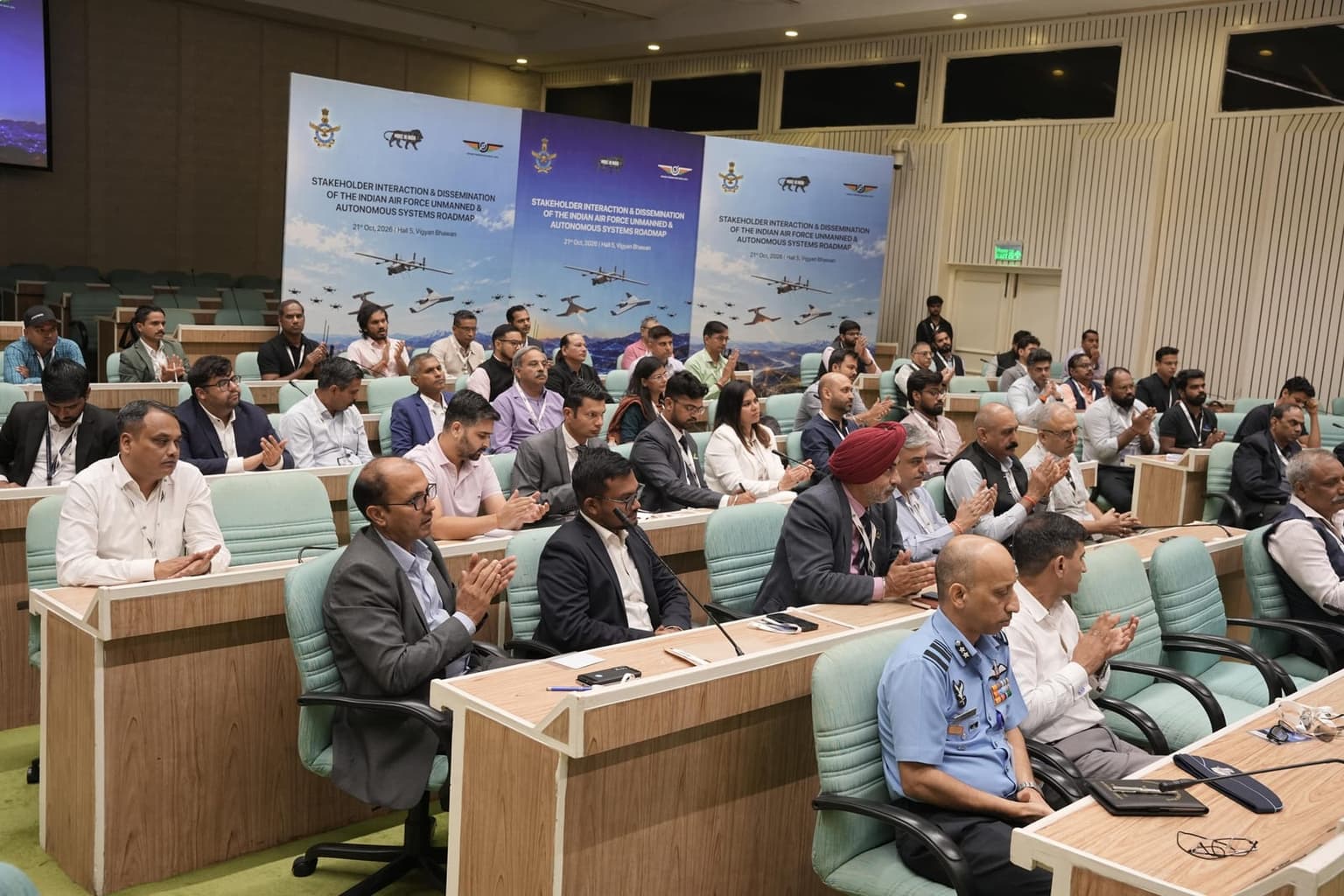
On 21 October 2026 the Indian Air Force held an Industry Outreach Programme at Vigyan Bhawan, New Delhi, to share its long-term requirements in unmanned and autonomous systems with about 100 industry representatives, building on the roadmap released at IAF Dronathon 2026.
The Indian Air Force held an Industry Outreach Programme at Vigyan Bhawan in New Delhi on 21 October 2026 to tell industry what it will need in unmanned and autonomous systems over the long term. Micro, Small and Medium Enterprises, startups and other industry partners were the audience.
Who ran it and who came
The programme was chaired by Air Marshal Premkumar K, VM, VSM, Director General (Weapon Systems) at Air Headquarters. Around 100 representatives of drone companies and allied industry partners attended, a turnout the Air Force reads as a sign of how far its engagement with India's unmanned ecosystem has come.
It builds on the roadmap from Pokhran
The event rests on the IAF Unmanned and Autonomous Systems Roadmap, which was released during IAF Dronathon 2026 at Pokhran on 14 September 2026. At the outreach the Air Force both explained its future requirements and handed out the roadmap booklet to industry partners, so that firms can read the operational requirement for themselves rather than guess at it.
What the roadmap envisages
The roadmap sets out a layered and networked family of unmanned systems, framed around how quickly air power is changing. The emphasis is on indigenous capabilities that are operationally relevant, reliable and resilient, and that work alongside manned platforms the force already flies and will fly later. Self-reliance here was described at the event as an operational necessity rather than an aspiration.
The critical technology areas
| Area | Why it is listed |
|---|---|
| Indigenous propulsion | To cut dependence on outside sources |
| Autonomous software | Core to systems that fly and decide without a pilot |
| Resilient navigation | To keep flying when navigation signals are contested |
| Standardised interfaces | To let systems plug into a networked family |
Why it matters
Through steady engagement with industry, MSMEs, startups and academia, the Air Force wants faster innovation, collaborative development and emerging technology turned into usable operational capability. The aim stated is a domestic ecosystem able to support India's self-reliance in defence technology. For the exam the pairing to hold is the roadmap with Dronathon 2026 at Pokhran, and the outreach with Vigyan Bhawan.
Important Facts
| Event | IAF Industry Outreach Programme on unmanned and autonomous systems |
|---|---|
| Venue | Vigyan Bhawan, New Delhi |
| Date | 21 October 2026 |
| Chaired by | Air Marshal Premkumar K, VM, VSM, Director General (Weapon Systems), Air Headquarters |
| Participation | Around 100 representatives of drone companies and industry partners |
| Roadmap | IAF Unmanned and Autonomous Systems Roadmap |
| Roadmap released at | IAF Dronathon 2026, Pokhran, on 14 September 2026 |
| Critical technology areas | Indigenous propulsion, autonomous software, resilient navigation, standardised interfaces |
| Audience | MSMEs, startups, industry partners and academia |
Exam Point of View
Remember the venue (Vigyan Bhawan, New Delhi), the chair (Air Marshal Premkumar K, Director General (Weapon Systems)), the attendance (about 100 industry representatives), where and when the roadmap was released (IAF Dronathon 2026 at Pokhran, 14 September 2026), and the four critical technology areas named.
Practice Questions
At which event was the IAF Unmanned and Autonomous Systems Roadmap released?
- A.Aero India 2026 at Bengaluru
- B.IAF Dronathon 2026 at Pokhran
- C.DefExpo 2026 at Gandhinagar
- D.Exercise Vayu Shakti at Jaisalmer
Show answer
The roadmap was released there on 14 September 2026, and the Industry Outreach Programme of 21 October 2026 at Vigyan Bhawan in New Delhi was built on it, with the roadmap booklet distributed to industry partners on that day.
Read the full explanation →Who chaired the Indian Air Force's Industry Outreach Programme on unmanned and autonomous systems held on 21 October 2026?
- A.The Chief of Air Staff
- B.The Director General (Weapon Systems), Air Headquarters
- C.The Defence Secretary
- D.The Chairman of the Defence Research and Development Organisation
Show answer
Around 100 representatives of drone companies and allied industry partners attended, which the Air Force treated as a measure of its growing engagement with the unmanned ecosystem in the country.
Read the full explanation →Which of the following was named by the IAF as a critical technology area for unmanned and autonomous systems?
- A.Resilient navigation
- B.Hypersonic glide vehicles
- C.Nuclear propulsion for aircraft
- D.Satellite launch vehicles
Show answer
At the outreach the Air Force listed four areas needing focused attention: indigenous propulsion, autonomous software, resilient navigation and standardised interfaces, all of them meant to cut dependence on external sources and strengthen the domestic defence ecosystem.
Read the full explanation →Frequently Asked Questions
Where was the IAF Unmanned and Autonomous Systems Roadmap released?
At IAF Dronathon 2026 held at Pokhran on 14 September 2026. The roadmap booklet was later distributed to industry partners at the outreach programme of 21 October 2026.
Who chaired the IAF Industry Outreach Programme of 21 October 2026?
Air Marshal Premkumar K, VM, VSM, Director General (Weapon Systems) at Air Headquarters. The programme was held at Vigyan Bhawan in New Delhi with around 100 industry representatives.
Which technology areas does the IAF see as critical for unmanned systems?
Indigenous propulsion, autonomous software, resilient navigation and standardised interfaces, all aimed at reducing dependence on external sources and strengthening the domestic defence ecosystem.
Sources
Current Affairs 21 October 2026
- SARAS Mela 2026: First National Edition Outside Delhi-NCRGovernment Schemes
- Police Commemoration Day 2026: Amit Shah Honours Fallen PoliceImportant Days
- SKOCH Gold Award 2026 for Coal Ministry SUVIKALP Mine ToolAwards & Honours
- Swachhata Campaign 6.0: ICAR Holds Nearly 4,000 Clean DrivesGovernment Schemes
- President Murmu Presents Lalit Kala Akademi Awards in New DelhiAwards & Honours
- Army Commanders Conference Begins; Land Warfare Doctrine ReleaseDefence
- Defence Ministry Inks Rs 770 Crore Deal for LLLR-I RadarsDefence
- Vummidi Ethiraj, Craftsman of the Historic Sengol, Passes AwayObituaries
Related Current Affairs
Related GK
- MP Language, Dialects and Literature: Exam Notes
22 October 2026 · Madhya Pradesh
- Religious and Tourist Places of Haryana: Exam Notes
22 October 2026 · Haryana
- Bihar Languages and Literature: Maithili, Bhojpuri, Magahi
22 October 2026 · Bihar
Take the Quiz
- Current Affairs Quiz
NDA Current Affairs Quiz: 21 October 2026
12 questions12 minutesStart Quiz