
Q1 2026-27 GDP Estimates Explained: Base Year and Deflators
GDP at current prices for the first quarter of 2026-27 stood at Rs 88.27 lakh crore, and manufacturing GVA was worked out using the double deflation method.
Why in News
On 2 September 2026 the Ministry of Statistics and Programme Implementation released a set of answers on the first-quarter 2026-27 GDP estimates, covering the new 2022-23 base year, double deflation and the revisions to last year's figures.
The Ministry of Statistics and Programme Implementation issued a backgrounder on 2 September 2026 answering the doubts raised about the first quarter of 2026-27. That quarter runs from April to June. Two changes in method explain almost every question that was asked.
A new base year
The updated annual and quarterly series was put out on 31 August 2026. Its base year is 2022-23. A base year fixes the reference prices against which real growth is measured. It is changed from time to time so that relative prices still describe the economy as it actually is. The new series also uses a fresh output Producer Price Index and a Banking Services Price Index, both with the same base year.
What double deflation does
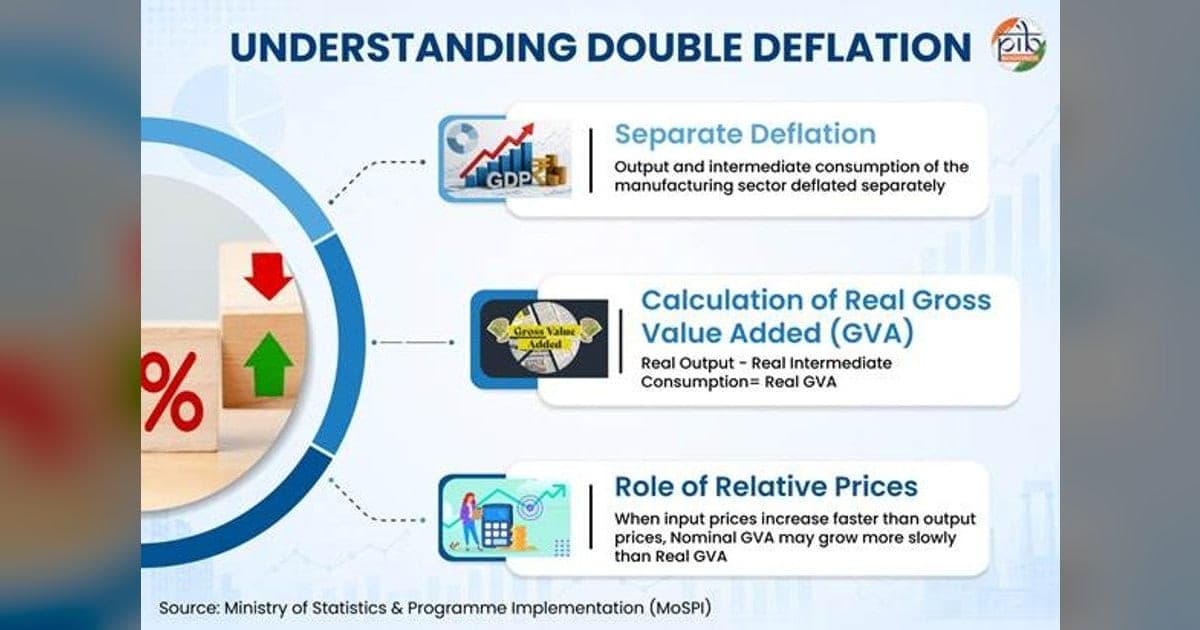
The second change is double deflation for manufacturing. Output and intermediate consumption are deflated one by one, and real Gross Value Added is the gap between the two. The IMF treats this as the preferred way of measuring output in volume terms. Input prices rose faster than output prices during the quarter. Nominal GVA therefore grew more slowly than real GVA, and the implicit GVA deflator turned negative. Factory prices did not fall. Cotton ginning and textiles, basic metals, and rubber and plastic goods were among the activities where input prices ran ahead.
The numbers that were questioned
| Manufacturing nominal GVA growth | 7.7 per cent |
| Manufacturing real GVA growth | 9.2 per cent |
| Manufacturing implicit GVA deflator | -1.5 per cent |
| Agriculture implied inflation | 3.9 per cent |
| Mining real GVA growth | -2.4 per cent |
| Mining nominal GVA growth | 22.3 per cent |
| Implied GDP inflation | 2.5 per cent |
Agriculture is handled the other way round. Its GVA is built at constant prices first, then raised to current prices with the relevant producer price index, whose farm group rose by about 5 per cent. The implied GDP deflator is not CPI and not WPI. It is a ratio of current-price GDP to constant-price GDP, it covers the whole economy, and it is derived from more than 300 separate item-level deflators.
Why last year's figure moved
Mining shows the widest gap between real and nominal growth. Crude petroleum and natural gas prices rose 69.5 per cent in April, 72.2 per cent in May and 33.7 per cent in June. The first quarter of 2025-26 has itself been restated four times: Rs 86.05 lakh crore on 29 August 2025 under the old 2011-12 series, Rs 80.32 lakh crore once the 2022-23 series arrived, Rs 80.44 lakh crore with the provisional estimates of 5 June 2026, and Rs 80.00 lakh crore after the new IIP and PPI series were folded in. The Ministry's point is that Rs 88.27 lakh crore must be compared with Rs 80.32 lakh crore from the same series, never with the superseded Rs 86.05 lakh crore.
Important Facts
| Ministry | Statistics and Programme Implementation (MoSPI) |
|---|---|
| Quarter | First quarter (April-June) of 2026-27 |
| New base year | 2022-23, replacing 2011-12 |
| Updated series released | 31 August 2026 |
| New method | Double deflation for manufacturing |
| GDP at current prices, Q1 2026-27 | Rs 88.27 lakh crore |
| Comparable Q1 2025-26 estimate | Rs 80.32 lakh crore |
| Manufacturing implicit GVA deflator | -1.5 per cent |
| Mining nominal GVA growth | 22.3 per cent |
| Item-level deflators used | More than 300 |
Exam Point of View
Remember the new base year (2022-23), the release date of the updated series (31 August 2026), what double deflation is and that the IMF prefers it, the manufacturing deflator of -1.5 per cent, mining's real and nominal growth of -2.4 and 22.3 per cent, and the first-quarter figure of Rs 88.27 lakh crore.
Practice Questions
What is the base year of India's updated series of annual and quarterly GDP estimates?
- A.2004-05
- B.2011-12
- C.2022-23
- D.2024-25
Show answer
Correct answer: C. 2022-23
Explanation
The correct answer is 2022-23. The backgrounder states that the updated series of annual and quarterly GDP estimates, released on 31 August 2026, takes 2022-23 as its base year. The same base year is used for the new output Producer Price Index and for the Banking Services Price Index that feed into the series. A base year supplies the reference prices against which real growth is measured, and it is revised from time to time so that relative prices keep describing the economy as it is. Option B, 2011-12, is the series that has now been replaced; the backgrounder uses it only to explain why an old estimate of Rs 86.05 lakh crore cannot be compared with a figure from the new series. Options A and D do not appear in the release at all. Candidates often confuse the year of release with the base year, so note that 2026 is when the series came out and 2022-23 is the base it rests on.
Under double deflation, which two items are deflated separately to arrive at real Gross Value Added?
- A.Output and intermediate consumption
- B.Exports and imports
- C.Wages and profits
- D.Government spending and private consumption
Show answer
Correct answer: A. Output and intermediate consumption
Explanation
The correct answer is output and intermediate consumption. Double deflation is a production-side technique: gross output is deflated with one price index and intermediate consumption with another, and real Gross Value Added is what remains after subtracting the second from the first. India now applies it to industries in the manufacturing sector, and the IMF describes it as the preferred method for measuring GDP in volume terms. Option B is wrong because exports and imports belong to the expenditure side of the accounts and are not what this method separates. Option C is wrong because wages and profits are components of the income approach, not quantities that are deflated in this exercise. Option D is wrong for the same reason as B: private final consumption expenditure is a measure of final demand, and the backgrounder says plainly that double deflation does not enter its calculation because final demand has no intermediate consumption to subtract.
GDP at current prices for the first quarter of 2026-27 was estimated at:
- A.Rs 80.32 lakh crore
- B.Rs 86.05 lakh crore
- C.Rs 88.27 lakh crore
- D.Rs 94.60 lakh crore
Show answer
Correct answer: C. Rs 88.27 lakh crore
Explanation
The correct answer is Rs 88.27 lakh crore. The release says the first quarter of 2026-27 should be compared with the earlier first-quarter figure from the same series, and in doing so it names the current-price estimate for the quarter. Option A, Rs 80.32 lakh crore, is the estimate for the first quarter of 2025-26 once the 2022-23 base-year series was introduced in February 2026, and it is the figure the new quarter must be measured against. Option B, Rs 86.05 lakh crore, is the estimate first published on 29 August 2025 under the old 2011-12 series; the Ministry argues it cannot be compared directly with a number from the revised series. Option D does not appear anywhere in the release. Also remember the two later revisions of the same quarter, to Rs 80.44 lakh crore with the provisional estimates of 5 June 2026 and then to Rs 80.00 lakh crore after the new IIP and PPI series were incorporated.
Why did the mining and quarrying sector show real GVA growth of -2.4 per cent but nominal GVA growth of 22.3 per cent?
- A.Because mining output rose sharply in volume terms
- B.Because mineral prices, especially crude petroleum and natural gas, rose steeply
- C.Because the sector was moved out of the GDP series
- D.Because coal production was excluded from the estimates
Show answer
Correct answer: B. Because mineral prices, especially crude petroleum and natural gas, rose steeply
Explanation
The correct answer is the steep rise in mineral prices. Constant-price estimates for mining are built from the Index of Industrial Production, which grew -3.8 per cent in April, -1.4 per cent in May and 1.6 per cent in June, broadly matching real GVA growth of -2.4 per cent. Nominal estimates are then derived by applying producer price indices, and those prices climbed sharply: crude petroleum and natural gas by 69.5 per cent in April, 72.2 per cent in May and 33.7 per cent in June, and mining of metal ores by 27.6, 25.2 and 23.5 per cent. That price surge, not any inconsistency in the data, explains the gap. Option A is wrong because volumes fell in two of the three months. Option C is wrong because mining remains part of the series. Option D is wrong because coal and lignite are covered, and in fact recorded negative price inflation in all three months.
Frequently Asked Questions
What is the base year of India's updated GDP series?
2022-23, in place of 2011-12. The updated annual and quarterly series was released on 31 August 2026 and also uses a new output Producer Price Index and a Banking Services Price Index with the same base year.
What is double deflation?
A method in which an industry's output and its intermediate consumption are deflated separately, real GVA being the difference. India now applies it to manufacturing, and the IMF regards it as the preferred way to measure GDP in volume terms.
Why did manufacturing show a negative implicit deflator?
Because input prices rose faster than output prices, nominal GVA grew 7.7 per cent while real GVA grew 9.2 per cent. The resulting implicit GVA deflator was -1.5 per cent. It does not mean manufactured goods became cheaper.
Sources
- Understanding Q1 2026-27 GDP Estimates (opens in a new tab) — Press Information Bureau
- Additional Information related to GDP Estimates Received After Release of Q1 Estimates of FY 2026-27 (opens in a new tab) — Press Information Bureau
Current Affairs 2 September 2026
- Japan Credit Rating Agency Upgrades India to 'A-', Outlook StableEconomy
- GIFT IFSC Banks Disburse $52.82 Billion Under RBI Swap FacilityBanking & Finance
- Legal Metrology (Indian Standard Time) Rules 2026 NotifiedNational
- Tenzing Norgay National Adventure Awards 2024 AnnouncedAwards & Honours
- 16th Aero India to Be Held at Bengaluru in February 2027Defence
- 18th BRICS IP Offices Heads Meeting Held in New DelhiSummits & Conferences
- IBCA and ADB Sign MoU at Tiger Landscapes Workshop in DelhiEnvironment
Related Current Affairs
- Economy
Steel Sector Grows in April-August 2026; NMDC Sets August Record
23 September 2026 · 2 min read
- Economy
Japan Credit Rating Agency Upgrades India to 'A-', Outlook Stable
23 September 2026 · 2 min read




Take the Quiz
- Current Affairs Quiz
RBI Weekly Current Affairs Quiz: 31 August – 6 September 2026
23 questions23 minutesStart Quiz