
Jal Jeevan Mission 2.0 Regional Conference Ends in Agra
The second regional conference on Jal Jeevan Mission 2.0 closed at Agra, with seven northern States and Union Territories and Jal Arpan Diwas events.
Why in News
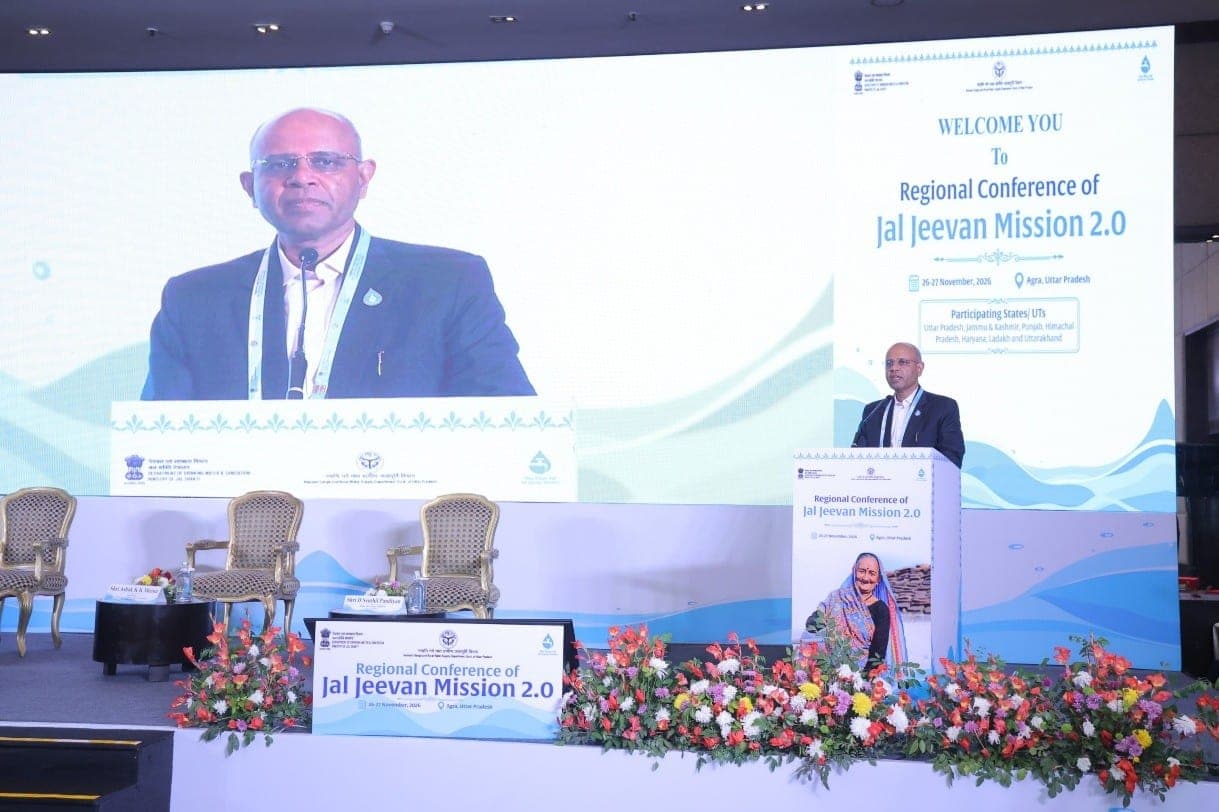
The second regional conference on Jal Jeevan Mission 2.0 concluded at Agra on 27 November 2026, with seven northern States and Union Territories agreeing on reforms and Jal Arpan Diwas held across five villages of Uttar Pradesh.
The second regional conference on Jal Jeevan Mission 2.0 closed at Agra in Uttar Pradesh on 27 November 2026. It was organised by the Department of Drinking Water and Sanitation (DDWS) of the Ministry of Jal Shakti and brought together seven northern States and Union Territories over two days to work out how the reformed mission will be carried out.
What was discussed
Shri Ashok K. K. Meena, Secretary of the department, said the meeting had helped the participating States reach a common reading of the reforms under the new phase of the mission. He praised two practices seen in Uttar Pradesh, the use of solar energy to run rural water supply schemes and command-and-control systems to watch over and operate the infrastructure, and asked other States to study them. He stressed that drinking water in a village is a local service, so the ownership of assets must sit with Gram Panchayats and the community, backed by their financial, technical and institutional capacity.
Jal Arpan Diwas in the villages
| Scheme visited | District |
|---|---|
| Badhera (Bhadaira) Water Supply Scheme and 456 MLD plant | Etah |
| Nagla Babu Water Supply Scheme | Hathras |
| Simrau Water Supply Scheme | Mainpuri |
| Shahpur Qutub Water Supply Scheme | Aligarh |
| Sultanpur Water Supply Scheme | Hathras |
Five teams of officials from the Centre, the participating States and partner ministries visited rural water supply schemes and joined Jal Arpan Diwas ceremonies across five villages. At the field sites the Secretary and Shri Kamal Kishore Soan, Additional Secretary and Mission Director of the National Jal Jeevan Mission, drank water straight from household taps to show confidence in its safety. Gram Panchayat members, Village Water and Sanitation Committees, self-help groups and school children took part, and women trained in field testing demonstrated water quality checks.
Convergence and capacity
Shri Soan called for digital mapping of all drinking water infrastructure and said the department and the Ministry of Panchayati Raj have agreed to fold water and sanitation training into the capacity-building work already running under the Rashtriya Gram Swaraj Abhiyan. Shri D. Senthil Pandiyan, Joint Secretary, said sustainable rural water service needs a whole-of-government approach across drinking water, Panchayati Raj, rural development, tribal affairs and skill development. Shri Vijay Kumar of the Ministry of Panchayati Raj pointed to the room the 16th Finance Commission framework offers, urging States to map infrastructure on the e-GramSwaraj portal and put Finance Commission grants into operation and maintenance. The States closed the meeting by reaffirming their commitment to speed up the mission.
Important Facts
| Event | Second regional conference on Jal Jeevan Mission 2.0 |
|---|---|
| Venue | Agra, Uttar Pradesh |
| Organiser | Department of Drinking Water and Sanitation, Ministry of Jal Shakti |
| Participants | Seven northern States and Union Territories |
| Secretary, DDWS | Shri Ashok K. K. Meena |
| Mission Director, NJJM | Shri Kamal Kishore Soan, Additional Secretary |
| Field visit | Badhera (Bhadaira) scheme and 456 MLD treatment plant, Etah |
| Community event | Jal Arpan Diwas in five villages of Uttar Pradesh |
Exam Point of View
Remember the mission (Jal Jeevan Mission 2.0), the organiser (Department of Drinking Water and Sanitation, Ministry of Jal Shakti), the venue (Agra) and that this was the second regional conference with seven northern States and Union Territories. Also note Jal Arpan and Jal Arpan Diwas, the 456 MLD plant at Etah, Gram Panchayat ownership of assets, the Village Water and Sanitation Committees, the tie-up with Rashtriya Gram Swaraj Abhiyan and the e-GramSwaraj portal.
Practice Questions
The second regional conference on Jal Jeevan Mission 2.0 concluded in which city?
- A.Lucknow
- B.Agra
- C.Aligarh
- D.Mainpuri
Show answer
The two-day meeting, organised by the Department of Drinking Water and Sanitation of the Ministry of Jal Shakti, ended there on the twenty-seventh of November 2026 and brought together seven northern States and Union Territories.
Read the full explanation →Under Jal Jeevan Mission 2.0, Jal Arpan refers to which step?
- A.Laying new pipelines in tribal villages
- B.Transferring ownership of water assets to Gram Panchayats and communities
- C.Testing water samples in district laboratories
- D.Releasing central grants to State water departments
Show answer
The Secretary of the department described Jal Arpan as an important move towards handing responsibility and ownership of drinking water infrastructure to the community, and said it should be understood as shared responsibility for service delivery rather than a mere handover of structures.
Read the full explanation →The water treatment plant visited by the Secretary, DDWS, at Etah during the conference has a capacity of:
- A.256 MLD
- B.356 MLD
- C.456 MLD
- D.556 MLD
Show answer
Shri Ashok K. K. Meena, Secretary of the Department of Drinking Water and Sanitation, visited the Badhera, also written Bhadaira, water supply scheme and its treatment plant of this capacity in Etah district, and joined the Jal Arpan Diwas celebration there.
Read the full explanation →Frequently Asked Questions
Where was the second regional conference on Jal Jeevan Mission 2.0 held?
At Agra in Uttar Pradesh, concluding on 27 November 2026. It was organised by the Department of Drinking Water and Sanitation of the Ministry of Jal Shakti and drew seven northern States and Union Territories.
What is Jal Arpan under Jal Jeevan Mission 2.0?
Jal Arpan is the step of handing over responsibility and ownership of rural drinking water infrastructure to Gram Panchayats and village communities. Jal Arpan Diwas ceremonies were held across five villages of Uttar Pradesh during the conference.
Which platforms were named for capacity building and mapping?
Training on water and sanitation is to be folded into the Rashtriya Gram Swaraj Abhiyan framework, and States were asked to map drinking water infrastructure on the e-GramSwaraj portal and use Finance Commission grants for operation and maintenance.
Sources
- https://www.pib.gov.in/PressReleasePage.aspx?PRID=2342708 (opens in a new tab) — Press Information Bureau
Current Affairs 27 November 2026
- CeNS Bengaluru Develops Stable Tunable White LED TechnologyScience & Technology
- 65th Aerospace Medicine Conference Held at IAM BengaluruSummits & Conferences
- Ayush Pavilion Wins Gold at 45th IITF 2026, CBIC Takes BronzeAwards & Honours
- TRAI Issues Reference Interconnect Offer Amendment RulesNational
- NHAI Gets 32 Bids for Ganga, Varuna Corridors in VaranasiNational
- CSIR-CDRI Lucknow Opens BSL-3 Lab for Tuberculosis ResearchScience & Technology
- Bal Vivah Mukt Bharat Campaign Completes Two YearsNational
- TRAI Widens 1601-Series Calling to More Sectors in Phase-IINational
Related Current Affairs
- Government Schemes
Rural Tourism in India: Strategy, Homestays and Village Awards
29 November 2026 · 3 min read
- Government Schemes
Dr Ambedkar Medical Aid Scheme Gives SC, ST Patients ₹3.50 Lakh
27 November 2026 · 2 min read
- Government Schemes
National Overseas Scholarship Funds 20 ST Students Every Year
27 November 2026 · 2 min read
- Government Schemes
PM-ABHIM Has Approved 19,983 Health Infrastructure Units
26 November 2026 · 2 min read
- Government Schemes
Jal Jeevan Mission 2.0 to Train 1 Lakh Nal Jal Mitras
25 November 2026 · 2 min read

Related GK
- Famous Personalities of Rajasthan: Exam Notes
28 October 2026 · Rajasthan
- Districts and Divisions of Rajasthan: Exam Notes
28 October 2026 · Rajasthan
- Tourism and World Heritage Sites of Rajasthan Notes
27 October 2026 · Rajasthan
Take the Quiz
- Current Affairs Quiz
Railway Current Affairs Quiz: 27 November 2026
25 questions25 minutesStart Quiz