
IIA Bengaluru Team Finds Rare Stellar Fossil HE 1153-0518
Astronomers from IIA Bengaluru and Dakshin Kamrup College identified HE 1153-0518, a rare CEMP-no star holding chemical clues to the universe’s first stars.
Why in News
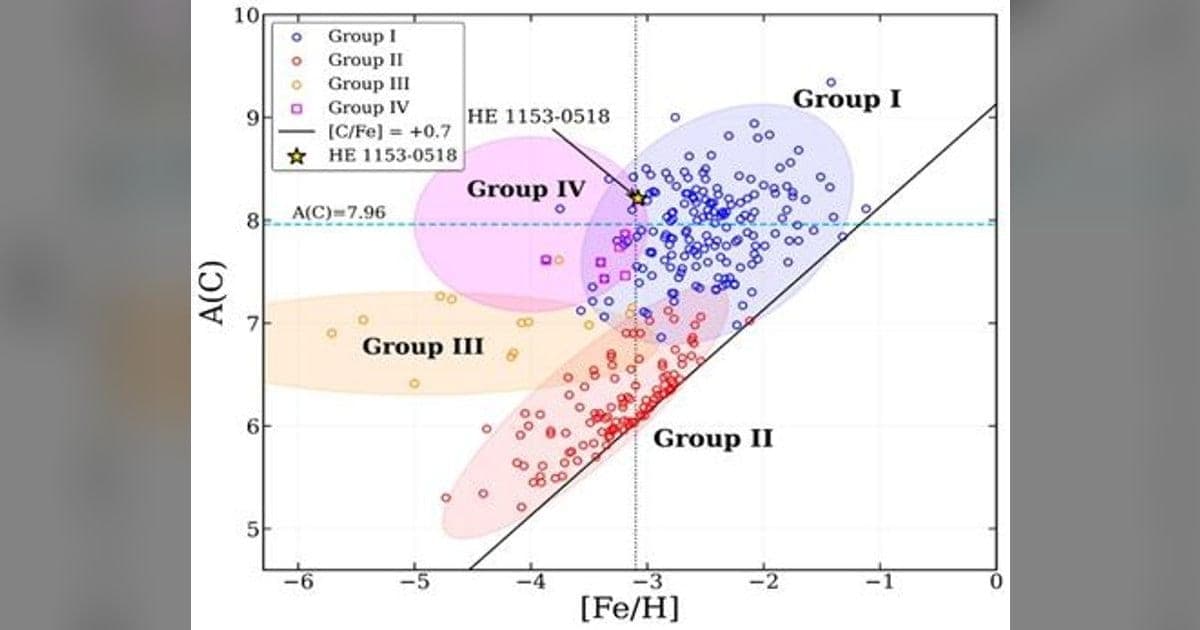
On 23 November 2026 scientists from the Indian Institute of Astrophysics, Bengaluru, and Dakshin Kamrup College, Assam, reported the discovery of HE 1153-0518, a rare CEMP-no stellar fossil that preserves chemical clues to the first generations of stars in the Universe.
A faint, ancient star has turned out to be a record of the very first stars that ever shone. Astronomers have identified HE 1153-0518 as a rare stellar fossil whose chemistry still carries the fingerprints of the earliest generations of stars in the Universe. The finding was announced on 23 November 2026.
Who did the work
The team came from the Indian Institute of Astrophysics (IIA), Bengaluru, an autonomous institute of the Department of Science and Technology, and from Dakshin Kamrup College, Assam. They used high-resolution spectroscopic data from the Subaru telescope in Hawaii, along with recent astrometric and photometric measurements, to pin down the star’s atmospheric properties and the abundance of each element in it. Partha Pratim Goswami of Dakshin Kamrup College led the study; Aruna Goswami of IIA is a co-author. It has been published in the Monthly Notices of the Royal Astronomical Society.
Why an old star is a fossil
The first stars formed only a few hundred million years after the Big Bang. Those giants are long gone, but before they exploded as supernovae they seeded the surrounding gas with freshly made elements. Stars that condensed out of that seeded gas are poor in metals and still hold the chemical signature of their parents, which is why astronomers treat them as fossils and read the early Universe from them.
What makes this star unusual
- It belongs to a scarce sub-group of carbon-enhanced metal-poor stars known as CEMP-no stars: rich in carbon, short of the heavy elements built by neutron capture.
- Its iron content is only about a thousandth of the Sun’s, yet it is notably rich in carbon and sodium.
- A low carbon isotope ratio points to heavy internal mixing of its gas.
- Extra infrared glow in its spectrum hints at dust around the star.
Why it matters for exams and science
By reading the elements in such stars, astronomers can study nuclear reactions that took place more than 13 billion years ago, long before the Sun and the Solar System existed. The authors matched the measured abundances against theoretical models of nucleosynthesis to work out where each element came from. Every chemically primitive star of this kind tightens the constraints on models of how the Milky Way built up its elements, and the IIA has pursued this line of high-resolution stellar spectroscopy for many years.
Important Facts
| Discovery | HE 1153-0518, a rare ancient stellar fossil |
|---|---|
| Class of star | CEMP-no star, a sub-group of carbon-enhanced metal-poor stars |
| Institutes | Indian Institute of Astrophysics (IIA), Bengaluru, and Dakshin Kamrup College, Assam |
| Parent department | IIA is an autonomous institute of the Department of Science and Technology |
| Telescope used | Subaru telescope, Hawaii, for high-resolution spectroscopy |
| Lead author | Partha Pratim Goswami, Dakshin Kamrup College |
| Co-author | Aruna Goswami, Indian Institute of Astrophysics |
| Iron abundance | About one-thousandth of the Sun’s, while rich in carbon and sodium |
| Other signatures | Low carbon isotope ratio indicating internal mixing; excess infrared emission suggesting circumstellar dust |
| Journal | Monthly Notices of the Royal Astronomical Society (MNRAS) |
| Time window studied | Nucleosynthesis more than 13 billion years ago, before the Sun formed |
Exam Point of View
Remember the star’s name (HE 1153-0518), the institutes (IIA Bengaluru under DST, and Dakshin Kamrup College, Assam), the telescope (Subaru, in Hawaii), the class of star (CEMP-no, carbon-enhanced metal-poor), its iron content (about a thousandth of the Sun’s) and the journal (Monthly Notices of the Royal Astronomical Society).
Practice Questions
The rare stellar fossil HE 1153-0518 was studied by a team from which Indian institute?
- A.Indian Institute of Astrophysics, Bengaluru
- B.Physical Research Laboratory, Ahmedabad
- C.Inter-University Centre for Astronomy and Astrophysics, Pune
- D.Aryabhatta Research Institute of Observational Sciences, Nainital
Show answer
Its team worked with Dakshin Kamrup College in Assam, and the lead author of the study, Partha Pratim Goswami, is from that college, while Aruna Goswami of the IIA is a co-author.
Read the full explanation →HE 1153-0518 belongs to which class of stars?
- A.Cepheid variable stars
- B.Carbon-enhanced metal-poor (CEMP-no) stars
- C.Wolf-Rayet stars
- D.T Tauri stars
Show answer
The study placed HE 1153-0518 in this previously unrecognised sub-class: CEMP-no stars show enhanced carbon but are deficient in the heavy elements built by neutron-capture nucleosynthesis, and they form a rare family of stellar fossils that opens a window on the earliest phases of Galactic evolution.
Read the full explanation →Which telescope provided the high-resolution spectroscopic data used to study HE 1153-0518?
- A.Hubble Space Telescope
- B.Subaru telescope, Hawaii
- C.Devasthal Optical Telescope, Nainital
- D.James Webb Space Telescope
Show answer
The team used high-resolution spectroscopic data gathered there, along with recent astrometric and photometric data, to measure the star’s atmospheric properties and the abundance of its elements with high precision.
Read the full explanation →Frequently Asked Questions
What is HE 1153-0518?
A rare ancient star identified as a stellar fossil, belonging to the CEMP-no sub-group of carbon-enhanced metal-poor stars. Its chemistry preserves the signatures of the earliest generations of stars, so it helps astronomers reconstruct the chemical history of the early Universe and of the Milky Way.
Which institutes and telescope were involved in the discovery?
A team from the Indian Institute of Astrophysics, Bengaluru, an autonomous institute of the Department of Science and Technology, worked with Dakshin Kamrup College, Assam. They used high-resolution spectroscopic data from the Subaru telescope in Hawaii, together with recent astrometric and photometric data.
Why are metal-poor stars called stellar fossils?
Because they formed from gas already enriched by the explosions of the very first stars and still carry that chemical signature. The first stars themselves no longer exist, so reading the elements in these survivors is the way astronomers study nucleosynthesis from more than 13 billion years ago.
Sources
- https://www.pib.gov.in/PressReleasePage.aspx?PRID=2340331 (opens in a new tab) — Press Information Bureau
Current Affairs 23 November 2026
- Nayi Chetna 5.0 Gender Campaign to Begin on 25 NovemberGovernment Schemes
- Ayush Pavilion Draws Crowds at 45th IITF 2026 in New DelhiNational
- India-Nepal Talks: Saryu-Kamla Express and Vision DocumentInternational
- 92nd NBWL Standing Committee Meeting Themed on Marine LifeEnvironment
- National HPV Vaccination Campaign Crosses One Crore DosesNational
- 1st SCO Civilization Dialogue Forum Holds Gyan Bharatam SessionSummits & Conferences
- MY Bharat Yuva Samvad on Constitution Day in 600+ DistrictsGovernment Schemes
- Floriculture Exports Rise to USD 258.26 Million in FY 2025-26Economy
Related Current Affairs
- Science & Technology
Telecom Startups and MSME Conclave 2026 Held at Bharat Mandapam
24 November 2026 · 2 min read
- Science & Technology
India's Space Economy Set to Grow to USD 40-45 Billion
24 November 2026 · 2 min read
- Science & Technology
IASST Guwahati Builds MOF Material That Destroys Pyrene
23 November 2026 · 2 min read
- Science & Technology
India’s First Human Metabolic Chamber Opens at CMC Vellore
23 November 2026 · 2 min read
- Science & Technology
IIT Madras Gets Sleep Study Facility and Autism Lab
22 November 2026 · 2 min read
- Science & Technology
Genome Sequencing Covers 10,000 Indians From 84 Populations
22 November 2026 · 2 min read

Related GK
- Famous Personalities of Rajasthan: Exam Notes
28 October 2026 · Rajasthan
- Districts and Divisions of Rajasthan: Exam Notes
28 October 2026 · Rajasthan
- Tourism and World Heritage Sites of Rajasthan Notes
27 October 2026 · Rajasthan
Take the Quiz
- Current Affairs Quiz
State Exams Current Affairs Quiz: 23 November 2026
25 questions25 minutesStart Quiz