
IASST Guwahati Builds MOF Material That Destroys Pyrene
Scientists at IASST Guwahati packed copper nanowires into a metal-organic framework to break down pyrene, removing 99 per cent of the pollutant with palladium.
Why in News
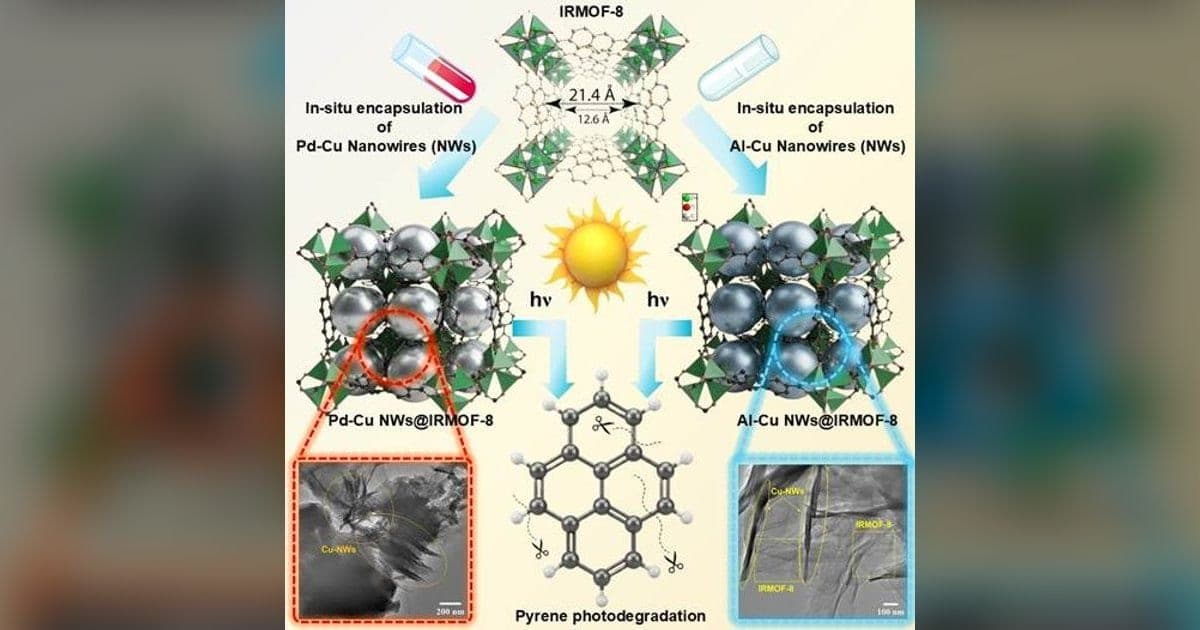
On 23 November 2026 researchers at the Institute of Advanced Study in Science and Technology, Guwahati, reported a new hybrid material made by confining copper nanowires in IRMOF-8, which harnesses a broad range of light to degrade the persistent pollutant pyrene.
A team of Indian scientists has built a material that uses ordinary sunlight to tear apart one of water’s most stubborn poisons. Researchers at the Institute of Advanced Study in Science and Technology (IASST), Guwahati, an autonomous institute of the Department of Science and Technology, announced the work on 23 November 2026.
The pollutant in question
The target is pyrene, a polycyclic aromatic hydrocarbon that lingers in the environment. It is poisonous to living things and hard to clear away, which is why it has drawn so much attention from chemists looking for a way to break it down rather than merely move it elsewhere.
What was made
The team worked with a metal-organic framework, the class of porous molecular scaffolds whose channels let gases and chemicals pass through, and whose importance was marked by the Nobel Prize in Chemistry in 2026. Into the pores of an isoreticular framework called IRMOF-8 they confined copper nanowires, then added metal nanostructures to catch more light. One-dimensional metallic nanowires suit this task because they carry current well and interact strongly with light, so they absorb more of it than bulk metal would.
Two metals, two results
- Adding palladium widened the material’s light absorption through plasmonic effects and removed 99 per cent of the pyrene under the conditions tested.
- Choosing aluminium instead, because it is cheap and abundant, produced an antenna-reactor arrangement that still removed 85 per cent.
The porous framework matters because it holds the components close together, which helps charge move between them. The treatment combined solar energy with ultrasonication.
Who did it and where it appeared
Professor Devasish Chowdhury led the study with his doctoral scholar Netra Prova Baruah, working with Professor Mojibur R. Khan, Mandira Thakur, Ipsah Akhtar, Rahul Sonkar and Professor Arundhuti Devi. It has been published in ACS Applied Energy Materials. Professor Chowdhury said the aluminium-based system performed substantially well, which matters because it points to a way of cutting dependence on noble metals. Plasmonic photocatalysis of this kind can use both visible and near-infrared light, making it attractive for cleaning up aquatic ecosystems.
Important Facts
| Institute | Institute of Advanced Study in Science and Technology (IASST), Guwahati |
|---|---|
| Parent body | Autonomous institute under the Department of Science & Technology |
| Material | IRMOF-8-confined copper nanowire hybrid with palladium or aluminium nanostructures |
| Target pollutant | Pyrene, a persistent polycyclic aromatic hydrocarbon (PAH) |
| Palladium version | Removed 99 per cent of pyrene under the conditions tested |
| Aluminium version | Removed 85 per cent; chosen for abundance and low cost |
| Mechanism | Plasmonic photocatalysis using visible and near-infrared light, with ultrasonication |
| Lead researcher | Professor Devasish Chowdhury, with PhD scholar Netra Prova Baruah |
| Journal | ACS Applied Energy Materials |
| Related award | Metal-organic frameworks were recognised by the Nobel Prize in Chemistry in 2026 |
Exam Point of View
Remember the institute (IASST Guwahati, under DST), the framework (IRMOF-8, isoreticular metal-organic framework), the nanowire metal (copper), the two added metals and their removal rates (palladium 99 per cent, aluminium 85 per cent), the pollutant (pyrene, a polycyclic aromatic hydrocarbon), the lead scientist (Professor Devasish Chowdhury) and that metal-organic frameworks won the Nobel Prize in Chemistry in 2026.
Practice Questions
Which institute developed the metal-organic framework material that degrades the pollutant pyrene using sunlight?
- A.IASST Guwahati
- B.IIT Guwahati
- C.CSIR-NEIST Jorhat
- D.NIT Silchar
Show answer
Its researchers confined copper nanowires inside an isoreticular metal-organic framework called IRMOF-8 and added metal nanostructures so the material could absorb a wider range of light and break down pyrene.
Read the full explanation →Pyrene, the pollutant targeted in the study, belongs to which class of compounds?
- A.Chlorofluorocarbons
- B.Polycyclic aromatic hydrocarbons
- C.Organophosphates
- D.Heavy metal salts
Show answer
Pyrene is a persistent pollutant of this family, toxic to organisms and difficult to remediate, which is why scientists have been searching for ways to break it down rather than relocate it.
Read the full explanation →Which metal was chosen as a cheaper, abundant alternative to palladium in the new hybrid material?
- A.Aluminium
- B.Platinum
- C.Silver
- D.Gold
Show answer
The team chose it as an alternative to palladium because it is abundant, inexpensive and has useful plasmonic properties, and the aluminium system formed a promising antenna-reactor platform.
Read the full explanation →Frequently Asked Questions
Which institute developed the new MOF-based material to degrade pyrene?
The Institute of Advanced Study in Science and Technology (IASST), Guwahati, an autonomous institute under the Department of Science and Technology. The study was led by Professor Devasish Chowdhury with his doctoral scholar Netra Prova Baruah and published in ACS Applied Energy Materials.
How effective was the new material in removing pyrene?
The version using palladium in copper nanowires inside IRMOF-8 removed 99 per cent of the pyrene under the investigated irradiation and ultrasonication conditions, while the aluminium-based version removed 85 per cent. Aluminium was tried because it is abundant and cheap, reducing reliance on noble metals.
What is a metal-organic framework?
A molecular construction with large internal spaces through which gases and other chemicals can flow. Their importance was recognised by the Nobel Prize in Chemistry in 2026. In this work an isoreticular framework named IRMOF-8 provided the porous host that held copper nanowires close to the added metal nanostructures.
Sources
- https://www.pib.gov.in/PressReleasePage.aspx?PRID=2340334 (opens in a new tab) — Press Information Bureau
Current Affairs 23 November 2026
- Nayi Chetna 5.0 Gender Campaign to Begin on 25 NovemberGovernment Schemes
- Ayush Pavilion Draws Crowds at 45th IITF 2026 in New DelhiNational
- India-Nepal Talks: Saryu-Kamla Express and Vision DocumentInternational
- 92nd NBWL Standing Committee Meeting Themed on Marine LifeEnvironment
- National HPV Vaccination Campaign Crosses One Crore DosesNational
- 1st SCO Civilization Dialogue Forum Holds Gyan Bharatam SessionSummits & Conferences
- MY Bharat Yuva Samvad on Constitution Day in 600+ DistrictsGovernment Schemes
- Floriculture Exports Rise to USD 258.26 Million in FY 2025-26Economy
Related Current Affairs
- Science & Technology
Telecom Startups and MSME Conclave 2026 Held at Bharat Mandapam
24 November 2026 · 2 min read
- Science & Technology
India's Space Economy Set to Grow to USD 40-45 Billion
24 November 2026 · 2 min read
- Science & Technology
IIA Bengaluru Team Finds Rare Stellar Fossil HE 1153-0518
23 November 2026 · 2 min read
- Science & Technology
India’s First Human Metabolic Chamber Opens at CMC Vellore
23 November 2026 · 2 min read
- Science & Technology
IIT Madras Gets Sleep Study Facility and Autism Lab
22 November 2026 · 2 min read
- Science & Technology
Genome Sequencing Covers 10,000 Indians From 84 Populations
22 November 2026 · 2 min read
Related GK
- Famous Personalities of Rajasthan: Exam Notes
28 October 2026 · Rajasthan
- Districts and Divisions of Rajasthan: Exam Notes
28 October 2026 · Rajasthan
- Tourism and World Heritage Sites of Rajasthan Notes
27 October 2026 · Rajasthan
Take the Quiz
- Current Affairs Quiz
State Exams Current Affairs Quiz: 23 November 2026
25 questions25 minutesStart Quiz