
India's GDP Grows 7.8% in Q1 of 2026-27, Best in Four Years
India's real GDP rose 7.8% in the first quarter of 2026-27 to ₹81.36 lakh crore, the strongest first-quarter growth in four years, while real GVA gained 8.2%.
Why in News
Data released on 1 September 2026 showed India's real GDP growing 7.8 per cent in the first quarter of 2026-27 to ₹81.36 lakh crore, the best first-quarter reading in four years, and the Prime Minister congratulated the nation on the figure.
India's economy opened the financial year 2026-27 with real GDP growth of 7.8 per cent in the first quarter. Manufacturing and services carried the quarter. The reading is the best first-quarter growth in the four years from 2023-24 to 2026-27. It also beat the Reserve Bank of India's own projection of 7.0 per cent for the quarter. Prime Minister Narendra Modi congratulated the country on the number in a video message and said the figures showed rising confidence in the economy.
The quarter in figures
| Measure | Q1 of 2026-27 | Growth |
| Real GDP (constant prices) | ₹81.36 lakh crore | 7.8% |
| Nominal GDP (current prices) | ₹88.27 lakh crore | 10.3% |
| Real GVA | ₹73.82 lakh crore | 8.2% |
| Nominal GVA | ₹80.53 lakh crore | 11.5% |
GDP is the value of final goods and services made inside the country in an accounting period. GVA measures what each producer, industry or sector adds on its own.
What pushed growth up
Investment led the quarter. Gross Fixed Capital Formation rose 11.9 per cent, against 5.8 per cent a year earlier. Household spending, measured as Private Final Consumption Expenditure, grew 7.1 per cent. Exports of goods and services grew 12.0 per cent.
On the production side the tertiary sector expanded 10.0 per cent, up from 8.0 per cent. Financial, real estate, IT and professional services inside it grew 12.1 per cent. The secondary sector grew 8.6 per cent and manufacturing alone 9.2 per cent.
Older years revised upwards
The Ministry of Statistics and Programme Implementation raised its real GDP growth estimates for the three previous years. The figure for 2023-24 moved from 7.2 to 7.3 per cent, for 2024-25 from 7.1 to 7.2 per cent, and for 2025-26 from 7.7 to 7.8 per cent. The revision rests on new price and production indices with base year 2022-23, including an Output Producer Price Index and a Banking Services Price Index.
How the world reads it
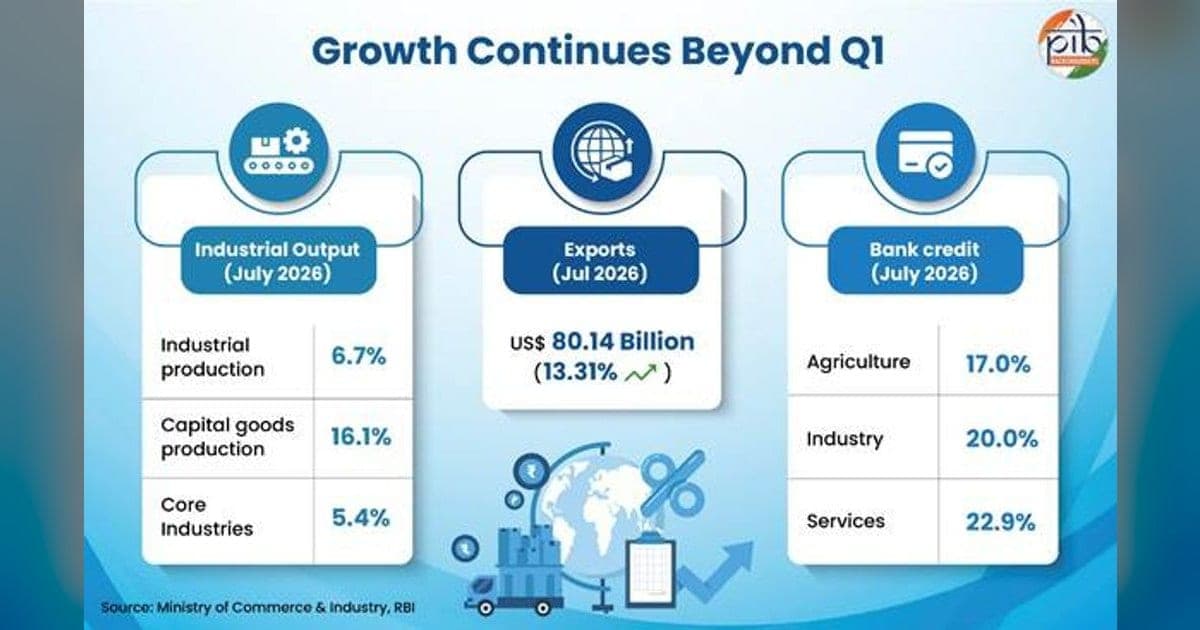
In July 2026 the International Monetary Fund called India one of the fastest growing economies and a key engine of world growth. In August 2026 S&P Global Ratings kept India's sovereign rating at BBB with a stable outlook, after lifting the long-term rating to that level in 2025 following a gap of eighteen years. Industrial production grew 6.7 per cent in July 2026, and exports of goods and services during April to July were 13.16 per cent higher than a year before.
Important Facts
| Quarter | First quarter (Q1) of 2026-27 |
|---|---|
| Real GDP growth | 7.8 per cent |
| Real GDP level | ₹81.36 lakh crore |
| Nominal GDP | ₹88.27 lakh crore, up 10.3 per cent |
| Real GVA | ₹73.82 lakh crore, up 8.2 per cent |
| RBI projection for the quarter | 7.0 per cent |
| Investment (GFCF) | Up 11.9 per cent |
| Manufacturing growth | 9.2 per cent |
| Data source | Ministry of Statistics and Programme Implementation (MoSPI) |
| New base year for revisions | 2022-23 |
Exam Point of View
Remember the headline rate (7.8 per cent real GDP growth in Q1 of 2026-27), the levels (real GDP ₹81.36 lakh crore, nominal GDP ₹88.27 lakh crore, real GVA ₹73.82 lakh crore), the RBI's estimate it beat (7.0 per cent), the driver figures (investment 11.9 per cent, consumption 7.1 per cent, exports 12.0 per cent, manufacturing 9.2 per cent), the source ministry (MoSPI) and the new base year 2022-23 used for the revised estimates.
Practice Questions
What was India's real GDP growth in the first quarter of 2026-27?
- A.6.9 per cent
- B.7.0 per cent
- C.7.8 per cent
- D.8.2 per cent
Show answer
Correct answer: C. 7.8 per cent
Explanation
The correct answer is 7.8 per cent. Real GDP, that is GDP at constant prices, is estimated at ₹81.36 lakh crore for the first quarter of 2026-27, and that level represents growth of 7.8 per cent. The figure is the highest first-quarter growth recorded in the four years from 2023-24 onwards, and manufacturing and services carried it. Each wrong option is a real number from the same release, which is what makes them tempting. Option A is the growth rate of the first quarter of the previous year, so it is the base against which this quarter is compared. Option B is the Reserve Bank of India's projection for the quarter, which the outcome exceeded. Option D is the growth of real Gross Value Added, not of GDP; real GVA stood at ₹73.82 lakh crore. Keep the three apart: 7.0 was the forecast, 7.8 the GDP outcome and 8.2 the GVA outcome.
Which body publishes India's quarterly GDP estimates referred to here?
- A.NITI Aayog
- B.Ministry of Statistics and Programme Implementation
- C.Reserve Bank of India
- D.Department of Economic Affairs
Show answer
Correct answer: B. Ministry of Statistics and Programme Implementation
Explanation
The correct answer is the Ministry of Statistics and Programme Implementation, usually shortened to MoSPI. Every table in the release, whether the expenditure components, the sector-wise Gross Value Added or the revised annual estimates, is sourced to that ministry. MoSPI also carried out the upward revision of real GDP growth for the three earlier years and moved the estimates to new price and production indices with base year 2022-23, among them an Output Producer Price Index and a Banking Services Price Index. Option C is wrong but close to the fact: the Reserve Bank of India had projected 7.0 per cent growth for this quarter, a forecast rather than the estimate itself, and the actual outcome was higher. NITI Aayog and the Department of Economic Affairs are not named in the release as the source of these national accounts figures at all.
Which expenditure component of real GDP recorded 11.9 per cent growth in the quarter?
- A.Private Final Consumption Expenditure
- B.Gross Fixed Capital Formation
- C.Government Final Consumption Expenditure
- D.Imports of goods and services
Show answer
Correct answer: B. Gross Fixed Capital Formation
Explanation
The correct answer is Gross Fixed Capital Formation, the measure of investment funded within the economy. It grew 11.9 per cent in the first quarter of 2026-27 against 5.8 per cent in the same quarter of the previous year, and that jump is the sharpest change among the expenditure components listed. Option A is wrong on the number rather than the idea: Private Final Consumption Expenditure, which is household spending on goods and services, grew 7.1 per cent, up from 6.8 per cent. Exports grew 12.0 per cent, up from 6.0 per cent. Government consumption and imports are not among the components given growth figures in this release, so options C and D cannot be supported from it. For revision, remember the trio of drivers in order: exports 12.0, investment 11.9 and household consumption 7.1 per cent.
Which statement about the revised national accounts estimates is correct?
- A.The new base year for price and production indices is 2022-23
- B.Growth for the three previous years was revised downwards
- C.The revision dropped the Output Producer Price Index
- D.Real GDP growth for 2025-26 was revised to 7.1 per cent
Show answer
Correct answer: A. The new base year for price and production indices is 2022-23
Explanation
The correct answer is that the new base year is 2022-23. The annual revised estimates use new price and production indices on that base, including an Output Producer Price Index and a Banking Services Price Index, along with updated administrative data drawn from several sources. Option B reverses the direction of the change, because real GDP growth was revised upwards for all three earlier years. Option C is wrong for the same reason of fact: the Output Producer Price Index is one of the new indices brought in, not one removed. Option D misplaces a number that does appear in the release; 7.1 per cent was the earlier estimate for 2024-25, which was itself revised to 7.2 per cent, while the estimate for 2025-26 moved up from 7.7 to 7.8 per cent. The revisions matter because they show the strong quarter sitting on an already stronger path.
Frequently Asked Questions
How much did India's real GDP grow in the first quarter of 2026-27?
By 7.8 per cent, taking real GDP to ₹81.36 lakh crore. It was the highest first-quarter growth in the four years from 2023-24 and was above the Reserve Bank of India's estimate of 7.0 per cent.
What is the difference between GDP and GVA?
GDP is the value of final goods and services produced in the domestic economy in an accounting period. GVA measures the contribution of individual producers, industries or sectors. Real GVA in the quarter was ₹73.82 lakh crore, a rise of 8.2 per cent.
Which expenditure component grew fastest in the quarter?
Exports of goods and services, at 12.0 per cent, followed closely by investment. Gross Fixed Capital Formation rose 11.9 per cent against 5.8 per cent a year earlier, while household consumption grew 7.1 per cent.
Sources
- India’s GDP Performance (opens in a new tab) — Press Information Bureau
- Prime Minister congratulates the nation on achieving 7.8% GDP growth; highlights surging economic confidence (opens in a new tab) — Press Information Bureau
Current Affairs 1 September 2026
- PM Modi Attends 26th SCO Summit at Bishkek, Kyrgyz RepublicSummits & Conferences
- Shakti Sharma Becomes First Woman Two-Star OfficerDefence
- IPPB Marks 9th Foundation Day, Launches DakPay Sound BoxBanking & Finance
- PM Dhan-Dhaanya Krishi Yojana Score Rises to 38.85 in JulyGovernment Schemes
- Indian Railways Approves Kavach 4.0 and Three More WorksNational
- Swachh Sagar Surakshit Sagar 5.0 Launched for Ocean CleanupEnvironment
- RDI Fund of ₹1 Lakh Crore Needs Wider Awareness: MinisterScience & Technology
Related Current Affairs
- Economy
Mines Ministry Launches Concept Paper on Critical Mineral Recycling
22 September 2026 · 2 min read


Take the Quiz
- Current Affairs Quiz
State Exams Weekly Current Affairs Quiz: 31 August – 6 September 2026
27 questions27 minutesStart Quiz